Snell’s Law with PhET Interactive Simulations
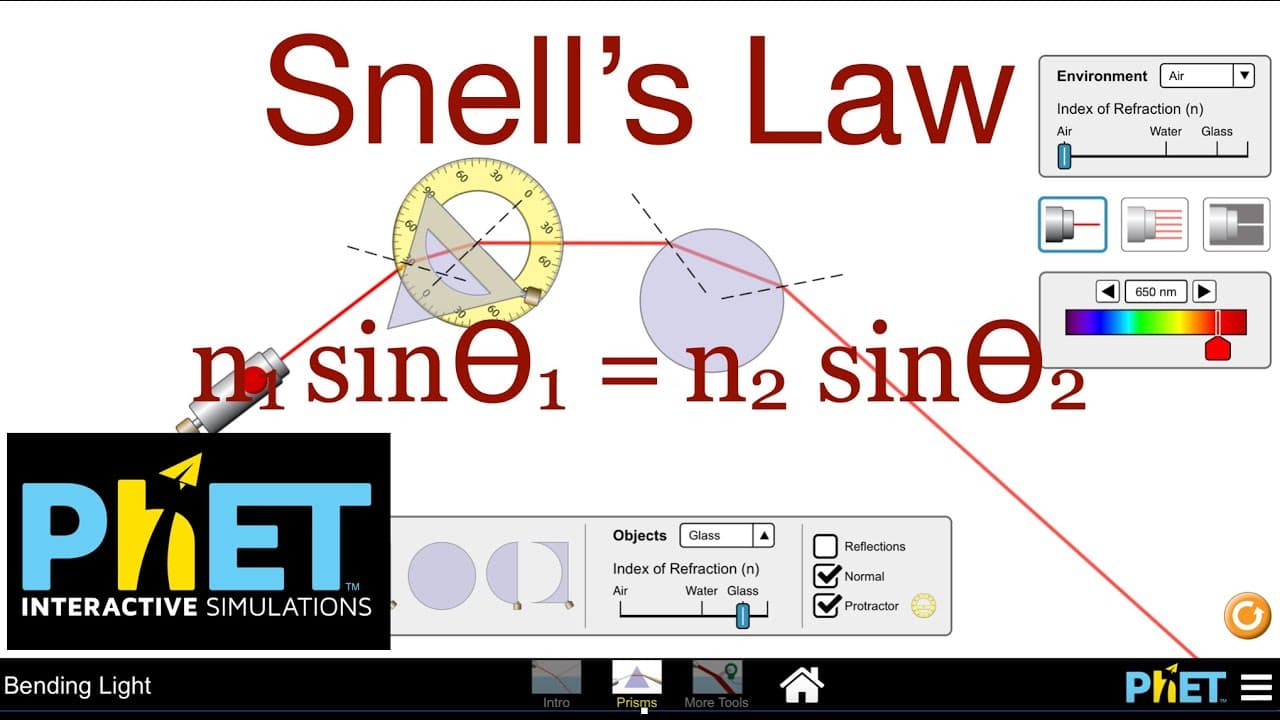
TL;DR
Exploring refraction and Snell's Law through simulations and qualitative/quantitative examples.
Transcript
in today's video we're going to be going over refraction and Snell's law to do that we're going to use one of the excellent simulations from pet interactive stimulations they have a bunch of really good simulations for Math and Science check out their website the link is in the description below and before we get started please don't forget to subs... Read More
Key Insights
- 🙂 Refraction is the bending of light at boundaries between materials with different optical densities.
- 🫰 Snell's Law quantitatively relates indices of refraction to angles of incidence and refraction.
- 🦻 Simulations can aid in visualizing and understanding the concepts of refraction and Snell's Law.
- 🙂 Understanding the behavior of light at boundaries helps in solving problems related to refraction and Snell's Law.
- 🫥 The normal line is crucial in measuring the angles of incidence and refraction in the context of Snell's Law.
- 📐 Different shapes of materials (square, triangular, circular prisms) exhibit similar principles of refraction.
- 🫰 Knowing how to apply Snell's Law can help in determining indices of refraction and angles in various scenarios.
Install to Summarize YouTube Videos and Get Transcripts
Explore YouTube Video Summarizer or Get YouTube Transcript Extractor
Questions & Answers
Q: What is refraction and how does it occur?
Refraction is the bending of light when it enters a different medium at a different speed. This bending is caused by the change in speed of light as it moves through materials with different optical densities.
Q: How does Snell's Law relate to refraction?
Snell's Law mathematically relates the indices of refraction of two materials to the angles of incidence and refraction. It provides a quantitative way to predict how light will bend when transitioning between different mediums.
Q: How can simulations help understand refraction and Snell's Law?
Simulations provide visual representations of how light bends and changes direction when passing through different materials. By interacting with simulations, learners can grasp the concepts of refraction and Snell's Law more effectively.
Q: What are some key principles to remember about refraction and Snell's Law?
Key principles include understanding how light bends at boundaries between materials with different optical densities, the role of indices of refraction, and the relationship between angles of incidence and refraction.
Summary & Key Takeaways
-
Refraction is the bending of light when it enters a different medium at a different speed.
-
Snell's Law relates the indices of refraction of two materials to the angles of incidence and refraction.
-
Using simulations and calculations, the video delves into understanding and solving problems related to refraction and Snell's Law.
Read in Other Languages (beta)
Share This Summary 📚
Summarize YouTube Videos and Get Video Transcripts with 1-Click
Try YouTube Summary with ChatGPT & Claude or YouTube Transcript Generator
Explore More Summaries from Step by Step Science 📚
Summarize YouTube Videos and Get Video Transcripts with 1-Click
Try YouTube Summary with ChatGPT & Claude or YouTube Transcript Generator