Cumulative geometric probability (less than a value) | AP Statistics | Khan Academy
TL;DR
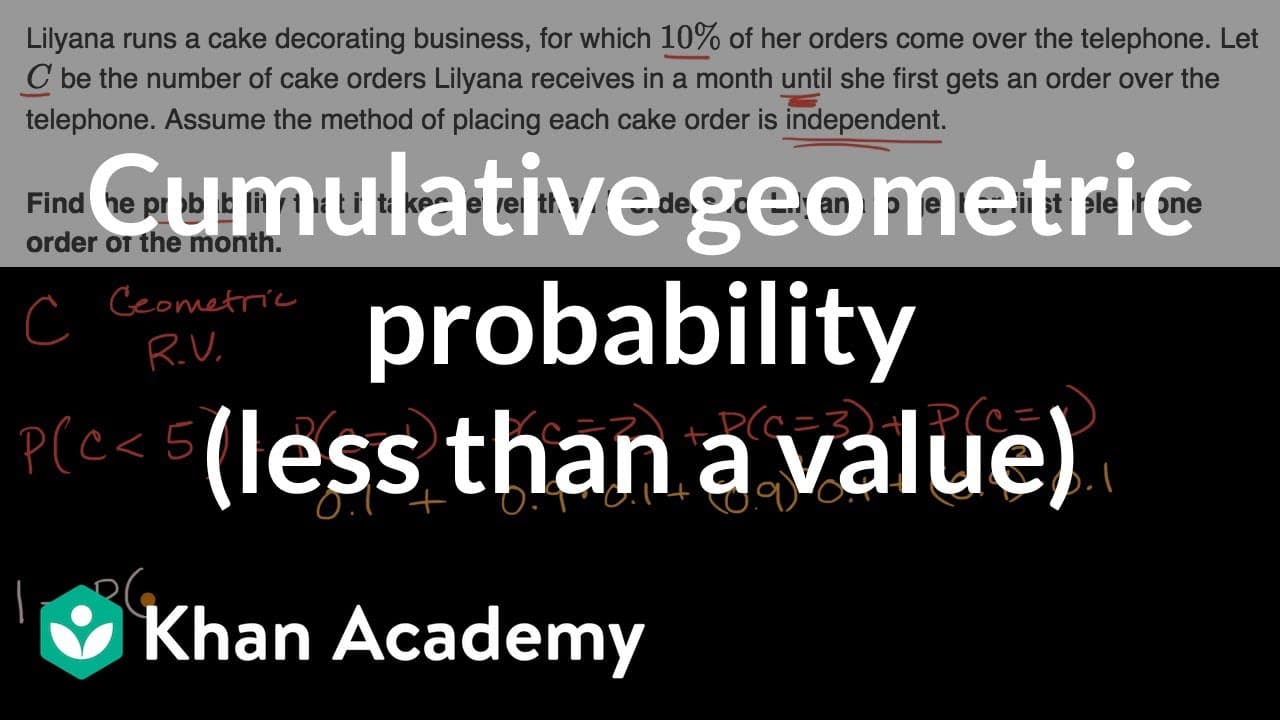
Find the probability of receiving a telephone order within the first five cake orders for a cake decorating business.
Transcript
- [Instructor] Lilyana runs a cake decorating business, for which 10% of her orders come over the telephone. Let C be the number of cake orders Lilyana receives in a month until she first gets an order over the telephone. Assume the method of placing each cake order is independent. So C, if we assume a few things, is a classic geometric random vari... Read More
Key Insights
- 🪈 The number of cake orders until the first telephone order follows a geometric random variable.
- 🪈 The probability of a telephone order remains constant at 10% for each cake order.
- 🪈 The probability that it takes fewer than five orders for Lilyana to get her first telephone order is 0.3439.
- 🪈 The probability can be calculated by subtracting the probability of having no telephone orders in the first four orders from 1.
- ❓ The calculation is derived from the principle of using complements to find probabilities.
Install to Summarize YouTube Videos and Get Transcripts
Explore YouTube Video Summarizer or Get YouTube Transcript Extractor
Questions & Answers
Q: Why is the number of cake orders until the first telephone order considered a geometric random variable?
The number of cake orders until the first telephone order is considered a geometric random variable because the probability of a telephone order remains constant at 10% for each trial, and the trials are independent.
Q: How can we calculate the probability that it takes fewer than five orders for Lilyana to get her first telephone order?
We can calculate the probability by finding the sum of individual probabilities for each case where Lilyana gets her first telephone order within the first four orders. Alternatively, we can subtract the probability of having no telephone orders in the first four orders from 1.
Q: What is the probability that C equals one (Lilyana's very first order is a telephone order)?
The probability that C equals one is 0.1 (10%). Since Lilyana's first order may be a telephone order, there is a 10% chance of it happening.
Q: How can we find the probability of C equals three (Lilyana gets her first telephone order on her third order)?
The probability that C equals three can be calculated by multiplying the probability of not having a telephone order (0.9) twice and then multiplying it by the probability of having a telephone order (0.1) on the third order.
Summary & Key Takeaways
-
Lilyana runs a cake decorating business, and 10% of her orders come over the telephone.
-
The number of cake orders Lilyana receives until she gets her first telephone order is a classic geometric random variable.
-
The task is to calculate the probability that it takes fewer than five orders for Lilyana to get her first telephone order of the month.
Read in Other Languages (beta)
Share This Summary 📚
Summarize YouTube Videos and Get Video Transcripts with 1-Click
Try YouTube Summary with ChatGPT & Claude or YouTube Transcript Generator
Explore More Summaries from Khan Academy 📚



Summarize YouTube Videos and Get Video Transcripts with 1-Click
Try YouTube Summary with ChatGPT & Claude or YouTube Transcript Generator