How Do Peptide Bonds Form Between Amino Acids?
TL;DR
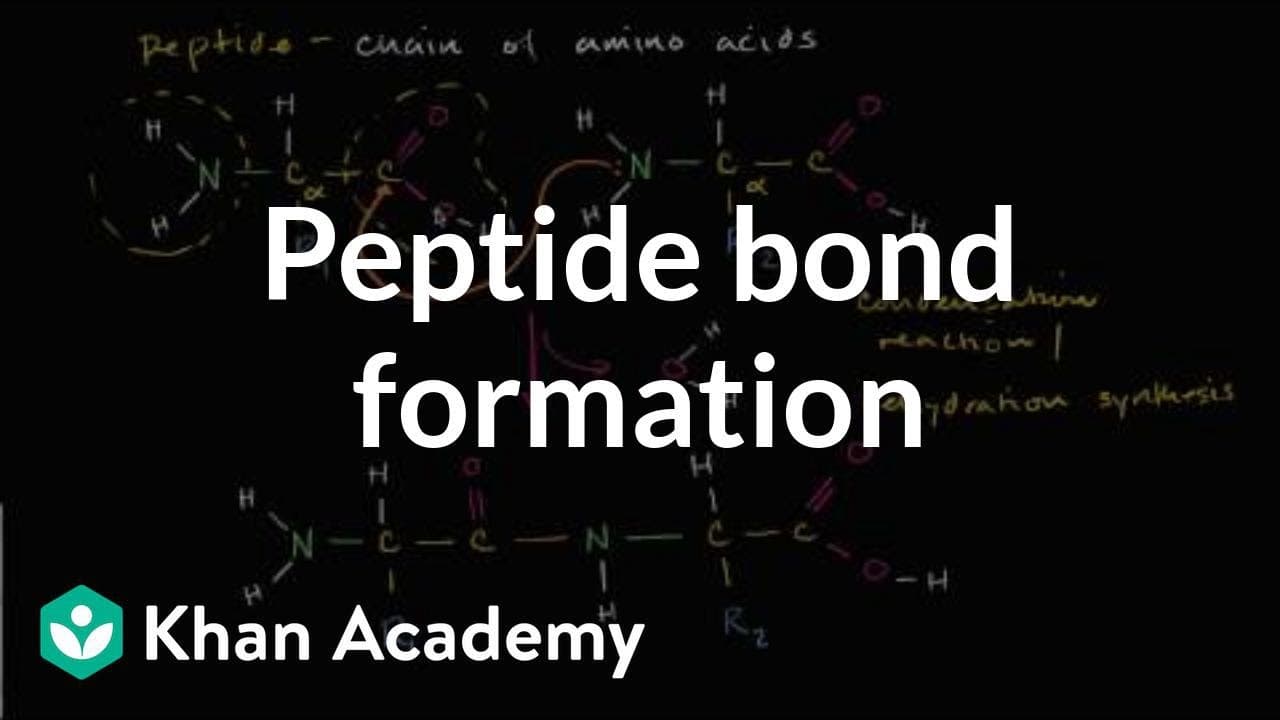
Peptide bonds form between two amino acids through a condensation reaction where the nitrogen of one amino acid attacks the carbon of another, releasing a water molecule. At physiological pH, amino acids typically exist as zwitterions, with the nitrogen carrying a positive charge and the carboxyl group a negative charge, facilitating peptide bond formation.
Transcript
- [Voiceover] So I've got two arbitrary amino acids here. We recognize the telltale signs of an amino acid. We have an amino group right over here that gives us the amino and amino acid. We have a carboxyl group right over here. This is the acid part of an amino acid. And in between we have a carbon, and we call that the alpha carbon. And that alph... Read More
Key Insights
- 👊 Peptide bonds are formed between amino acids through a condensation reaction, where the nitrogen attacks the carbon.
- 💦 The release of a water molecule during peptide bond formation is a characteristic of condensation reactions.
- 📈 Amino acids exist in a zwitterion form at physiological pH, with charges on different ends of the molecule but an overall neutral charge.
- 💁 The zwitterion form of amino acids allows for the formation of peptide bonds.
- 💁 The zwitterion form is in equilibrium with other forms of amino acids but tends to dominate at physiological pH.
- 🈂️ Nitrogen in the zwitterion form gains a proton to become positively charged, while the carboxyl group loses a proton and becomes negatively charged.
- 💁 The lone pair of electrons on the nitrogen in the zwitterion form plays a crucial role in peptide bond formation.
Install to Summarize YouTube Videos and Get Transcripts
Explore YouTube Video Summarizer or Get YouTube Transcript Extractor
Questions & Answers
Q: How are peptide bonds formed between two amino acids?
Peptide bonds are formed when the lone pair of electrons on the nitrogen of one amino acid attacks the carbon of another amino acid, resulting in the release of a water molecule. This forms a peptide linkage between the two amino acids.
Q: What is the significance of the zwitterion form of amino acids?
Amino acids exist in a zwitterion form at physiological pH, where the nitrogen gains a proton and becomes positively charged, while the carboxyl group loses a proton and becomes negatively charged. This form is essential for peptide bond formation.
Q: What is the difference between a condensation reaction and a dehydration synthesis?
Both terms refer to the same type of reaction in which a peptide bond is formed between amino acids. It is called a condensation reaction because a water molecule is released, and it is called dehydration synthesis because it involves the synthesis of a larger molecule by removing water.
Q: How does the zwitterion form of amino acids contribute to peptide bond formation?
In the zwitterion form, the nitrogen of one amino acid has an extra lone pair after giving its hydrogen proton, which can grab a proton from the solution. This allows the nitrogen to take back the electrons, leading to the formation of a peptide bond.
Summary & Key Takeaways
-
A peptide bond is formed between two amino acids by the nitrogen of one amino acid attacking the carbon of the other, resulting in the release of a water molecule.
-
The reaction, known as condensation or dehydration synthesis, involves the formation of a peptide linkage.
-
Amino acids exist in a zwitterion form at physiological pH, where the nitrogen gains a proton and becomes positively charged, while the carboxyl group loses a proton and becomes negatively charged.
Read in Other Languages (beta)
Share This Summary 📚
Summarize YouTube Videos and Get Video Transcripts with 1-Click
Try YouTube Summary with ChatGPT & Claude or YouTube Transcript Generator
Explore More Summaries from Khan Academy 📚



Summarize YouTube Videos and Get Video Transcripts with 1-Click
Try YouTube Summary with ChatGPT & Claude or YouTube Transcript Generator