What is Psychological Safety? ...and Why Does it Matter?
TL;DR
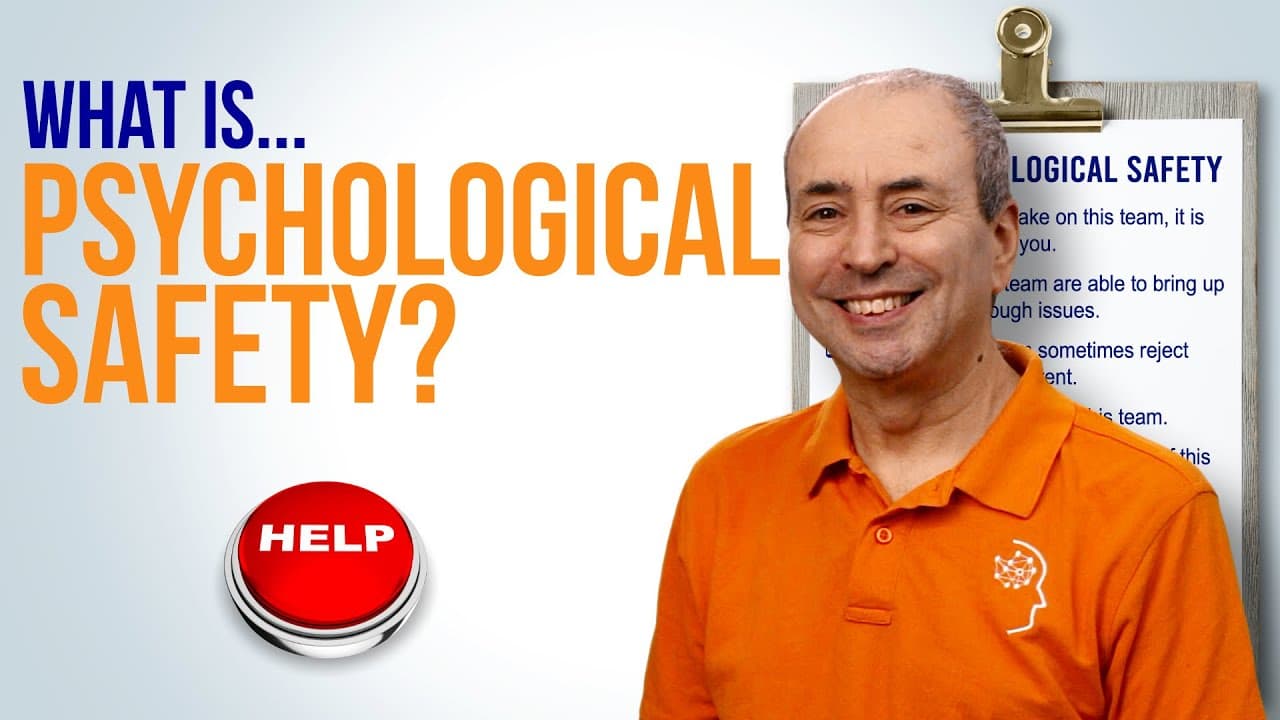
Psychological safety is the belief that individuals can freely express their thoughts and ideas at work without fear of punishment or humiliation, leading to increased innovation, productivity, and reduced stress levels.
Transcript
in this video I want to answer the question what is psychological safety say what you think at work without fear of humiliation or punishment if you don't then it's likely that you're going to suppress some of your ideas or concerns and that will be to the detriment of your organization your project and your client they will miss out on real opport... Read More
Key Insights
- 🥺 Psychological safety allows organizations to tap into their employees' creativity and ideas, leading to innovation.
- 🦺 Treating failures and mistakes as opportunities for learning rather than blaming individuals fosters a psychologically safe environment.
- 😷 Psychological safety can be measured through statements related to acceptance of mistakes and the ability to ask for help within a team.
- 💄 Involving team members in planning and decision-making processes makes them feel valued and encourages their input.
- 💪 Strong working relationships and a sense of camaraderie contribute to a psychologically safe environment.
- 😤 Team conflict can be reframed as a collaborative search for solutions, as long as it is respectful and constructive.
- 😤 Supporting team members during problem-solving builds trust and contributes to psychological safety.
Install to Summarize YouTube Videos and Get Transcripts
Explore YouTube Video Summarizer or Get YouTube Transcript Extractor
Questions & Answers
Q: What is psychological safety in the workplace?
Psychological safety refers to an environment where employees can voice their thoughts, concerns, and ideas without fear of punishment or humiliation.
Q: How does psychological safety benefit organizations and projects?
Psychological safety fosters innovation, creativity, and engagement among team members, leading to better outcomes, reduced stress levels, and improved decision-making.
Q: How can leaders promote psychological safety?
Leaders can promote psychological safety by acknowledging their own fallibility, modeling curiosity by asking questions, and framing work as a learning problem rather than merely execution.
Q: What can individuals do to contribute to psychological safety?
Individuals can contribute to psychological safety by involving their team in decision-making processes, building strong working relationships, and supporting team members during problem-solving.
Summary & Key Takeaways
-
Psychological safety allows employees to freely express ideas and concerns, benefiting the organization, projects, and clients.
-
The concept of psychological safety was first introduced by Carl Rogers in the 1950s.
-
Amy Edmondson's work in the late 1990s defined team psychological safety as a shared belief within a team that it is safe to take interpersonal risks.
Read in Other Languages (beta)
Share This Summary 📚
Summarize YouTube Videos and Get Video Transcripts with 1-Click
Try YouTube Summary with ChatGPT & Claude or YouTube Transcript Generator
Explore More Summaries from Online PM Courses - Mike Clayton 📚






Summarize YouTube Videos and Get Video Transcripts with 1-Click
Try YouTube Summary with ChatGPT & Claude or YouTube Transcript Generator