How to Solve Recursive Problems in 5 Steps
TL;DR
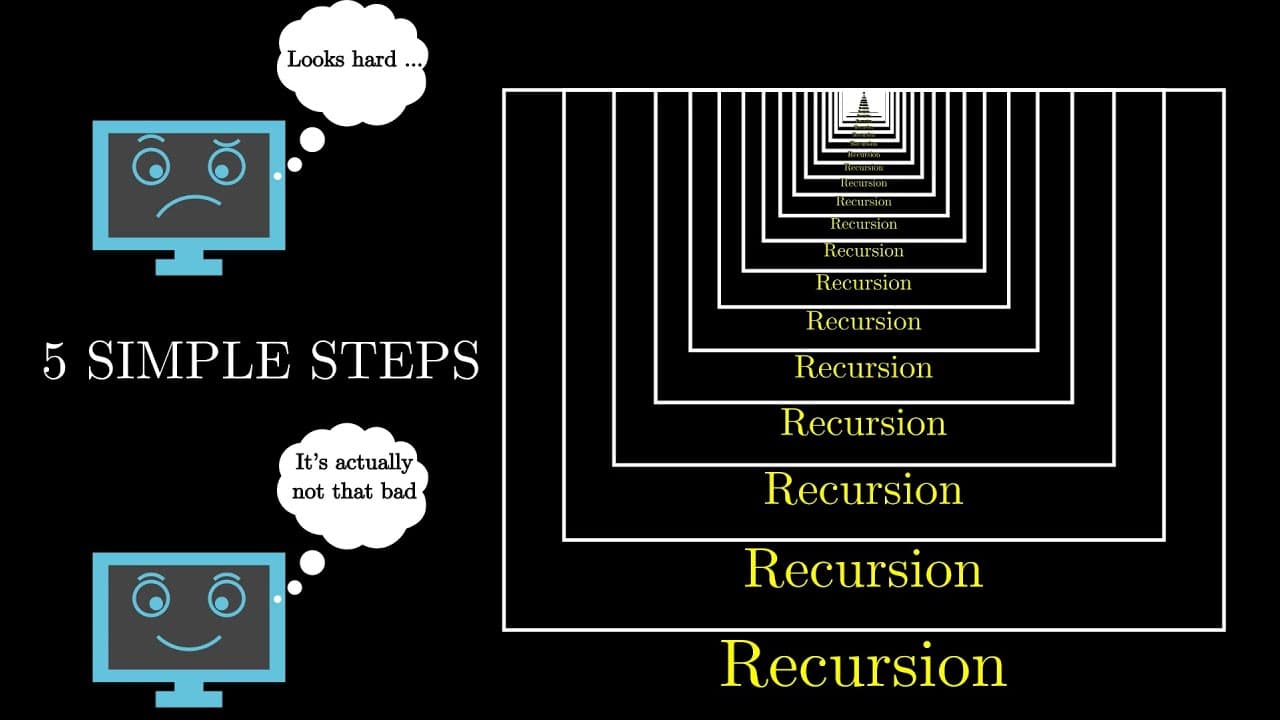
To solve recursive problems effectively, follow these five key steps: identify the base case, visualize examples, relate larger examples to smaller ones, generalize the recursive pattern, and write the code. This method simplifies complex recursive challenges, allowing for manageable solutions across varying difficulties.
Transcript
today we are going to talk about recursion I think most computer science students would agree that recursion felt more confusing than your average computer science topic in this video I'm gonna show you five simple steps that you can use to help you tackle any recursive problem and hopefully these steps will help you realize that in reality recursi... Read More
Key Insights
- ❓ Recursion can be challenging but becomes manageable by following a systematic approach.
- 💼 Base cases provide explicit answers and serve as the starting point for solving more complex cases.
- 🔠 Visualizing examples can help identify patterns and relationships between inputs and outputs.
- 😒 Generalizing patterns and making use of the recursive leap of faith can simplify the coding process.
- 👨💻 Recursive problems often have elegant and concise code solutions.
- 😫 Recursive problems can be examined and understood through example sets and visualizations.
- ⚾ Recursive problems may require modifying base cases after finding a general recursive pattern.
Install to Summarize YouTube Videos and Get Transcripts
Explore YouTube Video Summarizer or Get YouTube Transcript Extractor
Questions & Answers
Q: How can recursion be simplified into five steps?
Recursion can be approached by determining the base case, visualizing examples, relating larger examples to smaller ones, generalizing the pattern, and writing the code. This systematic approach helps break down complex problems into manageable steps.
Q: What is the significance of the base case in a recursive problem?
The base case represents the simplest possible input for a function, which often translates into an explicit answer. It serves as the starting point for building solutions to more complex cases.
Q: How can visualizing examples help in solving recursive problems?
Visualizing examples, such as treating the sum as building a triangle, helps understand how inputs and outputs interact. It allows for the identification of relationships between cases, making it easier to apply patterns and generalize the solution.
Q: What is the recursive leap of faith, and how does it aid in solving recursive problems?
The recursive leap of faith involves assuming that simpler versions of the problem are correct, which can speed up the problem-solving process. It helps build trust in the recursive pattern and simplifies the thinking process.
Q: How can the count partitions problem be solved recursively?
The count partitions problem can be solved by utilizing a recursive relationship. The total number of unique partitions in an N by M grid can be found by summing the count partitions of an N by M-1 grid and the count partitions of an N-1 by M grid, accounting for the subsets and the remaining partitions that incorporate M.
Key Insights:
- Recursion can be challenging but becomes manageable by following a systematic approach.
- Base cases provide explicit answers and serve as the starting point for solving more complex cases.
- Visualizing examples can help identify patterns and relationships between inputs and outputs.
- Generalizing patterns and making use of the recursive leap of faith can simplify the coding process.
- Recursive problems often have elegant and concise code solutions.
- Recursive problems can be examined and understood through example sets and visualizations.
- Recursive problems may require modifying base cases after finding a general recursive pattern.
- Mastering recursive problem-solving requires practice and contemplation.
Summary & Key Takeaways
-
Recursion, often considered confusing, can be tackled with five simple steps: determining the base case, visualizing examples, relating larger examples to smaller ones, generalizing the pattern, and writing the code.
-
The first problem involves summing non-negative integers up to a given number recursively by adding the number to the sum of the previous number.
-
The second problem requires finding the number of unique paths from the top left corner to the bottom right corner of an N by M grid, with movement limited to one step down or one step right.
-
The final problem involves counting the number of ways to partition N objects using parts up to M, derived by breaking down the problem into subsets and adding the remaining partitions that include M.
Read in Other Languages (beta)
Share This Summary 📚
Summarize YouTube Videos and Get Video Transcripts with 1-Click
Try YouTube Summary with ChatGPT & Claude or YouTube Transcript Generator
Explore More Summaries from Reducible 📚

Summarize YouTube Videos and Get Video Transcripts with 1-Click
Try YouTube Summary with ChatGPT & Claude or YouTube Transcript Generator