Introduction to Graph Theory: A Computer Science Perspective
TL;DR
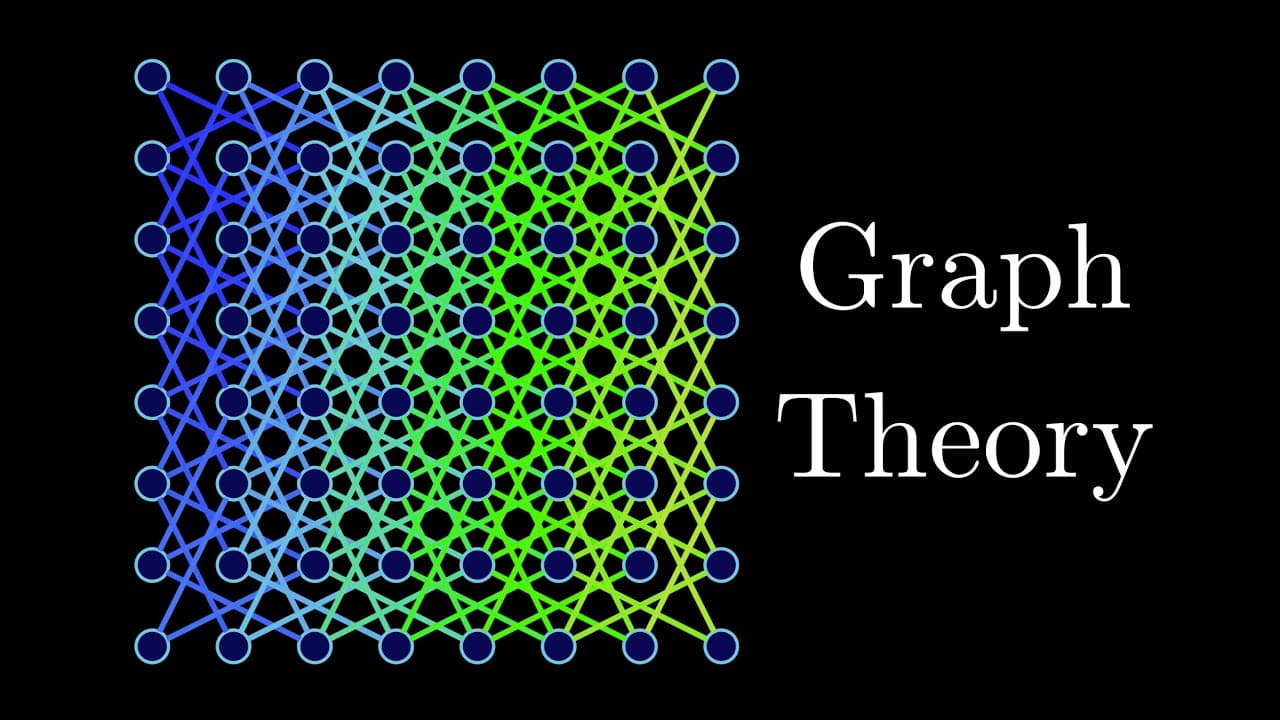
This video provides an introduction to graph theory, explaining its importance and applications, defining key terminology, discussing graph representations, and presenting various interesting problems in the field.
Transcript
In this video, I'll give you a brief intro into the vast and incredibly interesting field of graph theory from a computer science perspective. Here's an example of a type of graph that we're going to talk about extensively in this video. If you were to ask me "What's the simplest definition of a graph for someone who knows nothing about the field?"... Read More
Key Insights
- 🎨 Graph theory is a vast field with applications in diverse areas, such as mapping, social networks, puzzles, and circuit design.
- 📉 Graphs consist of vertices (nodes) and edges that represent relationships between components.
- 📉 Graphs can be represented in different ways, but the adjacency list is commonly used due to its efficiency for sparse graphs.
- 🚲 Important concepts in graph theory include neighbors, degree, paths, cycles, and connectivity.
- 🚲 Various interesting problems in graph theory involve connectivity, shortest paths, cycle detection, and vertex coloring.
Install to Summarize YouTube Videos and Get Transcripts
Explore YouTube Video Summarizer or Get YouTube Transcript Extractor
Questions & Answers
Q: What are some applications of graph theory?
Graph theory has practical applications in mapping and navigation, social networks, and even solving puzzles like Sudoku. It helps in finding the best routes, recommending friends, and developing algorithms for efficient problem-solving.
Q: How are graphs represented as data structures in computer science?
Graphs can be represented using different data structures, such as adjacency matrices, edge sets, and adjacency lists. The adjacency list representation is most commonly used, as it enables easy access to neighbors and is more memory-efficient for sparse graphs.
Q: What are some interesting problems in graph theory?
Some interesting graph theory problems include connectivity, where algorithms determine the existence of paths between vertices or the connectivity of the entire graph. The shortest path problem involves finding the path with the least length between two vertices. Other problems include cycle detection, vertex coloring, and finding paths that use every edge or vertex exactly once.
Q: Are there efficient algorithms for all graph theory problems?
While there are efficient algorithms for problems like connectivity and shortest path, some problems, such as finding a path that uses every vertex exactly once, do not have efficient algorithms. These problems are computationally challenging and remain as open research questions.
Key Insights:
- Graph theory is a vast field with applications in diverse areas, such as mapping, social networks, puzzles, and circuit design.
- Graphs consist of vertices (nodes) and edges that represent relationships between components.
- Graphs can be represented in different ways, but the adjacency list is commonly used due to its efficiency for sparse graphs.
- Important concepts in graph theory include neighbors, degree, paths, cycles, and connectivity.
- Various interesting problems in graph theory involve connectivity, shortest paths, cycle detection, and vertex coloring.
- While some graph theory problems have efficient algorithms, others remain computationally challenging and unsolved.
Summary & Key Takeaways
-
Graph theory is the study of networks that define and visualize relationships between components, represented by vertices and edges.
-
Graph theory has various applications, such as mapping and navigation, social networks, and even solving Sudoku puzzles.
-
Important terminology includes neighbors, degree, paths, cycles, connectivity, and different types of graphs such as undirected, directed, weighted, and trees.
Read in Other Languages (beta)
Share This Summary 📚
Summarize YouTube Videos and Get Video Transcripts with 1-Click
Try YouTube Summary with ChatGPT & Claude or YouTube Transcript Generator
Explore More Summaries from Reducible 📚
Summarize YouTube Videos and Get Video Transcripts with 1-Click
Try YouTube Summary with ChatGPT & Claude or YouTube Transcript Generator