Finding average rate of change of polynomials | Algebra 2 | Khan Academy
TL;DR
The video explains how to find the average rate of change of a function over a given interval.
Transcript
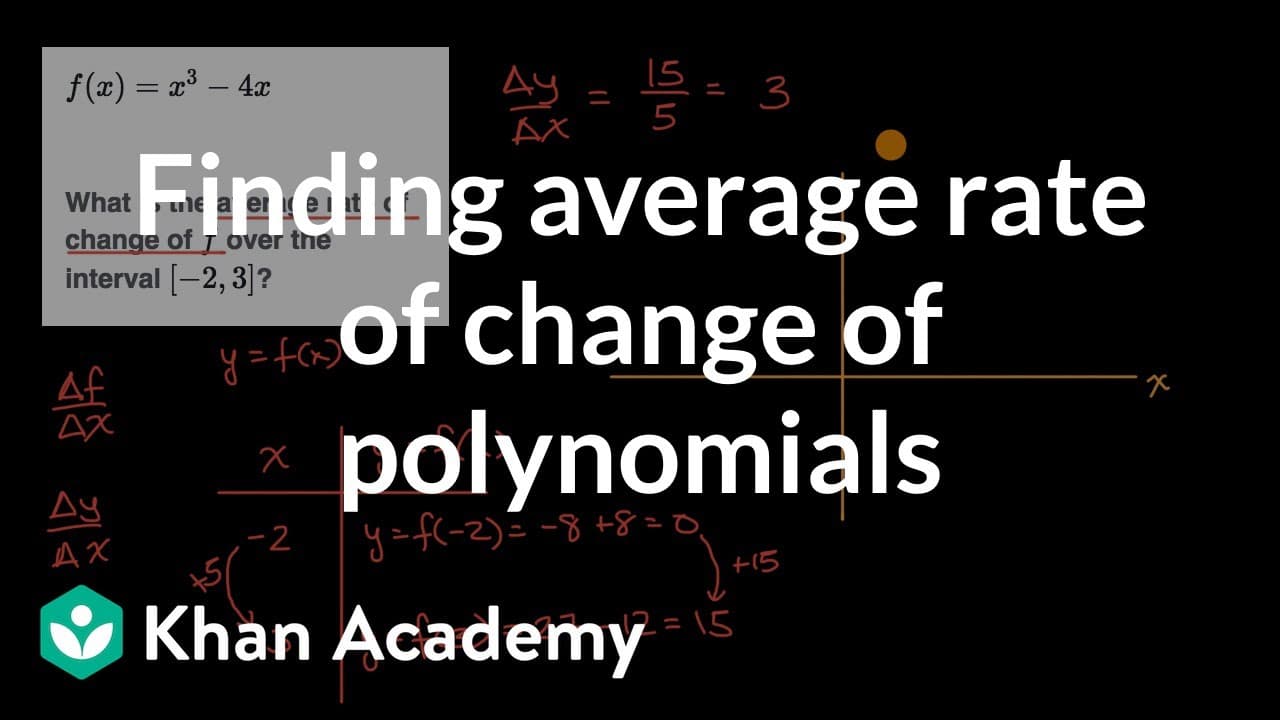
- [Instructor] We are asked, What is the average rate of change of the function f, and this function is f up here, this is the definition of it, over the interval from negative two to three, and it's a closed interval because they put these brackets around it instead of parentheses, so that means it includes both of these boundaries. Pause this vid... Read More
Key Insights
- 💱 Average rate of change of a function can be calculated by finding the change in y divided by the change in x.
- 💱 The average rate of change represents how much the function changes, on average, for each unit change in x.
- 🫥 The average rate of change can be visualized by connecting the two boundary points of the interval and finding the slope of the line.
Install to Summarize YouTube Videos and Get Transcripts
Explore YouTube Video Summarizer or Get YouTube Transcript Extractor
Questions & Answers
Q: How can the average rate of change of a function be conceptualized?
The average rate of change can be seen as the change in the value of the function divided by the change in x. It represents how much the function changes per unit change in x on average.
Q: How can the average rate of change be calculated using a table?
By plugging in the x-values of the interval into the function and finding the corresponding y-values, the change in y can be determined. Dividing the change in y by the change in x gives the average rate of change.
Q: Can the average rate of change be visualized?
Yes, it can be visualized by plotting the function on a graph. The average rate of change is represented by the slope of the line connecting the two points at the boundaries of the interval.
Q: What is the average rate of change for the given function over the interval from -2 to 3?
The average rate of change is 3, as the change in y is 15 and the change in x is 5, resulting in a ratio of 15/5.
Summary & Key Takeaways
-
Average rate of change of a function can be viewed as the change in the value of the function divided by the change in x.
-
The average rate of change can be calculated using a table or by visualizing the function.
-
The average rate of change for the given function over the interval from -2 to 3 is 3.
Read in Other Languages (beta)
Share This Summary 📚
Summarize YouTube Videos and Get Video Transcripts with 1-Click
Try YouTube Summary with ChatGPT & Claude or YouTube Transcript Generator
Explore More Summaries from Khan Academy 📚



Summarize YouTube Videos and Get Video Transcripts with 1-Click
Try YouTube Summary with ChatGPT & Claude or YouTube Transcript Generator