Worked free response question on unemployment | APⓇ Macroeconomics | Khan Academy
TL;DR
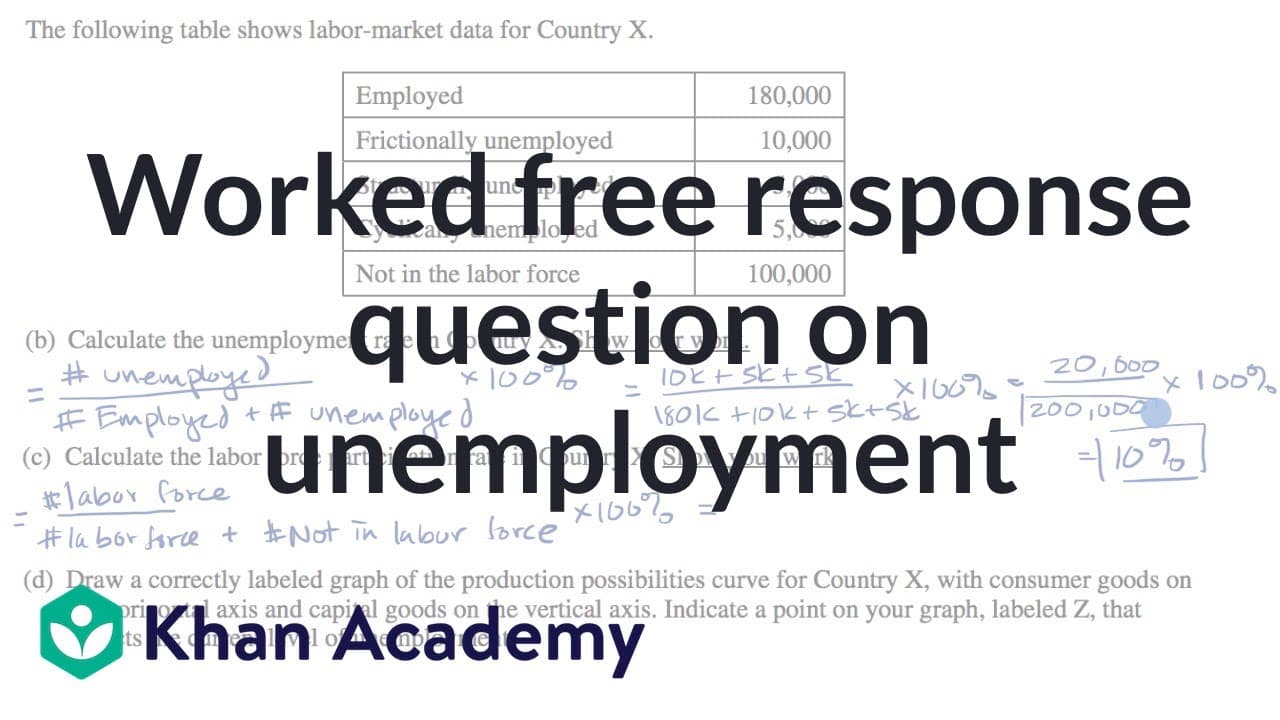
The video explains how to calculate the unemployment and labor force participation rates for Country X and also demonstrates how to draw a production possibilities curve indicating the current level of unemployment.
Transcript
- [Instructor] We are told the following table shows labor-market data for Country X. And they tell us how many are employed, frictionally unemployed, structurally unemployed, cyclically unemployed, and also not in the labor force. So this first question here and actually we skipped part a because we want all of these to focus on our labor force, s... Read More
Key Insights
- ☠️ Calculating the unemployment rate involves summing up the numbers for frictionally unemployed, structurally unemployed, and cyclically unemployed individuals and dividing them by the total labor force.
- 🔬 The labor force participation rate shows the proportion of the labor force (employed plus unemployed) in relation to the total eligible population.
- 🤕 People not in the labor force may include those who are not of working age, incarcerated, institutionalized, or serving in the military.
Install to Summarize YouTube Videos and Get Transcripts
Explore YouTube Video Summarizer or Get YouTube Transcript Extractor
Questions & Answers
Q: How is the unemployment rate calculated?
The unemployment rate is calculated by dividing the sum of frictionally unemployed, structurally unemployed, and cyclically unemployed individuals by the total labor force. The result is then multiplied by 100% to express it as a percentage.
Q: What is the labor force participation rate?
The labor force participation rate is calculated by dividing the labor force (employed plus unemployed) by the total eligible population. The result is then multiplied by 100% to express it as a percentage.
Q: What factors determine the number of people not in the labor force?
People not in the labor force include individuals who are not of working age, those who are incarcerated or institutionalized, and people in the military. These factors exclude them from being part of the labor force.
Q: How does cyclically unemployment affect the production possibilities curve?
Cyclical unemployment indicates that the economy is producing below its potential. Therefore, the production possibilities curve would show a point below the curve to represent the current level of unemployment.
Summary & Key Takeaways
-
The video provides labor-market data for Country X, including the numbers for employed, unemployed, frictionally unemployed, structurally unemployed, cyclically unemployed, and those not in the labor force.
-
It shows how to calculate the unemployment rate by dividing the sum of frictionally unemployed, structurally unemployed, and cyclically unemployed individuals by the total labor force.
-
The video also demonstrates how to calculate the labor force participation rate by dividing the labor force (employed plus unemployed) by the total eligible population.
Read in Other Languages (beta)
Share This Summary 📚
Summarize YouTube Videos and Get Video Transcripts with 1-Click
Try YouTube Summary with ChatGPT & Claude or YouTube Transcript Generator
Explore More Summaries from Khan Academy 📚



Summarize YouTube Videos and Get Video Transcripts with 1-Click
Try YouTube Summary with ChatGPT & Claude or YouTube Transcript Generator