Surveys and Samples
TL;DR
Critique and improve six different survey examples to ensure meaningful results based on sample choice.
Transcript
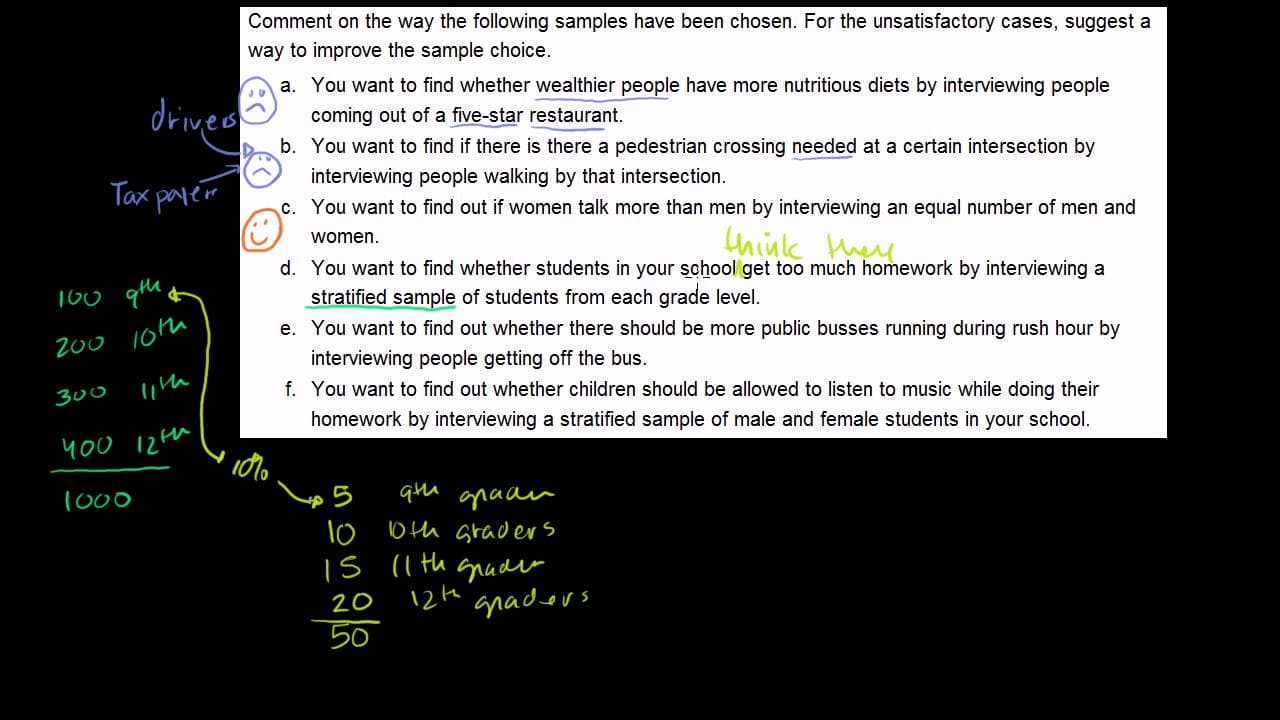
What we have here is six examples of possible surveys that might be conducted. What we want to do is critique them, see whether they're actually doing things that will give meaningful results, or results that you can actually make some judgment based on. So let's read the directions. It says, comment on the way the following samples have been chose... Read More
Key Insights
- 🖐️ Sample choice plays a crucial role in obtaining meaningful survey results.
- 🥺 Biases can occur when surveying specific locations or populations, leading to skewed data.
- ❓ Surveys should consider the perspectives of multiple stakeholders to capture a comprehensive understanding of the topic.
- ❓ Comparative analysis and objective measurements can enhance survey validity.
- ⚧️ Random sampling and avoiding discrimination on wealth or gender can provide more reliable data.
Install to Summarize YouTube Videos and Get Transcripts
Explore YouTube Video Summarizer or Get YouTube Transcript Extractor
Questions & Answers
Q: Why is surveying people at a five-star restaurant to determine dietary habits biased?
Surveying people at a five-star restaurant skews the sample towards wealthier individuals and those who eat out, excluding people who cook for themselves or cannot afford to eat at such establishments. It also does not account for the type of food served at the restaurant, which can further skew the results.
Q: How can the survey on the need for a pedestrian crossing be improved?
Rather than only interviewing people walking by the intersection, a more comprehensive approach would be to survey a random sample of residents within a certain radius of the intersection. This ensures a broader perspective and includes stakeholders such as drivers, taxpayers, and those who avoid the intersection.
Q: Is surveying an equal number of men and women to determine whether women talk more than men a valid method?
If conducted in a non-biased environment and using an equal number of men and women, this method can provide meaningful insights into differences in communication behavior. However, care should be taken to avoid skewed samples based on the survey location or specific demographic factors.
Q: Why might surveying a stratified sample of students from each grade level to assess homework be limited?
While this method ensures representation from each grade level, it only captures the perspective of students and does not consider the viewpoints of parents or teachers. Comparing student performance with and without music during homework could provide more conclusive results.
Q: What are the limitations of surveying people getting off the bus to determine if more buses are needed during rush hour?
This survey is biased as it only captures the opinions of bus riders and does not consider the perspectives of non-bus riders or those using the bus at different times. Assessing bus occupancy levels during rush hour would provide more objective data.
Q: How could the survey on allowing children to listen to music while doing homework be improved?
To obtain more comprehensive insights, the survey should include perspectives from parents, teachers, and students who both listen to music and those who do not. Additionally, comparing academic performance between the two groups could provide more meaningful findings.
Summary & Key Takeaways
-
Surveying people at a five-star restaurant to determine if wealthier people have more nutritious diets is biased as it only captures a skewed sample of wealthy individuals.
-
Interviewing people walking by a certain intersection to assess the need for a pedestrian crossing is biased and may exclude important perspectives of drivers and other stakeholders.
-
Conducting a survey to determine if women talk more than men by interviewing an equal number of men and women can provide meaningful insights if done in a non-biased environment.
-
Interviewing a stratified sample of students from each grade level in a school to assess if they receive too much homework is limited in scope and may not provide a comprehensive understanding of the issue.
-
Interviewing people getting off the bus to determine if there should be more public buses running during rush hour is biased and does not consider the perspectives of non-bus riders or people using the bus at different times.
-
Interviewing a stratified sample of male and female students to determine if children should be allowed to listen to music while doing homework is limited as it does not consider the perspectives of parents or teachers.
Read in Other Languages (beta)
Share This Summary 📚
Summarize YouTube Videos and Get Video Transcripts with 1-Click
Try YouTube Summary with ChatGPT & Claude or YouTube Transcript Generator
Explore More Summaries from Khan Academy 📚



Summarize YouTube Videos and Get Video Transcripts with 1-Click
Try YouTube Summary with ChatGPT & Claude or YouTube Transcript Generator