Rectangular and trapezoidal Riemann approximations
TL;DR
Calculating the area under a curve can be done using rectangles, midpoints, or trapezoids, each with different methods for determining height and width.
Transcript
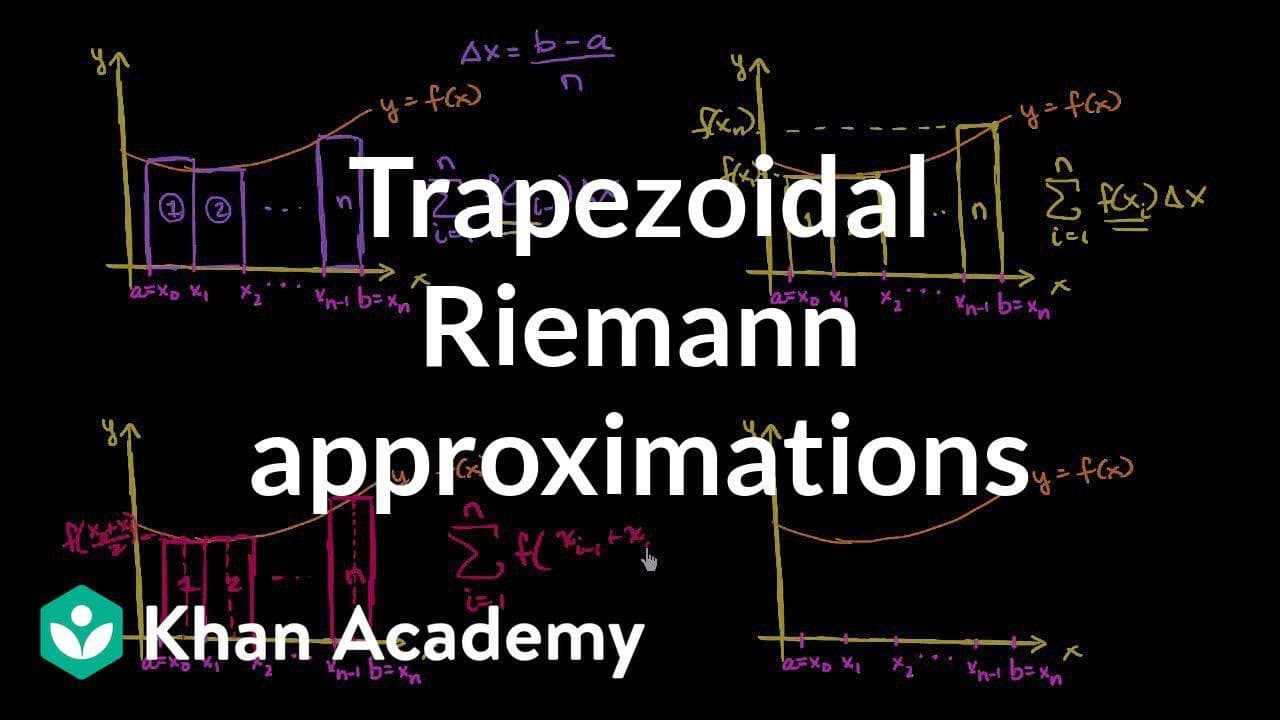
In the last few videos, we've been approximating the area under the curve using rectangles, where the height of each rectangle was defined by the function evaluated at the left boundary. So this would have been the first rectangle. Then the second rectangle would look something like this. And then we'd go all the way to the nth rectangle would look... Read More
Key Insights
- 🗂️ Approximating the area under a curve involves dividing it into geometric shapes like rectangles, trapezoids, or using midpoints.
- 💠 Different methods for determining the height and width of these shapes can be used, resulting in different formulas.
- 🍹 Calculus textbooks may present various notations and methods for approximating areas, but they all essentially sum up the areas of the shapes.
Install to Summarize YouTube Videos and Get Transcripts
Explore YouTube Video Summarizer or Get YouTube Transcript Extractor
Questions & Answers
Q: What is the basic method for approximating the area under a curve using rectangles?
The basic method is to divide the area into rectangles, where the height of each rectangle is determined by the function evaluated at the left boundary and the width is constant.
Q: Can the height of each rectangle be determined by the function evaluated at the right boundary instead?
Yes, an alternative method is to use the right boundary to determine the height of each rectangle. This changes the formula for calculating the area.
Q: What is the midpoint method for approximating the area under a curve?
The midpoint method involves using the midpoint between the left and right boundaries to determine the height of each rectangle. The width remains constant.
Q: How can trapezoids be used to approximate the area under a curve?
Trapezoids can be used by dividing the area into trapezoids, where the height is the average of the function values at the left and right boundaries. The width remains constant.
Summary & Key Takeaways
-
The area under a curve can be approximated using rectangles, where the height is determined by the function evaluated at the left boundary and the width is constant.
-
Alternatively, the height of each rectangle can be determined by the function evaluated at the right boundary or the midpoint between the two boundaries.
-
Trapezoids can also be used to approximate the area, where the height is the average of the function values at the two boundaries.
Read in Other Languages (beta)
Share This Summary 📚
Summarize YouTube Videos and Get Video Transcripts with 1-Click
Try YouTube Summary with ChatGPT & Claude or YouTube Transcript Generator
Explore More Summaries from Khan Academy 📚



Summarize YouTube Videos and Get Video Transcripts with 1-Click
Try YouTube Summary with ChatGPT & Claude or YouTube Transcript Generator