The Second Great Awakening - part 2
TL;DR
The Second Great Awakening was a religious movement in the early 19th century that was influenced by the cultural, social, and economic changes of the time.
Transcript
- [Instructor] In the last video, I started discussing the Second Great Awakening, which was this era of increased religious fervor, religious conversion, and religiously inspired social action that happened in the early 19th century of the United States' history, so approximately 1790 to 1850, although I'd say that the height of this time was from... Read More
Key Insights
- 🧑🏭 The Second Great Awakening was driven by a combination of cultural, social, and economic factors.
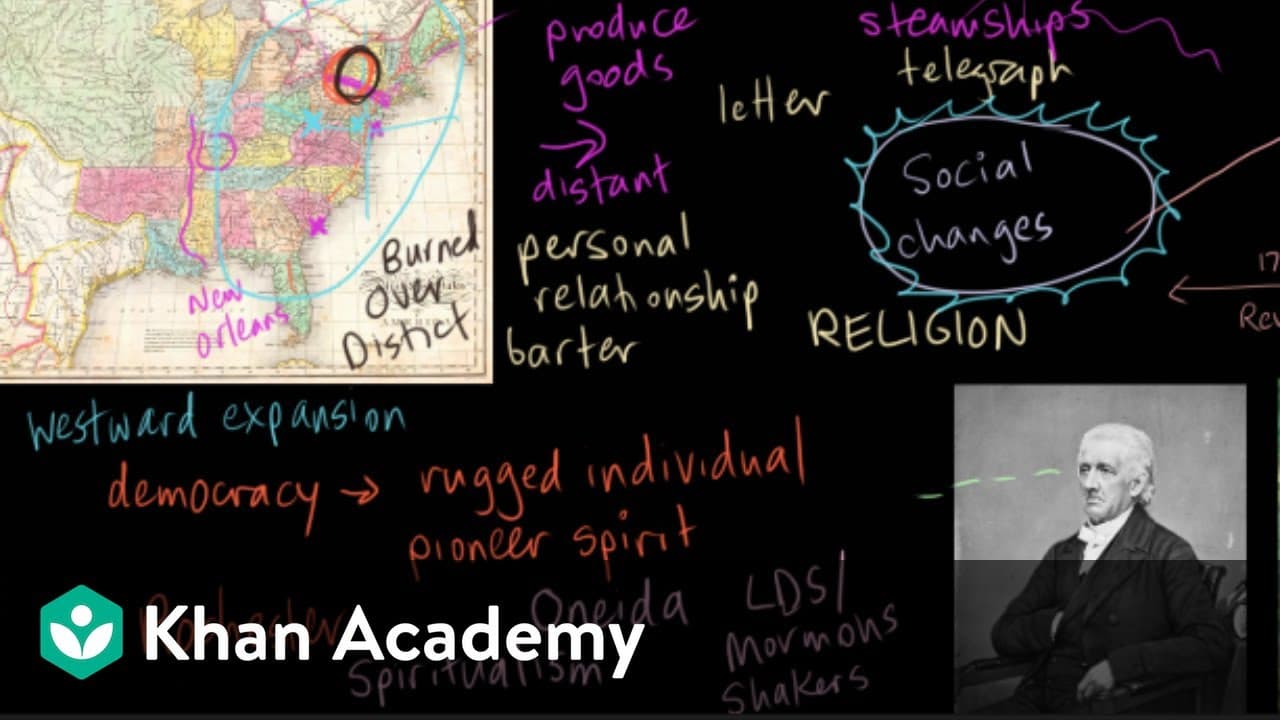
- 🔬 The Market Revolution, with advancements in transportation and a shift to wage labor, created anxiety and inspired individuals to seek moral guidance through religion.
- 😮 Westward expansion and the rise of the middle class contributed to the popularity of the Second Great Awakening as individuals embraced ideas of individualism and self-reliance.
Install to Summarize YouTube Videos and Get Transcripts
Explore YouTube Video Summarizer or Get YouTube Transcript Extractor
Questions & Answers
Q: What was the significance of circuit riders in the Second Great Awakening?
Circuit riders were preachers without their own congregations who organized camp meetings and preached about a passionate form of Christianity to large crowds. They played a crucial role in spreading religious fervor during this time.
Q: How did the Market Revolution contribute to the growth of the Second Great Awakening?
The Market Revolution, with advancements in transportation and the shift to wage labor, created anxieties and uncertainties. In response, many individuals turned to religion as a source of moral guidance, social cohesion, and a way to navigate the changing landscape of American society.
Q: How did westward expansion contribute to the rise of the Second Great Awakening?
As the United States expanded westward, the population spread out, leading to an expansion of the middle class and increased political power. The idea of individualism and self-reliance, characteristic of the time, aligned with the religious teachings of the Second Great Awakening, making it popular among the growing number of people taking their own fate into their hands.
Q: Why was Rochester significant in the growth of new religious movements during the Second Great Awakening?
Rochester, located along the Erie Canal, became a boomtown during the Market Revolution. Within its radius, the "burned-over district," numerous religious revivals and new movements were born, including the Oneida Community, spiritualism, the Church of Jesus Christ of Latter-Day Saints (Mormons), and the Shakers.
Summary & Key Takeaways
-
The Second Great Awakening was characterized by increased religious fervor, conversion, and social action in the early 19th century.
-
Circuit riders played a significant role in this movement, organizing camp meetings and preaching about an emotional version of Christianity.
-
The Market Revolution, including innovations in transportation and a shift to wage labor, created anxieties and contributed to the growth of the Second Great Awakening.
Read in Other Languages (beta)
Share This Summary 📚
Summarize YouTube Videos and Get Video Transcripts with 1-Click
Try YouTube Summary with ChatGPT & Claude or YouTube Transcript Generator
Explore More Summaries from Khan Academy 📚



Summarize YouTube Videos and Get Video Transcripts with 1-Click
Try YouTube Summary with ChatGPT & Claude or YouTube Transcript Generator