Part 2 of proof of Heron's formula | Perimeter, area, and volume | Geometry | Khan Academy
TL;DR
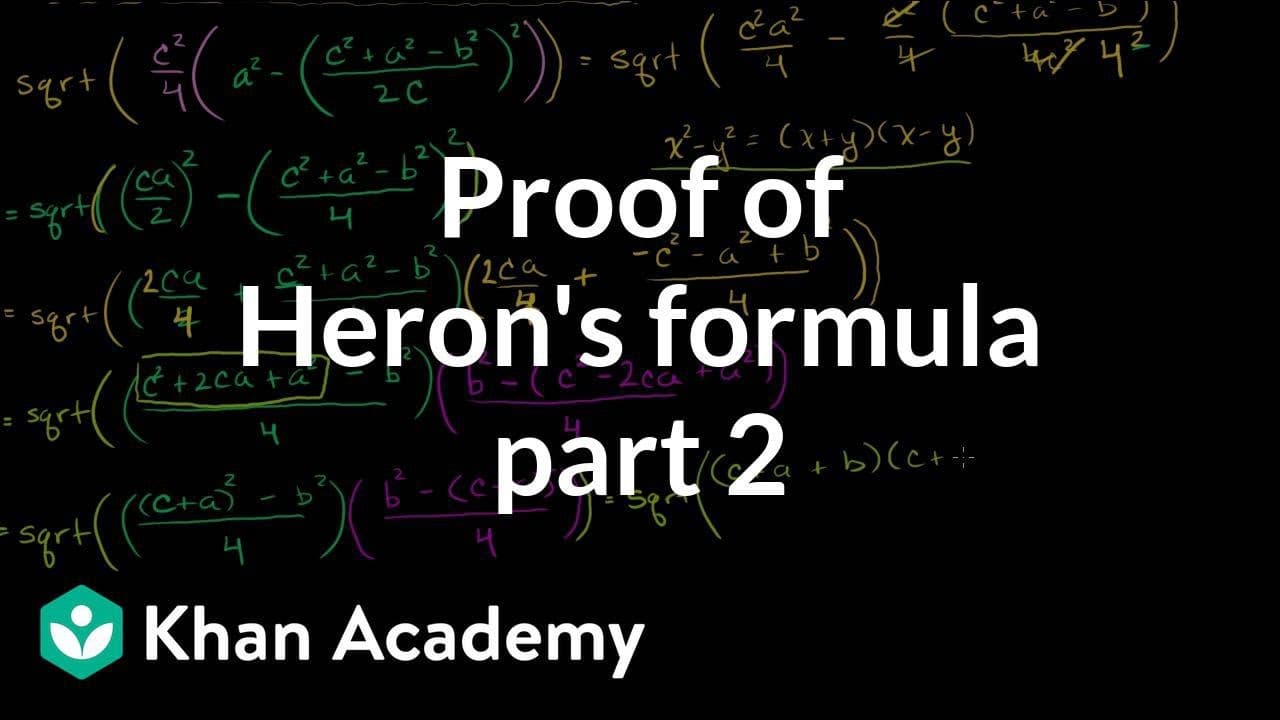
This video provides a step-by-step algebraic proof that Heron's formula is equivalent to the previously discussed formula for finding the area of a triangle with sides of length a, b, and c.
Transcript
In the last video, I claimed that this result we got for the area of a triangle that had sides of length a, b, and c is equivalent to Heron's formula. And what I want to do in this video is show you that this is equivalent to Heron's formula by essentially just doing a bunch of algebraic manipulation. So the first thing we want to do-- let's just s... Read More
Key Insights
- 🔺 The algebraic proof demonstrates the equivalence of Heron's formula to the previously discussed formula for the area of a triangle.
- 😑 Manipulating and simplifying algebraic expressions is crucial in transforming the original equation into a more manageable form.
- 🖐️ Factoring polynomials plays a significant role in simplifying and identifying common terms in the equation.
- 😑 By defining S as the sum of the triangle's side lengths divided by 2, the equation for the area can be expressed in a more concise and elegant form.
- ✊ The proof highlights the power and versatility of algebraic techniques in solving mathematical problems.
- 🥡 The steps taken in the algebraic proof demonstrate the systematic approach used in mathematical reasoning.
- 💅 The video emphasizes the importance of understanding algebraic manipulation in order to appreciate the beauty of mathematical proofs.
Install to Summarize YouTube Videos and Get Transcripts
Explore YouTube Video Summarizer or Get YouTube Transcript Extractor
Questions & Answers
Q: How is the 1/2c term manipulated to simplify the expression?
The 1/2 c is rewritten as the square root of c squared over 4. By distributing this term, we obtain a squared term that cancels out with other terms, simplifying the expression.
Q: What is the significance of factoring polynomials in this proof?
Factoring polynomials helps simplify and manipulate the equation, allowing for the identification of common terms, which leads to the discovery of the formula for the area of a triangle being equivalent to Heron's formula.
Q: How does the equation for the area end up being divided by 4?
The division by 4 arises from squaring both the numerator and the denominator, which results in the squared term being multiplied by 4. This is then simplified to become a division by 4.
Q: What is the final simplified form of the equation for the area of a triangle?
The final equation is the square root of (S)(S - a)(S - b)(S - c), where S represents the sum of the triangle's side lengths divided by 2.
Summary & Key Takeaways
-
The video demonstrates how to simplify the expression for the area of a triangle by using algebraic manipulation.
-
By distributing and factoring polynomial expressions, the complicated equation is transformed into a simpler form.
-
The final result is the same as Heron's formula, validating the previous claim made in the last video.
Read in Other Languages (beta)
Share This Summary 📚
Summarize YouTube Videos and Get Video Transcripts with 1-Click
Try YouTube Summary with ChatGPT & Claude or YouTube Transcript Generator
Explore More Summaries from Khan Academy 📚



Summarize YouTube Videos and Get Video Transcripts with 1-Click
Try YouTube Summary with ChatGPT & Claude or YouTube Transcript Generator