Multiplication and Division Property of Equality
TL;DR
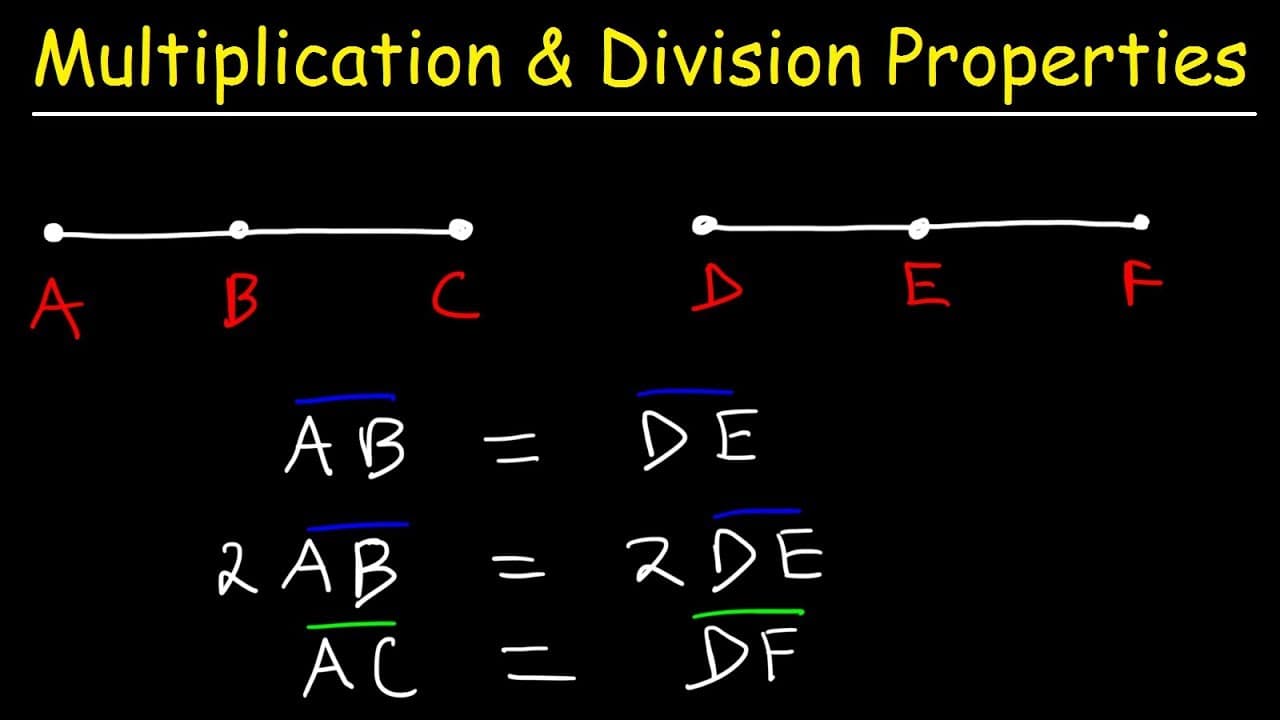
The multiplication property states that if segments or angles are congruent, their like multiples are congruent. The division property states that if segments or angles are congruent, their like divisions are congruent.
Transcript
in this lesson we're going to talk about the multiplication and division property of segments and angles as it relates to geometry so here's the basic idea of the multiplication property if segments or angles are congruent their like multiples are congruent so let's consider two segments let's say this is point a b c and this is d e f and let's say... Read More
Key Insights
- ✖️ The multiplication property states that if segments or angles are congruent, their like multiples are congruent.
- ➗ The division property states that if segments or angles are congruent, their like divisions are congruent.
- 🖐️ Midpoints of segments play a crucial role in using these properties.
- ✖️ The multiplication property allows us to find the lengths of segments by multiplying the congruent segments or angles by a certain factor.
- ➗ The division property allows us to find the lengths of segments by dividing the congruent segments or angles by a certain factor.
- 💦 The multiplication property can be used when working with midpoints to find the lengths of segments.
- 💦 The division property can be used when working with midpoints to find the lengths of segments.
Install to Summarize YouTube Videos and Get Transcripts
Explore YouTube Video Summarizer or Get YouTube Transcript Extractor
Questions & Answers
Q: What is the multiplication property of segments and angles in geometry?
The multiplication property states that if two segments or angles are congruent, then their like multiples are also congruent. This means that if segment AB is congruent to segment DE, then segment AC is congruent to segment DF, where AC is twice the length of AB.
Q: How does the division property relate to segments and angles in geometry?
The division property is the reverse of the multiplication property. It states that if two segments or angles are congruent, then their like divisions are also congruent. For example, if segment AC is congruent to segment DF, then segment AB is congruent to segment DE, where AB is half the length of AC.
Q: How can the multiplication property be applied when working with midpoints of segments?
When working with midpoints of segments, the multiplication property can be used to determine the lengths of the segments. For example, if point B is the midpoint of segment AC and segment AB is congruent to segment DE, then segment BC must also be congruent to segment EF. This allows us to use the multiplication property to find the lengths of the segments.
Q: How does the division property work when working with midpoints of segments?
When working with midpoints of segments, the division property can be used to determine the lengths of the segments. For example, if point B is the midpoint of segment AC and segment AC is congruent to segment DF, then segment AB must be congruent to segment DE. This allows us to use the division property to find the lengths of the segments.
Summary & Key Takeaways
-
The multiplication property states that if two segments are congruent, their respective multiples are also congruent.
-
The division property states that if two segments are congruent, their respective divisions are also congruent.
-
These properties can be applied when working with midpoints of segments.
Read in Other Languages (beta)
Share This Summary 📚
Summarize YouTube Videos and Get Video Transcripts with 1-Click
Try YouTube Summary with ChatGPT & Claude or YouTube Transcript Generator
Explore More Summaries from The Organic Chemistry Tutor 📚



Summarize YouTube Videos and Get Video Transcripts with 1-Click
Try YouTube Summary with ChatGPT & Claude or YouTube Transcript Generator