Thermistors - NTC & PTC - Thermal Resistors - Temperature Sensors & Resettable Fuses
TL;DR
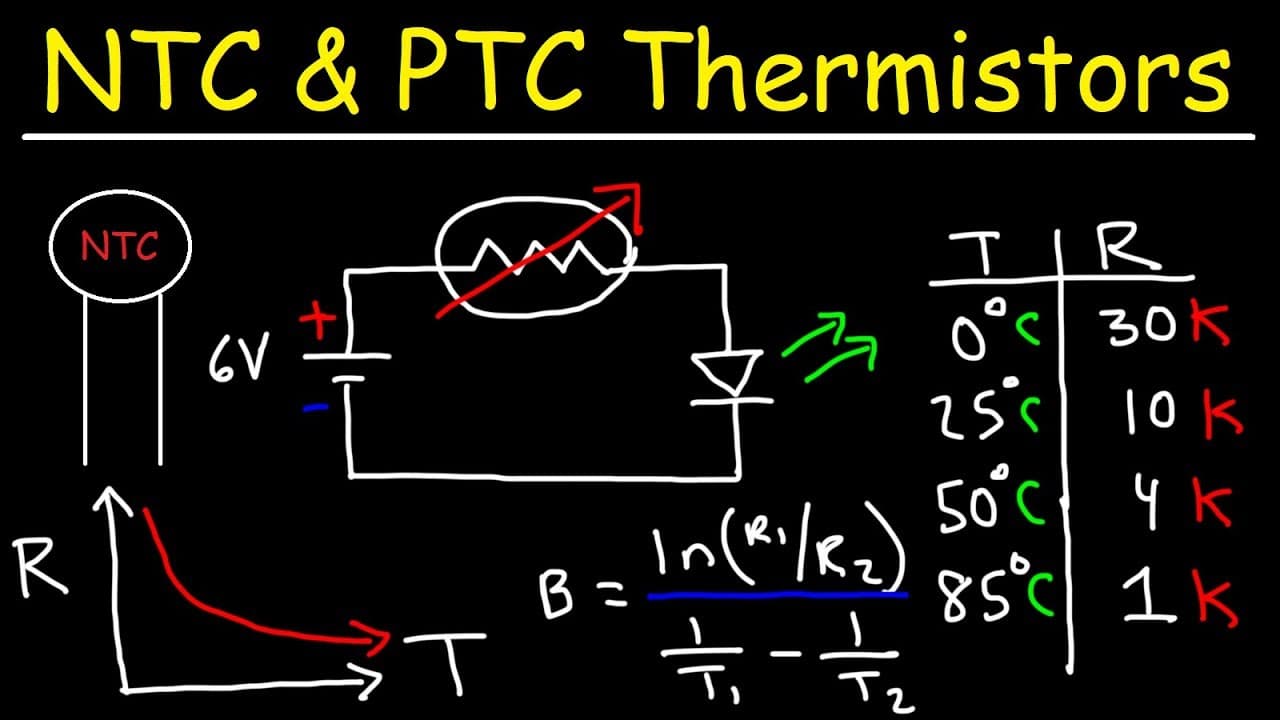
Thermistors are thermal resistors whose resistance depends on temperature. NTC thermistors have a negative temperature coefficient, decreasing resistance with temperature, while PTC thermistors have a positive temperature coefficient, increasing resistance with temperature.
Transcript
in this video we're going to talk about thermistors what is a thermistor a thermistor is a thermal resistor it's a resistor whose resistance is dependent on temperature now there's two types of thermistors need to be familiar with the ntc thermistors and the ptc thermistors the ntc thermistor stands for negative temperature coefficient thermal resi... Read More
Key Insights
- ⚾ Thermistors are thermal resistors that exhibit varying resistance based on temperature.
- 💱 NTC thermistors have a negative temperature coefficient, while PTC thermistors have a positive temperature coefficient, affecting their resistance with temperature changes.
- 😕 NTC thermistors are useful as temperature sensors, while PTC thermistors act as resettable fuses.
- 🤬 The electrical symbols for thermistors can be represented in different ways in circuit diagrams.
- 👫 NTC thermistors can be used to control the brightness of LEDs based on temperature changes.
- ❓ The relationship between temperature and resistance in NTC thermistors can be described using a formula that includes a beta constant.
- ❓ The beta constant can be calculated by knowing the resistance at two different temperatures.
Install to Summarize YouTube Videos and Get Transcripts
Explore YouTube Video Summarizer or Get YouTube Transcript Extractor
Questions & Answers
Q: What is the difference between NTC and PTC thermistors?
NTC thermistors have a negative temperature coefficient, meaning their resistance decreases as temperature increases. On the other hand, PTC thermistors have a positive temperature coefficient, resulting in increased resistance with increasing temperature.
Q: How are NTC thermistors used as temperature sensors?
NTC thermistors are sensitive to temperature changes, and their resistance decreases as the temperature rises. This property allows them to be used in devices that turn on when it's too hot or turn off when it's too cold, acting as temperature sensors.
Q: What applications do PTC thermistors have?
PTC thermistors have applications in fuses. When too much current flows through a circuit, the PTC thermistor heats up, increasing its resistance and limiting the amount of current flowing through it. This property allows the PTC thermistor to act as a resettable fuse.
Q: How can the brightness of an LED be controlled using an NTC thermistor?
By connecting an NTC thermistor in a circuit with an LED, the resistance of the NTC thermistor decreases as the temperature increases. This leads to an increase in current flow, resulting in the LED becoming brighter when the environment is hot and dimmer when it's cold.
Summary & Key Takeaways
-
Thermistors are thermal resistors that have varying resistance based on temperature, with NTC thermistors decreasing resistance with increasing temperature, and PTC thermistors increasing resistance with temperature.
-
NTC thermistors are used as temperature sensors, while PTC thermistors have applications in fuses, offering a resettable alternative.
-
The electrical symbols for thermistors can be represented as a resistor in a circle with an arrow, a rectangle with a line through it, or a resistor enclosed in a circle with NTC or PTC specifications.
Read in Other Languages (beta)
Share This Summary 📚
Summarize YouTube Videos and Get Video Transcripts with 1-Click
Try YouTube Summary with ChatGPT & Claude or YouTube Transcript Generator
Explore More Summaries from The Organic Chemistry Tutor 📚





Summarize YouTube Videos and Get Video Transcripts with 1-Click
Try YouTube Summary with ChatGPT & Claude or YouTube Transcript Generator