Ionization Energy and the Photoelectric Effect (AP Chemistry)
TL;DR
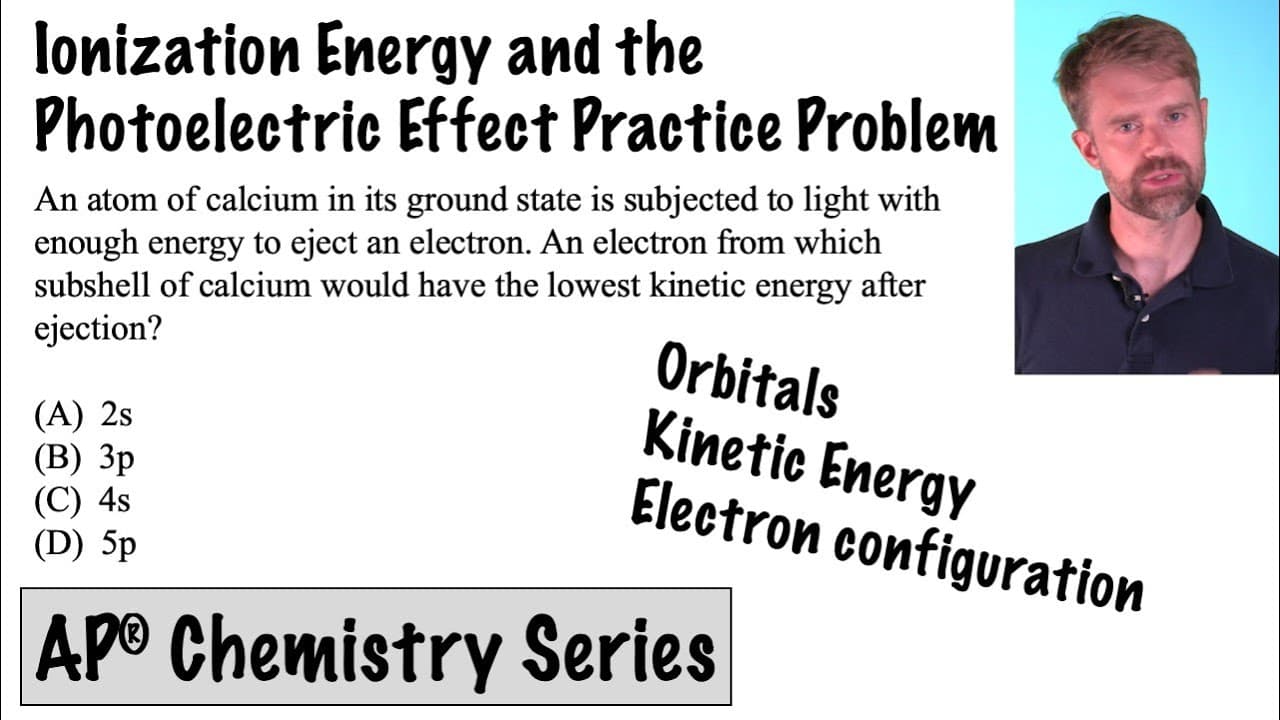
Ionization energy and photoelectric effect relate, impacting electron kinetic energy; 2s subshell on calcium has lowest kinetic energy.
Transcript
here we'll do a problem that focuses on ionization energy and the photoelectric effect an atom of calcium in its ground state is subjected to light with enough energy to eject an electron an electron from which subshell of calcium would have the lowest kinetic energy after ejection in order to answer this question we need to think about exactly wha... Read More
Key Insights
- 😚 Ionization energy increases as electrons are closer to the nucleus.
- ⏏️ Photoelectric effect transfers remaining energy into kinetic energy for ejected electron.
- 📪 Subshell closest to the nucleus has the lowest kinetic energy for an ejected electron.
- ❓ Understanding the relationship between ionization energy and electron ejection is crucial.
- 🆘 Thought process involving ionization energy and photoelectric effect helps determine electron kinetic energy.
- 🤔 Wording in questions may require critical thinking and step-by-step analysis.
- 🥺 Application of concepts leads to accurate answers in ionization energy problems.
Install to Summarize YouTube Videos and Get Transcripts
Explore YouTube Video Summarizer or Get YouTube Transcript Extractor
Questions & Answers
Q: What is ionization energy, and how does it relate to electron ejection?
Ionization energy is the energy needed to remove an electron from an atom, directly related to distance from the nucleus. It increases as electrons are closer to the nucleus due to the stronger positive pull.
Q: What is the photoelectric effect, and how does it affect electron kinetic energy?
The photoelectric effect is when a photon ejects an electron from an atom, with the remaining energy transforming into kinetic energy for the electron. More energy needed for ejection results in lower kinetic energy for the electron.
Q: How can we determine which subshell results in the lowest kinetic energy for an ejected electron?
By analyzing ionization energy and the photoelectric effect, we can deduce that the subshell closest to the nucleus (2s in calcium) will have the lowest kinetic energy due to the high energy needed for ejection.
Q: Why is the 2s subshell in calcium identified as having the lowest kinetic energy for an ejected electron?
The 2s subshell is closest to the nucleus in calcium, requiring more energy for ejection, resulting in less leftover kinetic energy after the photoelectric effect. This makes it have the lowest kinetic energy for the ejected electron.
Summary & Key Takeaways
-
Ionization energy required to eject electron, increases closer to nucleus.
-
Photoelectric effect transfers remaining energy into kinetic energy for ejected electron.
-
Using these concepts, 2s subshell on calcium has the lowest kinetic energy for ejected electron.
Read in Other Languages (beta)
Share This Summary 📚
Summarize YouTube Videos and Get Video Transcripts with 1-Click
Try YouTube Summary with ChatGPT & Claude or YouTube Transcript Generator
Explore More Summaries from Tyler DeWitt 📚

Summarize YouTube Videos and Get Video Transcripts with 1-Click
Try YouTube Summary with ChatGPT & Claude or YouTube Transcript Generator