Test correlation for significance
TL;DR
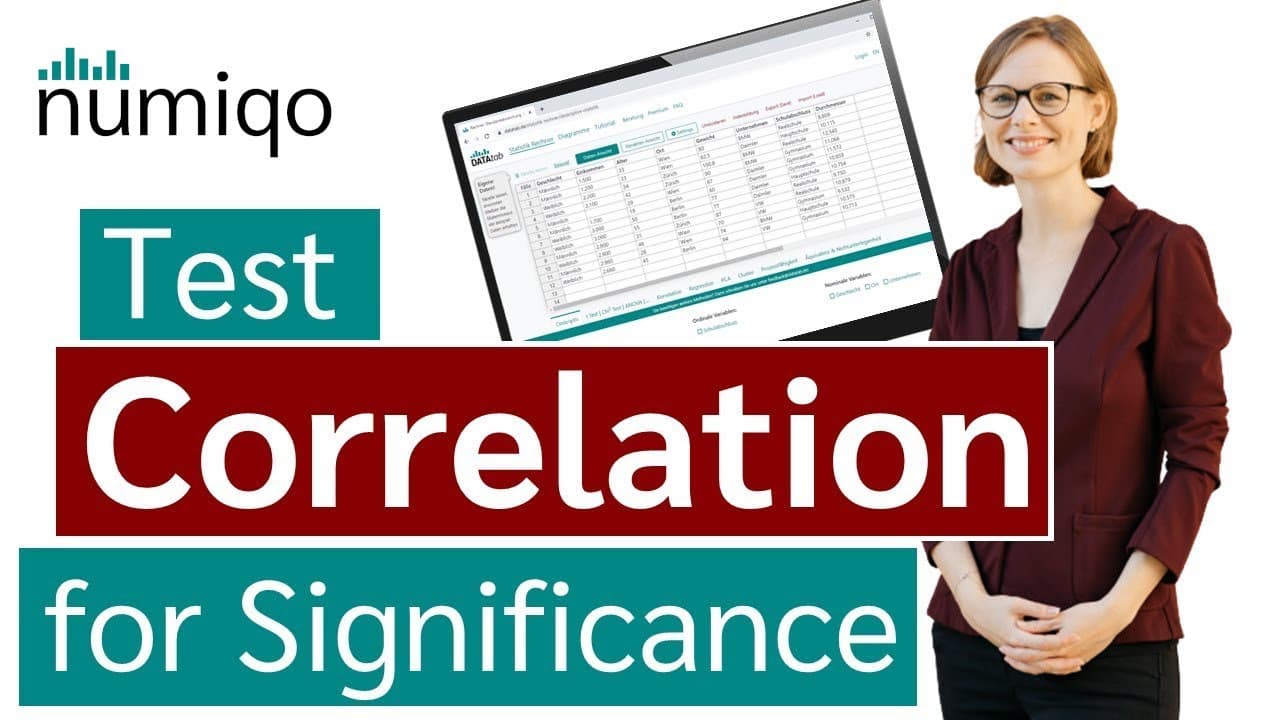
This video explains how to test the significance of a correlation coefficient using a t-test, with a demonstration using an online statistics calculator.
Transcript
hello in this video i explain how you can test a correlation for significance and that's where we start as you know from my previous video correlation analysis tests the linear relationship between variables in the first step of the correlation analysis you calculate the correlation coefficient for example the pearson correlation coefficient or the... Read More
Key Insights
- ❓ The first step in correlation analysis is calculating the correlation coefficient, such as Pearson or Spearman.
- 🏆 The significance of a correlation coefficient can be tested using a t-test, comparing it to a null hypothesis of no linear relationship.
- 😃 The t-value is calculated using the correlation coefficient and sample size, and the p-value is obtained from the t-value.
- ⚾ The p-value determines whether the null hypothesis should be retained or rejected based on the chosen significance level.
- ❓ An online statistics calculator, like datadeb.net, simplifies the process of testing correlation for significance.
- 🏆 The results of a correlation test indicate whether there is a significant relationship between the variables.
- ❓ Testing correlation for significance is crucial for generalizing findings from a sample to the entire population.
Install to Summarize YouTube Videos and Get Transcripts
Explore YouTube Video Summarizer or Get YouTube Transcript Extractor
Questions & Answers
Q: What is the purpose of testing correlation for significance?
Testing correlation for significance helps determine if a correlation observed in a sample can be generalized to the entire population. It ensures the validity of the findings.
Q: How is the t-value calculated in the testing of correlation for significance?
The t-value is calculated using the formula, t = r * sqrt((n-2)/(1-r^2)), where r is the correlation coefficient and n is the sample size. It measures the strength and direction of the linear relationship.
Q: How is the p-value used to determine whether to retain or reject the null hypothesis?
The p-value indicates the probability of observing a correlation coefficient as extreme as the one calculated from the sample, assuming the null hypothesis is true. If the p-value is smaller than the significance level, the null hypothesis is rejected.
Q: How can an online statistics calculator be used to test correlation for significance?
An online statistics calculator like datadeb.net can calculate the t-value and p-value for a correlation coefficient. By inputting the variables and choosing the correlation type (Pearson or Spearman), the calculator provides the results and interpretation.
Key Insights:
- The first step in correlation analysis is calculating the correlation coefficient, such as Pearson or Spearman.
- The significance of a correlation coefficient can be tested using a t-test, comparing it to a null hypothesis of no linear relationship.
- The t-value is calculated using the correlation coefficient and sample size, and the p-value is obtained from the t-value.
- The p-value determines whether the null hypothesis should be retained or rejected based on the chosen significance level.
- An online statistics calculator, like datadeb.net, simplifies the process of testing correlation for significance.
- The results of a correlation test indicate whether there is a significant relationship between the variables.
- Testing correlation for significance is crucial for generalizing findings from a sample to the entire population.
- Understanding the significance of correlation coefficients helps in making informed decisions and drawing accurate conclusions in statistical analysis.
Summary & Key Takeaways
-
The video discusses the importance of testing correlation for significance in order to determine if a correlation observed in a sample also exists in the population.
-
It explains that a t-test can be used to test whether a correlation coefficient is significantly different from zero, with the null hypothesis being that there is no linear relationship.
-
The video demonstrates how to calculate the t-value and p-value using an online statistics calculator and interpret the results.
Read in Other Languages (beta)
Share This Summary 📚
Summarize YouTube Videos and Get Video Transcripts with 1-Click
Try YouTube Summary with ChatGPT & Claude or YouTube Transcript Generator
Explore More Summaries from DATAtab 📚
![Confidence Interval [Simply explained] thumbnail](/_next/image?url=https%3A%2F%2Fi.ytimg.com%2Fvi%2FENnlSlvQHO0%2Fhqdefault.jpg&w=750&q=75)


![Chi-Square Test [Simply explained] thumbnail](/_next/image?url=https%3A%2F%2Fi.ytimg.com%2Fvi%2FrpKzq64GA9Y%2Fhqdefault.jpg&w=750&q=75)

Summarize YouTube Videos and Get Video Transcripts with 1-Click
Try YouTube Summary with ChatGPT & Claude or YouTube Transcript Generator