What Are the Key Concepts of Statistics for Data Science?
TL;DR
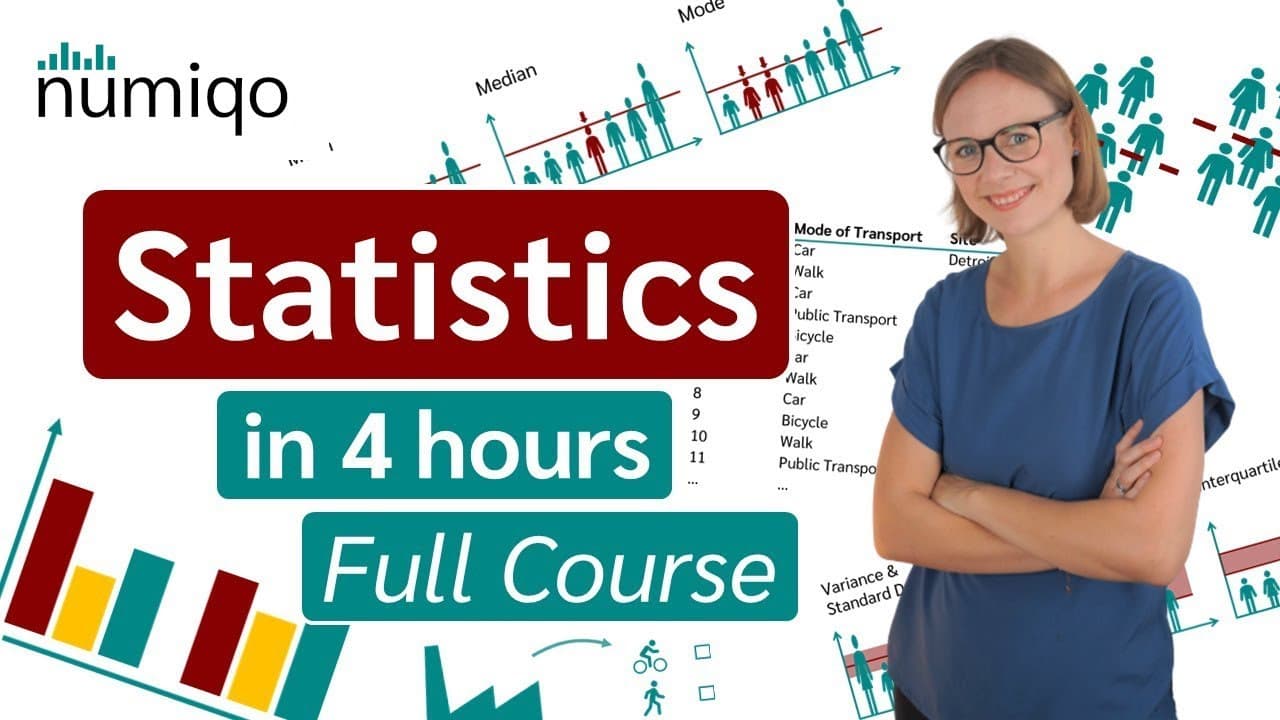
Key concepts of statistics for data science include descriptive statistics for summarizing data and inferential statistics for making generalizations about populations based on sample data. Essential topics also include various hypothesis tests like T-tests and ANOVA, as well as regression analysis, correlation methods, and clustering techniques. Understanding these concepts is crucial for effective data analysis and making informed decisions.
Transcript
Welcome to our full and free tutorial about statistics we will uncover the tools and techniques that help us make sense of data this video is designed to guide you through the fundamental concepts and most powerful statistical tests used in research today from the basics of descriptive statistics to the complexities of regression and Beyond we'll e... Read More
Key Insights
- 👨🔬 Understanding statistics is essential for interpreting data and making informed decisions in research.
- 👻 Descriptive statistics provide valuable summaries, but inferential statistics allow for broader conclusions about larger populations from sample data.
- 👨🔬 Hypothesis testing, including T-tests and ANOVA, is crucial for assessing differences between groups and validating research findings.
- 🏑 Regression techniques enable predictions and the exploration of relationships between variables, crucial for statistical analysis in various fields.
- 😉 K-means clustering is a powerful tool for uncovering hidden patterns in data, useful for segmenting populations based on shared characteristics.
- 👨🔬 A clear distinction between correlation and causation is vital in research to avoid misinterpretation of relationships among variables.
- 🎚️ Preparing data, including understanding measurement levels and creating dummy variables for categorical data, is necessary for effective statistical analysis.
Install to Summarize YouTube Videos and Get Transcripts
Explore YouTube Video Summarizer or Get YouTube Transcript Extractor
Questions & Answers
Q: What is the difference between descriptive and inferential statistics?
Descriptive statistics summarize the characteristics of a dataset, such as mean, median, and mode, without making conclusions about a larger population. In contrast, inferential statistics use sample data to make predictions or inferences about a population, allowing researchers to draw conclusions from limited data.
Q: Can you explain the process of conducting a T-test?
A T-test compares the means of two groups to determine if they are statistically different from each other. First, establish null and alternative hypotheses. Then, calculate the T value based on the means, standard deviations, and sample sizes. Finally, compare the T value against critical values or assess the P value to determine significance.
Q: What are the main assumptions for regression analysis?
Key assumptions for regression analysis include a linear relationship between dependent and independent variables, normally distributed residual errors, homoscedasticity (equal variance of residuals), and no multicollinearity among independent variables, ensuring the stability of the regression coefficients.
Q: What is K-means clustering, and how does it work?
K-means clustering is a method used to partition a dataset into K distinct clusters. The process involves selecting K initial cluster centroids, assigning data points to the nearest centroid, recalculating centroids based on these assignments, and repeating the process until cluster assignments no longer change.
Summary & Key Takeaways
-
This tutorial introduces fundamental concepts of statistics, including descriptive and inferential statistics, highlighting their roles in data understanding and analysis.
-
It covers various hypothesis tests such as T-tests and ANOVA, explaining their applications and differences, as well as assumptions necessary for valid results.
-
The tutorial also delves into regression analysis, correlation methods, and cluster analysis, providing a comprehensive view of how to analyze and interpret data.
Read in Other Languages (beta)
Share This Summary 📚
Summarize YouTube Videos and Get Video Transcripts with 1-Click
Try YouTube Summary with ChatGPT & Claude or YouTube Transcript Generator
Explore More Summaries from DATAtab 📚
![Confidence Interval [Simply explained] thumbnail](/_next/image?url=https%3A%2F%2Fi.ytimg.com%2Fvi%2FENnlSlvQHO0%2Fhqdefault.jpg&w=750&q=75)
Summarize YouTube Videos and Get Video Transcripts with 1-Click
Try YouTube Summary with ChatGPT & Claude or YouTube Transcript Generator