Alkene + Hg(OAc)2 - Alkoxymercuration Demercuration Reaction Mechanism
TL;DR
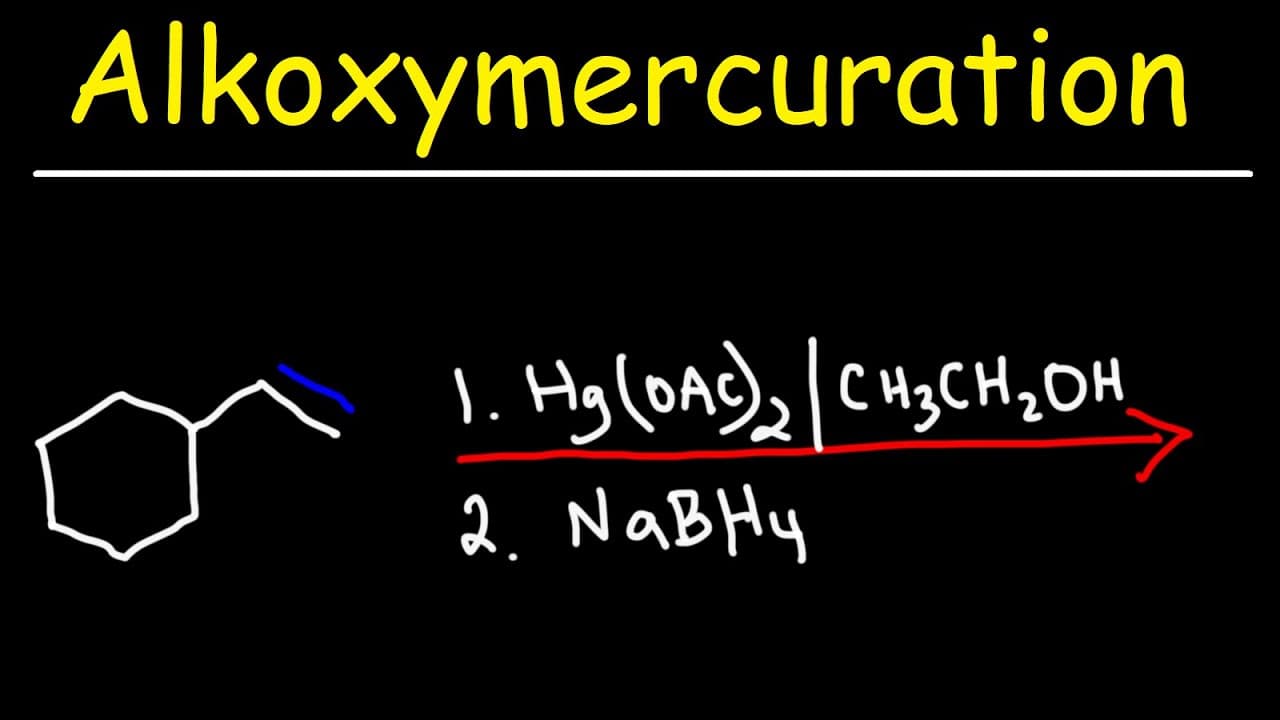
This video explains the alkoxymercuration-demercuration reaction and how it proceeds with Markovnikov regiochemistry.
Transcript
31 what is the major product of the reaction shown below so here we have the alkoxy merchorbation demerculation reaction this reaction doesn't have for the most part carbocation rearrangements but it does proceed with Markham the conv regional chemistry now if this was water instead of ethanol we would get an o h on the secondary carbon instead we'... Read More
Key Insights
- 🤲 The alkoxymercuration-demercuration reaction proceeds with Markovnikov regiochemistry, resulting in the addition of an ether group to a double bond.
- 💁 The reaction involves the formation of a stable mercurinium ion intermediate, which prevents carbocation rearrangement.
- 👊 Nucleophiles preferentially attack the more substituted carbon due to electrostatic attractions.
Install to Summarize YouTube Videos and Get Transcripts
Explore YouTube Video Summarizer or Get YouTube Transcript Extractor
Questions & Answers
Q: What is the major product of the alkoxymercuration-demercuration reaction?
The major product of the alkoxymercuration-demercuration reaction is an ether with Markovnikov regiochemistry, where the double bond is replaced by an ether group.
Q: Why does the reaction not exhibit carbocation rearrangement?
The reaction does not exhibit carbocation rearrangement because the formation of a more stable mercurinium ion intermediate prevents rearrangement. Resonance structures allow for the stabilization of the intermediate.
Q: Why does the nucleophile preferentially attack the more substituted carbon?
The nucleophile, in this case ethanol, prefers to attack the more substituted carbon due to electrostatic attractions. The partially negative oxygen is attracted to the partially positive carbon, resulting in the addition of the ether group to the more substituted carbon.
Q: What is the purpose of the sodium borohydride in the second step?
The sodium borohydride in the second step of the reaction replaces the mercury acetate group with a hydrogen atom. The mechanism for this step is not discussed in the video.
Summary & Key Takeaways
-
The alkoxymercuration-demercuration reaction involves the addition of an ether group to a double bond, following Markovnikov regiochemistry.
-
The reaction proceeds through the formation of a mercurinium ion intermediate, which is more stable due to resonance structures.
-
Nucleophiles, such as ethanol, preferentially attack the more substituted carbon due to electrostatic attractions.
-
The reaction is followed by a second step involving sodium borohydride, which replaces the mercury acetate group with a hydrogen.
Read in Other Languages (beta)
Share This Summary 📚
Summarize YouTube Videos and Get Video Transcripts with 1-Click
Try YouTube Summary with ChatGPT & Claude or YouTube Transcript Generator
Explore More Summaries from The Organic Chemistry Tutor 📚



Summarize YouTube Videos and Get Video Transcripts with 1-Click
Try YouTube Summary with ChatGPT & Claude or YouTube Transcript Generator