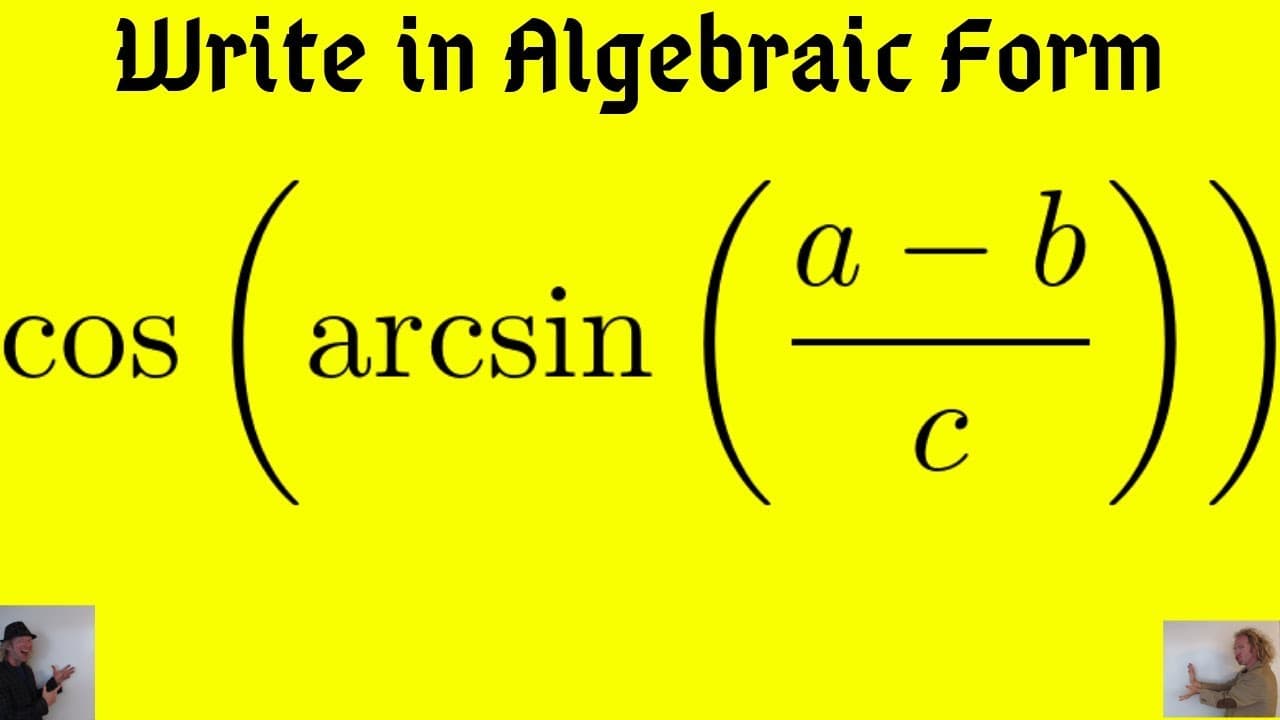
Write cos(arcsin((a-b)/c)) in Algebraic Form
TL;DR
Algebraic solution steps for trigonometry problems involving sine, cosine, and SOHCAHTOA.
Transcript
right in algebraic form solution it's the first step and a problem like this is to call the inside piece theta so we let theta be equal to what's inside so arc sine of a minus B over C the next thing you do is you rewrite this using the regular trig function so the arc sine takes a minus B over C and sends it to theta so that means that the sine of... Read More
Key Insights
- 😑 The initial step involves calling the inside piece theta and rewriting the expression using trigonometric functions.
- 🈸 Drawing a triangle with sides labeled a, b, c aids in the visualization and application of trigonometric concepts.
- 🙃 Utilizing Pythagoras' theorem facilitates the calculation of missing sides in trigonometry problems.
- 🙃 The application of SOHCAHTOA guides the process of determining unknown sides in a triangle.
- 👨💼 The algebraic solution steps demonstrate the systematic approach to solving trigonometry problems involving sine, cosine, and SOHCAHTOA.
- 🙃 Understanding the relationships between the sides of a triangle is essential in applying trigonometric principles.
- 🙃 The final answer is interpreted by relating the sides of the triangle using the appropriate trigonometric functions.
Install to Summarize YouTube Videos and Get Transcripts
Explore YouTube Video Summarizer or Get YouTube Transcript Extractor
Questions & Answers
Q: What is the first step in solving trigonometry problems using algebraic form?
The first step is to identify the inside piece as theta and rewrite the expression using trigonometric functions like sine and cosine to express it in a more manageable form.
Q: How is a triangle used in the algebraic solution of trigonometry problems?
A triangle is drawn where the side opposite to the angle is labeled as 'o', the hypotenuse is 'h', and the remaining side is labeled 'x' to apply SOHCAHTOA and solve for the missing side.
Q: What role does Pythagoras' theorem play in solving trigonometry problems algebraically?
Pythagoras' theorem is applied to relate the sides of the triangle, allowing for the determination of the missing side in trigonometry problems involving sine, cosine, and SOHCAHTOA.
Q: How is the final answer interpreted in the algebraic solution of trigonometry problems?
The final answer is derived by applying SOHCAHTOA to relate the sides of the triangle, ultimately expressing the trigonometric function of the given expression or angle.
Summary & Key Takeaways
-
Identify inside piece as theta and rewrite using trig functions.
-
Draw triangle with sides labeled a, b, c.
-
Apply Pythagoras' theorem to solve for the missing side of the triangle.
Read in Other Languages (beta)
Share This Summary 📚
Summarize YouTube Videos and Get Video Transcripts with 1-Click
Try YouTube Summary with ChatGPT & Claude or YouTube Transcript Generator
Explore More Summaries from The Math Sorcerer 📚


Summarize YouTube Videos and Get Video Transcripts with 1-Click
Try YouTube Summary with ChatGPT & Claude or YouTube Transcript Generator