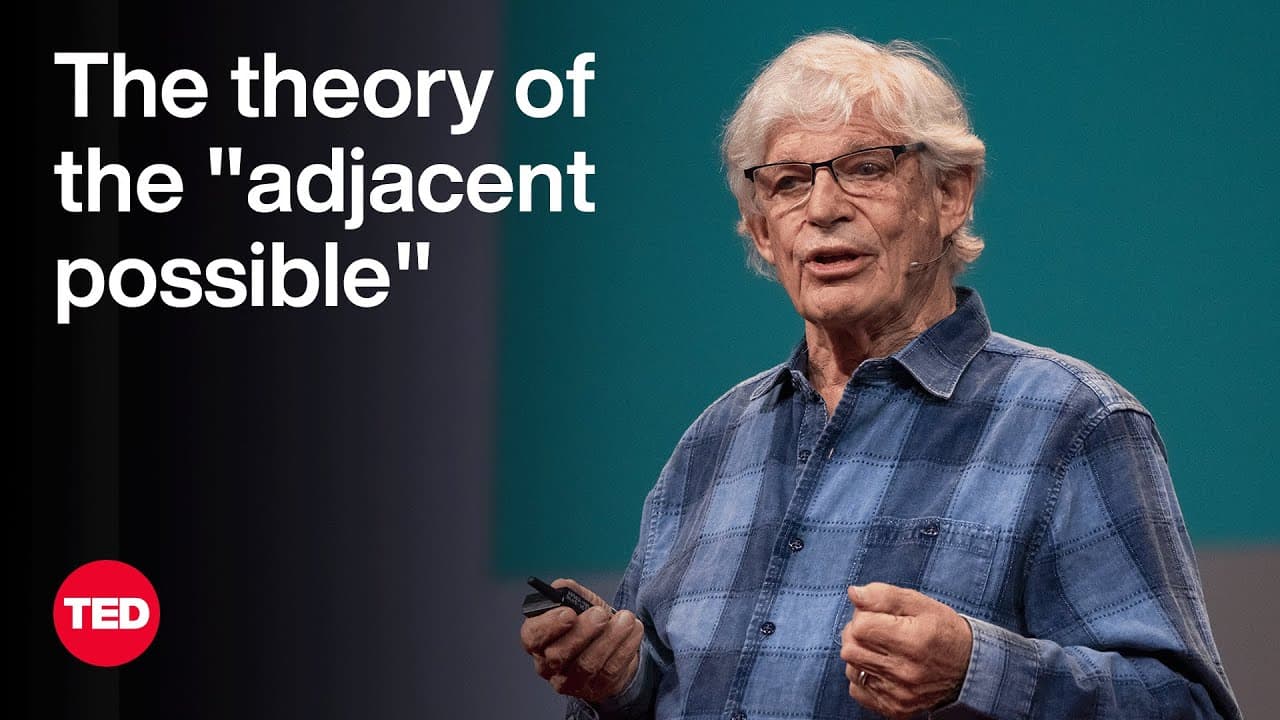
The "Adjacent Possible" – and How It Explains Human Innovation | Stuart Kauffman | TED
TL;DR
This content explores the concept of the biosphere's creative potential, the theory of the adjacent possible, and the importance of finding new solutions for soil problems.
Transcript
foreign years ago heraclitus said the world bubbles forth here's bubbling what is actual now enables what is next possible the adjacent possible the biaser has been bubbling forth for four billion years of creating new possibilities in the universe and that bubbling it's critical that physics cannot talk at all about bubbling new bubbles life on ea... Read More
Key Insights
- 🔬 The evolution of life on Earth has been driven by the "adjacent possible," where new possibilities bubble forth and create new opportunities for growth and development. It is through this process that single-celled organisms have evolved into complex multicellular organisms over billions of years.
- 💡 Jury rigging, or finding new uses for existing things, is a fundamental aspect of innovation in the biosphere. The ability to repurpose objects and combine them in new ways has allowed for the development of new technologies and adaptations.
- 🌱 The biosphere is constantly innovating and creating new possibilities that cannot be deduced through computation or set theory. We are in a phase of scientific transition beyond classical science, including Newtonian physics and quantum mechanics.
- 📈 The theory of the adjacent possible explains how the number of things in an economy or system increases slowly at first, then undergoes a burst of exponential growth. This pattern is observed in the Cambrian explosion and is evident in the growth of human settlements and global GDP.
- 💥 The tap process, based on the idea that things can be combined to create new things, shows that as each new innovation is made, the waiting time for the next innovation is halved. This predicts a future of rapid acceleration and innovation.
- 🌍 The Anthropocene era, characterized by unprecedented human impact on the planet, requires us to find new adjacent possibilities for sustainable solutions. Composting, particularly through the use of Johnson Sioux compost and fungal bacterial communities, presents a potential solution for soil degradation and carbon emissions.
- 🌱 By spreading fungal bacterial communities through coatings on seeds or incorporating them into biochar and fertilizers, we can address soil problems and contribute to a more sustainable future.
- 🔥 It is crucial to recognize our place within nature and work towards finding new adjacent possibilities for solving the challenges we face, rather than simply exploiting the Earth's resources. We must embrace innovation and live in harmony with the biosphere.
Install to Summarize YouTube Videos and Get Transcripts
Explore YouTube Video Summarizer or Get YouTube Transcript Extractor
Questions & Answers
Q: What is the significance of the Cambrian explosion?
The Cambrian explosion, which occurred 540 million years ago, was a period of rapid diversification in which many new species and phyla emerged. This burst of creativity lasted for 50 million years and resulted in the creation of the diverse forms of life that exist today.
Q: How does the theory of the adjacent possible explain the increase in the number of things over time?
The theory of the adjacent possible, or TAP, suggests that new things can be created by combining existing elements. As the number of existing things increases, the number of possible combinations and innovations also increases. This leads to a slow and steady growth in the number of things, followed by a sudden explosion in the number of possibilities and new inventions.
Q: How does the concept of jury-rigging relate to the creativity of the biosphere?
Jury-rigging refers to finding new uses or functions for existing elements. In the biosphere, this process of repurposing and combining causal properties allows for the creation of new possibilities and innovations. For example, dinosaur scales evolved from thermoregulation were jury-rigged into flight feathers, demonstrating the creative nature of the biosphere.
Q: Can we predict what the biosphere will become or what the adjacent possible will bring?
No, we cannot predict what the biosphere will become or what the adjacent possible will bring. The evolving biosphere and the adjacent possibilities it creates are not deducible or computable. Even with the use of set theory mathematics, it is impossible to determine what the biosphere will bring forth in terms of new possibilities and innovations.
Q: How does the theory of the adjacent possible relate to human evolution and innovation?
The theory of the adjacent possible can be observed in human evolution and innovation. Over time, the number of tools and innovations gradually increased but remained relatively stable. However, there are periods of sudden bursts in creativity and the emergence of new complex things, such as the Cambrian explosion and the recent increase in human habitats and GDP. This pattern suggests that human innovation follows the same TAP process as observed in the biosphere.
Q: What is the role of compost and soil in addressing environmental challenges?
Composting and improving soil health can play a crucial role in addressing environmental challenges. Good compost, like the Johnson Sioux compost, can reduce land use, degradation of forests, extinction events, and pandemics. Additionally, using fungal bacterial communities and biochar in fertilizers can help improve soil health and promote sustainable agriculture practices. These solutions have the potential to combat the negative effects of climate change and contribute to a healthier planet.
Q: What is the current state of carbon dioxide emissions and how can it be solved?
Carbon dioxide emissions are a pressing issue, with 40.5 billion tons emitted last year alone. To address this problem, solutions such as spreading Johnson Sioux compost across landscapes, coating seeds with beneficial fungal bacterial communities, distributing biochar, and incorporating fungal bacterial communities into fertilizers can be implemented. These approaches have the potential to reduce carbon emissions and provide solutions to soil-related challenges.
Q: What is the overall message regarding the biosphere and our relationship with nature?
The overall message is that we are part of nature and not above it. The biosphere and the concept of the adjacent possible demonstrate the ever-evolving creativity and innovation in nature. Human innovation follows a similar pattern, and it is essential to recognize our role in stewarding the planet and finding solutions to environmental challenges. By harnessing the power of the biosphere and working with nature, we can create a better future for ourselves and the planet.
Summary & Key Takeaways
-
The evolving biosphere has been bubbling forth for billions of years, creating new possibilities and organisms on Earth.
-
The process of jury rigging and finding new uses for things is fundamental to innovation and the expanding number of things in the world.
-
The theory of the adjacent possible explains the pattern of slow growth followed by bursts of creativity, seen in both evolution and human progress, and offers potential solutions for environmental challenges like soil degradation.
Read in Other Languages (beta)
Share This Summary 📚
Summarize YouTube Videos and Get Video Transcripts with 1-Click
Try YouTube Summary with ChatGPT & Claude or YouTube Transcript Generator
Explore More Summaries from TED 📚
Summarize YouTube Videos and Get Video Transcripts with 1-Click
Try YouTube Summary with ChatGPT & Claude or YouTube Transcript Generator