Power Series - Differentiation and Integration - Calculus 2
TL;DR
Power series can be differentiated and integrated using the power rule, with convergence determined by the radius of convergence.
Transcript
consider the function f of x and let's say that this function is represented by the power series which starts from zero goes to infinity of a sub n times x minus c raised to the n so this particular power series is centered at x equals c now let's go ahead and list out a few terms so when n is 0 we're going to get a sub 0 x minus c to the 0 power t... Read More
Key Insights
- ✊ Power series are represented by a sum of terms with coefficients multiplied by powers of x minus c.
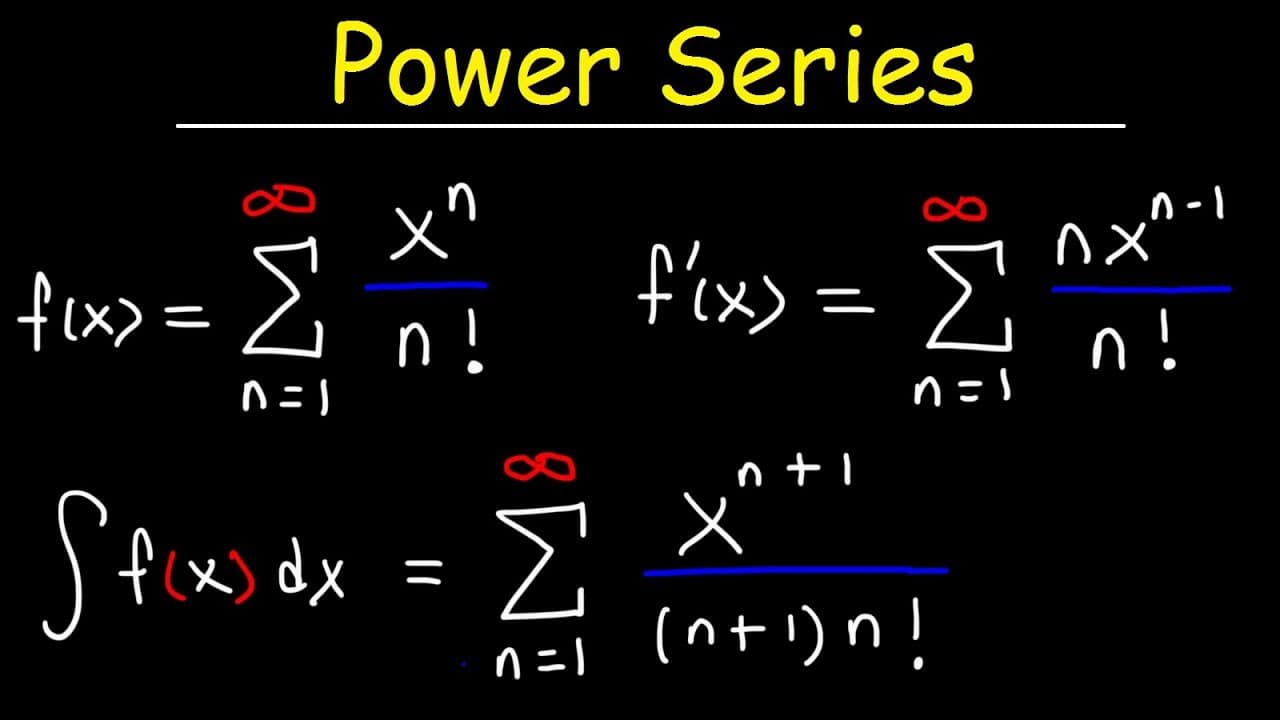
- ✊ Differentiation of a power series involves applying the power rule to each term, resulting in a new series with modified coefficients.
- ✊ Integration of a power series involves applying the power rule for integration to each term, resulting in a new series with modified coefficients.
- 🥳 The interval of convergence for a power series can be determined using the ratio test, and the endpoints should be checked separately for convergence or divergence.
- ☺️ The n values in a power series denote the terms in the series and determine the power of x minus c in each term.
- 🍉 The starting value of n can be 0 or 1, with n=1 generally used for the first non-zero term in the series.
- 🏆 Convergence or divergence of a power series can be determined using the ratio test or other convergence tests, such as the alternating series test or the integral test.
Install to Summarize YouTube Videos and Get Transcripts
Explore YouTube Video Summarizer or Get YouTube Transcript Extractor
Questions & Answers
Q: How can a power series be differentiated?
To differentiate a power series, apply the power rule by multiplying the coefficients by the original exponent and subtracting 1 from the exponent of x minus c. The result is a new power series with the coefficients multiplied by the respective exponents.
Q: How can a power series be integrated?
To integrate a power series, apply the power rule for integration by adding 1 to the exponents, dividing the coefficients by the new exponents, and adding the constant of integration. The result is a new power series with the coefficients divided by the respective exponents.
Q: What is the significance of the n values in a power series?
The n values represent the terms in the series and determine the power of x minus c in each term. Starting with n=0 is optional, as it does not change the resulting series, but n=1 is generally used to represent the first non-zero term.
Q: How is the interval of convergence determined for a power series?
The interval of convergence is determined using the ratio test. The ratio of consecutive terms should be less than 1 for convergence. The endpoints of the interval should be checked separately to see if the series converges or diverges at those points.
Summary & Key Takeaways
-
Power series are represented by the term a sub n times x minus c raised to the n, where n starts from 0 to infinity. The series is centered at x equals c.
-
The derivative of a power series can be found by applying the power rule to each term, resulting in a new power series with the coefficients multiplied by the original exponent.
-
The integral of a power series can be found by applying the power rule for integration to each term, resulting in a new power series with the coefficients divided by the next exponent.
Read in Other Languages (beta)
Share This Summary 📚
Summarize YouTube Videos and Get Video Transcripts with 1-Click
Try YouTube Summary with ChatGPT & Claude or YouTube Transcript Generator
Explore More Summaries from The Organic Chemistry Tutor 📚



Summarize YouTube Videos and Get Video Transcripts with 1-Click
Try YouTube Summary with ChatGPT & Claude or YouTube Transcript Generator