Negative externalities | Consumer and producer surplus | Microeconomics | Khan Academy
TL;DR
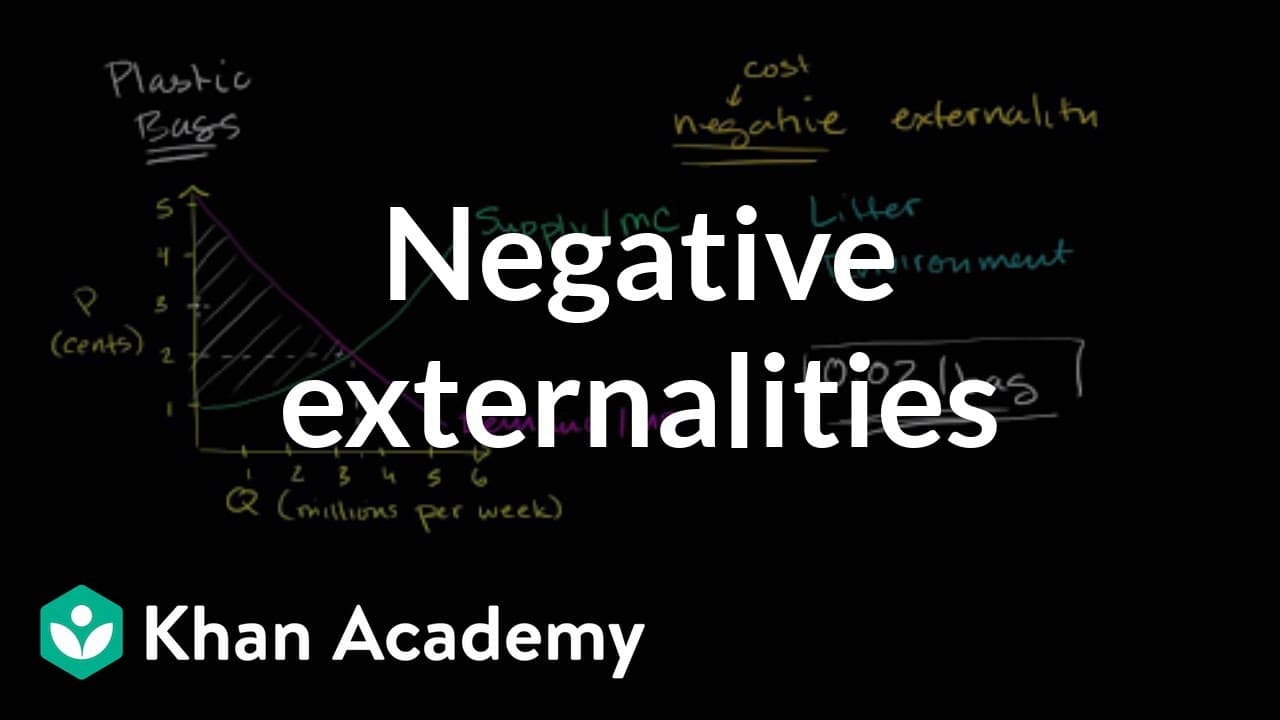
Plastic bags have a negative externality, causing cost to society and the environment beyond the producers' marginal cost.
Transcript
Let's think about the market for plastic bags. And I'm picking this market in particular because there might be some cost associated with plastic bags that aren't captured when you're only looking at it from the point of view of the suppliers or the consumers. So right over here, you have a demand curve. And that's really the demand coming from the... Read More
Key Insights
- 🥖 The demand and supply curves depict the diminishing marginal benefit and increasing marginal cost of plastic bag production.
- 🇨🇷 Plastic bags have a negative externality, imposing costs on society and the environment beyond the producers' marginal cost.
- 🧑🏭 Optimizing the benefits to society requires finding the equilibrium quantity and price that factors in the negative externality.
Install to Summarize YouTube Videos and Get Transcripts
Explore YouTube Video Summarizer or Get YouTube Transcript Extractor
Questions & Answers
Q: How does the demand curve for plastic bags change as more bags are produced?
As more bags are produced, the marginal benefit decreases, resulting in a lower demand curve for plastic bags.
Q: What is the negative externality associated with plastic bags?
The negative externality of plastic bags includes litter, increased environmental risks, and harm to animals, with a cost to society and the environment of $0.02 per bag.
Q: What is the optimal amount of bags to purchase according to the analysis?
The optimal amount of bags to purchase is determined by considering the supplier's marginal cost and society's additional cost, resulting in an equilibrium quantity of approximately 1.8 million bags.
Q: What happens if production exceeds the optimal quantity of bags?
Producing more than the optimal quantity leads to incurring costs that outweigh the benefits, resulting in a negative total benefit to society.
Summary & Key Takeaways
-
Plastic bags create a demand curve, showing the decreasing marginal benefit for supermarkets to produce more bags.
-
The supply curve represents the increasing marginal cost to produce more bags.
-
Plastic bags have a negative externality with a cost of $0.02 per bag, impacting society and the environment.
Read in Other Languages (beta)
Share This Summary 📚
Summarize YouTube Videos and Get Video Transcripts with 1-Click
Try YouTube Summary with ChatGPT & Claude or YouTube Transcript Generator
Explore More Summaries from Khan Academy 📚



Summarize YouTube Videos and Get Video Transcripts with 1-Click
Try YouTube Summary with ChatGPT & Claude or YouTube Transcript Generator