Standard cell potential | Applications of thermodynamics | AP Chemistry | Khan Academy
TL;DR
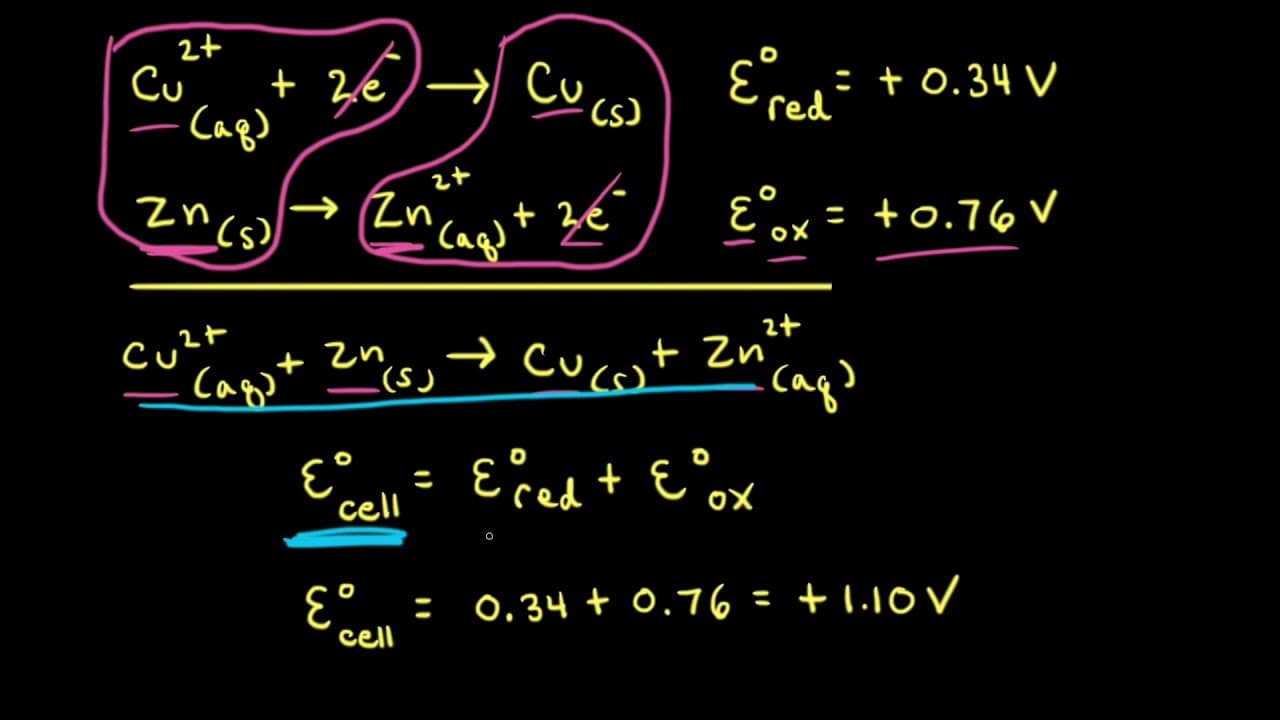
Standard Cell Potential (or Voltage) refers to the voltage of an electrochemical cell when reactants and products are in their standard states, and for a zinc-copper cell, it is equal to 1.10 volts.
Transcript
- [Instructor] Standard Cell Potential, which is also called Standard Cell Voltage, refers to the voltage of an electrochemical cell when reactants and products are in their standard states, at a particular temperature. For a zinc copper galvanic cell, solid zinc reacts with copper two plus ions, to form solid copper, and zinc two plus ions. Standa... Read More
Key Insights
- ⚡ Standard Cell Potential (or Voltage) is a measure of the voltage of an electrochemical cell when the reactants and products are in their standard states.
- 😑 For a zinc-copper galvanic cell, solid zinc reacts with copper two plus ions, resulting in the production of solid copper and zinc two plus ions.
- ⚡ The Standard Cell Potential for a zinc-copper cell is 1.10 volts at 25 degrees Celsius.
- 🪜 Standard Cell Potential can be calculated by adding the Standard Reduction Potentials for the reduction and oxidation half-reactions or by using a shortcut equation.
Install to Summarize YouTube Videos and Get Transcripts
Explore YouTube Video Summarizer or Get YouTube Transcript Extractor
Questions & Answers
Q: What is Standard Cell Potential?
Standard Cell Potential refers to the voltage of an electrochemical cell when the reactants and products are in their standard states at a particular temperature.
Q: How does a zinc-copper galvanic cell work?
In a zinc-copper cell, solid zinc reacts with copper two plus ions, causing oxidation at the zinc electrode and reduction at the copper electrode, resulting in the production of solid copper and zinc two plus ions.
Q: What is the significance of the Standard Cell Potential in a zinc-copper cell?
The Standard Cell Potential in a zinc-copper cell is 1.10 volts at 25 degrees Celsius. It represents the potential difference between the two electrodes and determines the overall voltage of the cell.
Q: How can the Standard Cell Potential be calculated?
The Standard Cell Potential can be calculated by adding the Standard Reduction Potentials of the reduction and oxidation half-reactions together. Alternatively, a shortcut equation can be used by subtracting the Standard Reduction Potential for oxidation from the Standard Reduction Potential for reduction.
Summary & Key Takeaways
-
Standard Cell Potential is the voltage of an electrochemical cell when reactants and products are in their standard states at a specific temperature.
-
In a zinc-copper galvanic cell, solid zinc reacts with copper two plus ions to form solid copper and zinc two plus ions.
-
The Standard Cell Potential for this cell is 1.10 volts at 25 degrees Celsius.
Read in Other Languages (beta)
Share This Summary 📚
Summarize YouTube Videos and Get Video Transcripts with 1-Click
Try YouTube Summary with ChatGPT & Claude or YouTube Transcript Generator
Explore More Summaries from Khan Academy 📚



Summarize YouTube Videos and Get Video Transcripts with 1-Click
Try YouTube Summary with ChatGPT & Claude or YouTube Transcript Generator