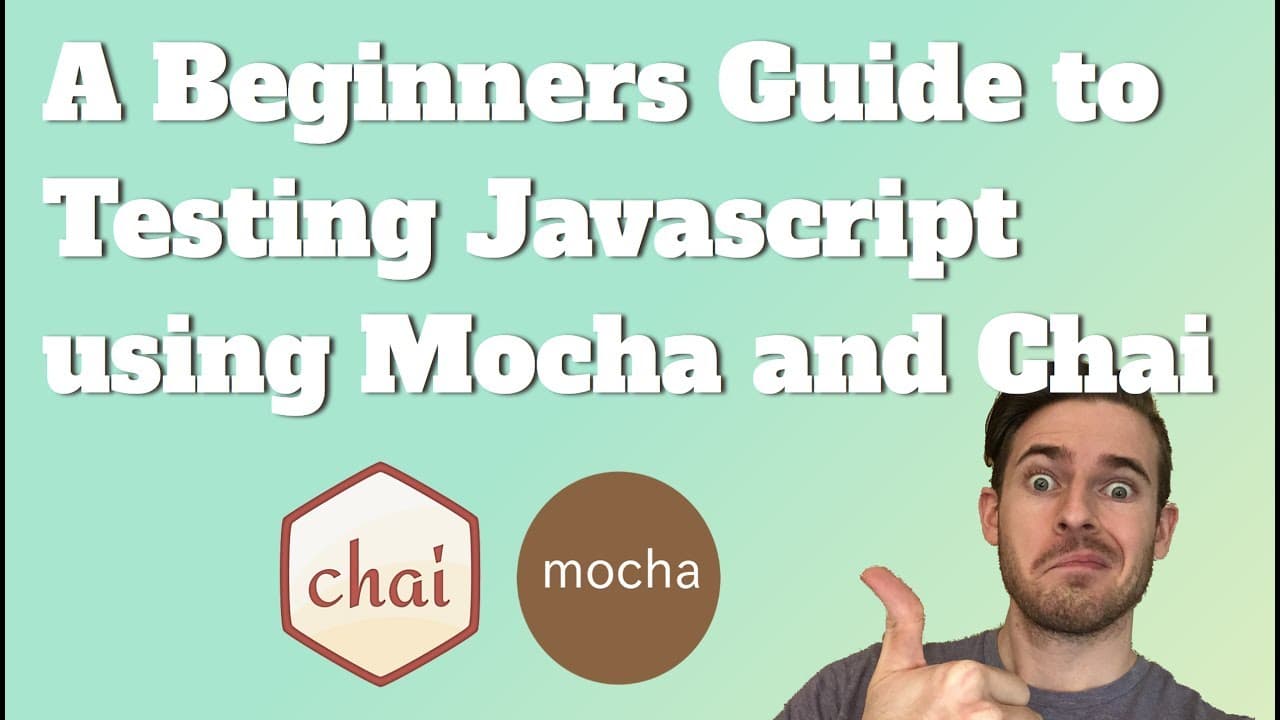
A Beginners Guide to Testing Javascript using Mocha and Chai
TL;DR
This tutorial guides beginners on using Mocha and Chai for JavaScript testing.
Transcript
coders I'm Cody and welcome to a beginner's guide to testing JavaScript using mocha and chai rule so basically just going to write a quick little module you know a simple number list which you can add numbers to it if the sum of the list multiply all the numbers together get the results etc and then test that the module data row is working as inten... Read More
Key Insights
- 💨 Mocha provides a structured way to write tests in JavaScript, making it a popular choice among developers for unit testing.
- 🤑 Chai complements Mocha with a rich set of assertion functions that make the intention of tests clear and human-readable.
- 🏆 Organizing tests into describe and it blocks helps maintain clarity in what is being tested, making it easier to identify issues later.
- 🏆 The concept of test-driven development (TDD) encourages writing tests first, leading to better software design and easier maintenance.
- 😑 Developers can leverage assertion statements in Chai to express expected outcomes in a way that resembles natural language.
- 😫 The tutorial emphasizes setting up an automated testing environment that can be expanded as projects grow in complexity.
- 🕸️ Tools like Karma and Protractor can integrate with Mocha and Chai, offering more comprehensive testing frameworks for modern web applications.
Install to Summarize YouTube Videos and Get Transcripts
Explore YouTube Video Summarizer or Get YouTube Transcript Extractor
Questions & Answers
Q: What are Mocha and Chai used for in JavaScript?
Mocha is a testing framework that allows developers to organize and run tests in JavaScript, while Chai is an assertion library that provides a variety of ways to validate conditions within those tests. Together, they facilitate writing automated tests to ensure code behaves as expected, enhancing reliability in development.
Q: How do you set up the testing environment for Mocha and Chai?
Setting up Mocha and Chai involves creating an HTML file that includes CSS for styling test results and scripts for both Mocha and Chai. You also need to create a global variable for the module under test, set up a designated area for displaying test results, and initiate the test runner to execute the tests.
Q: Can you explain the purpose of describe and it blocks in testing?
The "describe" block is used to group related tests and provide context for them, while the "it" block is where individual test cases are defined. Each "it" block contains a specific expectation or behavior that is being tested, enabling clear organization and readability when reviewing test outcomes.
Q: What is test-driven development (TDD) and how is it applied in this tutorial?
Test-driven development (TDD) is a software development approach where tests are written before the code that implements the desired functionality. In the tutorial, this is exemplified when a failing test is created before adjusting the module code to satisfy the test conditions, ultimately promoting better design and refactoring.
Q: What happens when a test fails in Mocha?
When a test fails in Mocha, it provides feedback indicating the expected outcome versus the actual outcome. This helps developers quickly identify which test did not pass and why. The failure message includes the specific block and expectation that was not met, guiding developers in debugging their code effectively.
Q: How can a developer focus on specific tests or skip tests in Mocha?
Developers can use the "only" method on a test or describe block to run just that particular test or group, simplifying debugging or development. Conversely, by using "skip," they can bypass specific tests without removing them from the code, allowing for selective execution of tests as needed during development.
Q: How does the tutorial suggest extending testing capabilities beyond Mocha and Chai?
The tutorial recommends exploring advanced testing tools like Karma for larger projects and Protractor for end-to-end testing scenarios, which simulate user interactions in a browser. These tools can enhance testing strategies for more complex applications, expanding the developer’s toolkit for ensuring application quality.
Q: What are some of the main methods for manipulating the number list in the example module?
The example module features methods such as "add," which appends numbers to the list; "sumAll," which calculates the total of all numbers; "multiplyAll," which computes the product of all numbers; and "clear," which resets the list by removing all its elements. These methods form the core functionality of the number list module being tested.
Summary & Key Takeaways
-
The tutorial introduces Mocha and Chai as tools for testing JavaScript modules, with a focus on creating a simple number list module.
-
It explains setting up the testing environment, including including the necessary libraries, and structuring test cases with descriptive blocks and assertions.
-
Finally, the tutorial covers advanced features like running specific tests and the suggestion of exploring further testing tools for larger projects.
Read in Other Languages (beta)
Share This Summary 📚
Summarize YouTube Videos and Get Video Transcripts with 1-Click
Try YouTube Summary with ChatGPT & Claude or YouTube Transcript Generator
Explore More Summaries from Web Dev Cody 📚

Summarize YouTube Videos and Get Video Transcripts with 1-Click
Try YouTube Summary with ChatGPT & Claude or YouTube Transcript Generator