Using Trigonometric Identities (IAL P4 3.2)
TL;DR
Explains using trigonometric identities to solve parametric equations.
Transcript
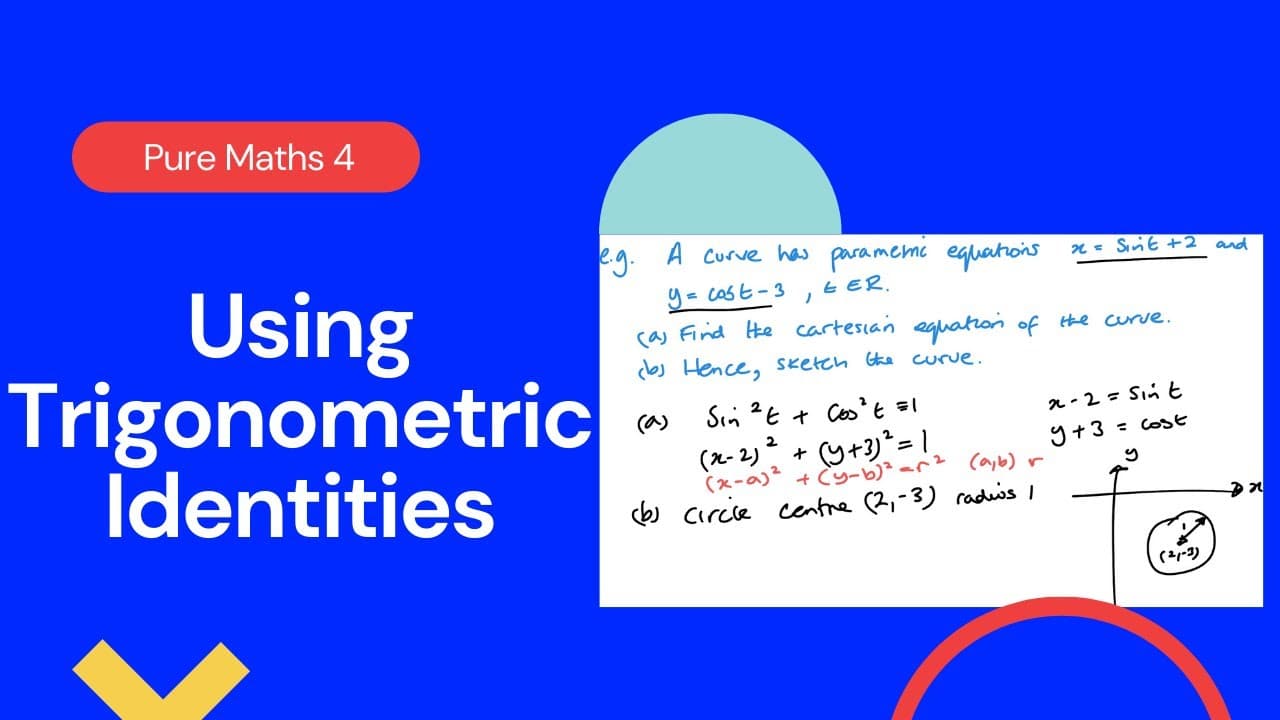
welcome back to p4 today we are looking at using trigonometric identities and this is within our parametric equations okay and it's unit 3.2 now to be able to do this you're going to need to know a few of your identities so you need to know that sine squared plus cos squared equals one you also need to know the variations of this so... Read More
Key Insights
- Understanding trigonometric identities like sine squared plus cosine squared equals one is crucial for solving parametric equations.
- The double angle formulas, such as sine 2θ and cosine 2θ, are essential tools in linking trigonometric equations.
- Parametric equations can be converted into Cartesian equations by substituting expressions for sine and cosine.
- Sketching curves from parametric equations involves identifying the type of curve, such as a circle, and determining its center and radius.
- When dealing with equations involving multiple angles, like 3t, it’s necessary to use double angle formulas for simplification.
- Determining the domain and range of parametric equations requires careful substitution and understanding of trigonometric limits.
- The maximum and minimum values of sine and cosine functions dictate the range of the equation.
- Recognizing the potential for errors in determining boundary values is important for accurate range calculation.
Install to Summarize YouTube Videos and Get Transcripts
Explore YouTube Video Summarizer or Get YouTube Transcript Extractor
Questions & Answers
Q: What is the significance of trigonometric identities in parametric equations?
Trigonometric identities are crucial in parametric equations as they allow for the transformation of these equations into Cartesian forms. By using identities like sine squared plus cosine squared equals one, and double angle formulas, one can simplify and solve parametric equations effectively, facilitating the sketching and analysis of curves.
Q: How can parametric equations be converted into Cartesian equations?
Parametric equations can be converted into Cartesian equations by substituting expressions for sine and cosine. For example, if sine and cosine are expressed in terms of a parameter t, they can be replaced in the identity sine squared plus cosine squared equals one to derive a Cartesian equation. This process often involves algebraic manipulation and application of trigonometric identities.
Q: What role do double angle formulas play in solving parametric equations?
Double angle formulas, such as sine 2θ and cosine 2θ, play a critical role in solving parametric equations involving multiple angles. They provide a means to simplify expressions and link trigonometric functions, which is essential when dealing with equations that cannot be directly transformed using basic identities. These formulas help in reducing complexity and finding relationships between equations.
Q: How is the sketching of curves from parametric equations approached?
Sketching curves from parametric equations involves identifying the type of curve represented by the Cartesian equation derived from the parametric form. For example, recognizing a circle and determining its center and radius is crucial. This requires knowledge of standard equation forms and careful plotting of key points, such as the center and points on the curve, to accurately represent the curve.
Q: Why is determining the domain and range important in parametric equations?
Determining the domain and range of parametric equations is important because it defines the set of possible values for the variables involved. This involves substituting boundary values into the equations and understanding the behavior of trigonometric functions. Accurate domain and range determination ensures the correct representation of the curve and avoids errors in its analysis and sketching.
Q: What challenges arise in dealing with equations involving multiple angles like 3t?
Equations involving multiple angles like 3t present challenges because they require the use of double angle formulas for simplification. These equations are more complex and need careful manipulation to express them in terms of a single trigonometric function. Additionally, determining the correct domain and range becomes more intricate due to the extended period of the trigonometric functions involved.
Q: How do maximum and minimum values of sine and cosine functions affect the range?
The maximum and minimum values of sine and cosine functions directly affect the range of parametric equations. Since sine and cosine oscillate between -1 and 1, these limits dictate the possible values that the parametric equations can take. Understanding these limits is essential to accurately determine the range and ensure that the curve is correctly represented within its boundaries.
Q: What potential errors should be considered when calculating the range?
When calculating the range, potential errors include incorrectly identifying boundary values and not considering the full oscillation of trigonometric functions. It is important to examine the behavior of the function over the entire specified interval and recognize points where maximum or minimum values occur. This ensures that the range is accurately captured and prevents misrepresentation of the curve.
Summary & Key Takeaways
-
This content focuses on using trigonometric identities to solve parametric equations, transforming them into Cartesian forms, and sketching the resultant curves. It highlights the importance of understanding sine and cosine relationships, double angle formulas, and the properties of circles.
-
The explanation includes examples of converting parametric equations into Cartesian equations, identifying the type of curve, and determining its properties like center and radius. The content emphasizes the need for a strong grasp of trigonometric identities and formulas.
-
The discussion covers the complexities of equations involving multiple angles and the importance of correctly identifying domain and range. It underscores the significance of recognizing maximum and minimum values in sine and cosine functions for accurate equation solving.
Read in Other Languages (beta)
Share This Summary 📚
Summarize YouTube Videos and Get Video Transcripts with 1-Click
Try YouTube Summary with ChatGPT & Claude or YouTube Transcript Generator
Explore More Summaries from Maths Deity 📚
Summarize YouTube Videos and Get Video Transcripts with 1-Click
Try YouTube Summary with ChatGPT & Claude or YouTube Transcript Generator