Parametric Equations (Edexcel IAL P4 3.1)
TL;DR
Parametric equations simplify complex graphs by using a third variable.
Transcript
welcome back to p4 today we're looking at parametric equations unit 3.1 now a normal set of a normal equation something in the form of y and x you know any kind of equation whether it's a straight line y equals m x plus c whether it's a quadratic any of these these are called cartesian equations and they are when we have an ... Read More
Key Insights
- Parametric equations use a third parameter to link x and y, making complex graphs easier to understand and manipulate.
- Converting parametric equations to Cartesian form involves eliminating the parameter, often simplifying integration and differentiation.
- The domain of a function in parametric form can relate to the range of another, helping visualize the relationship between variables.
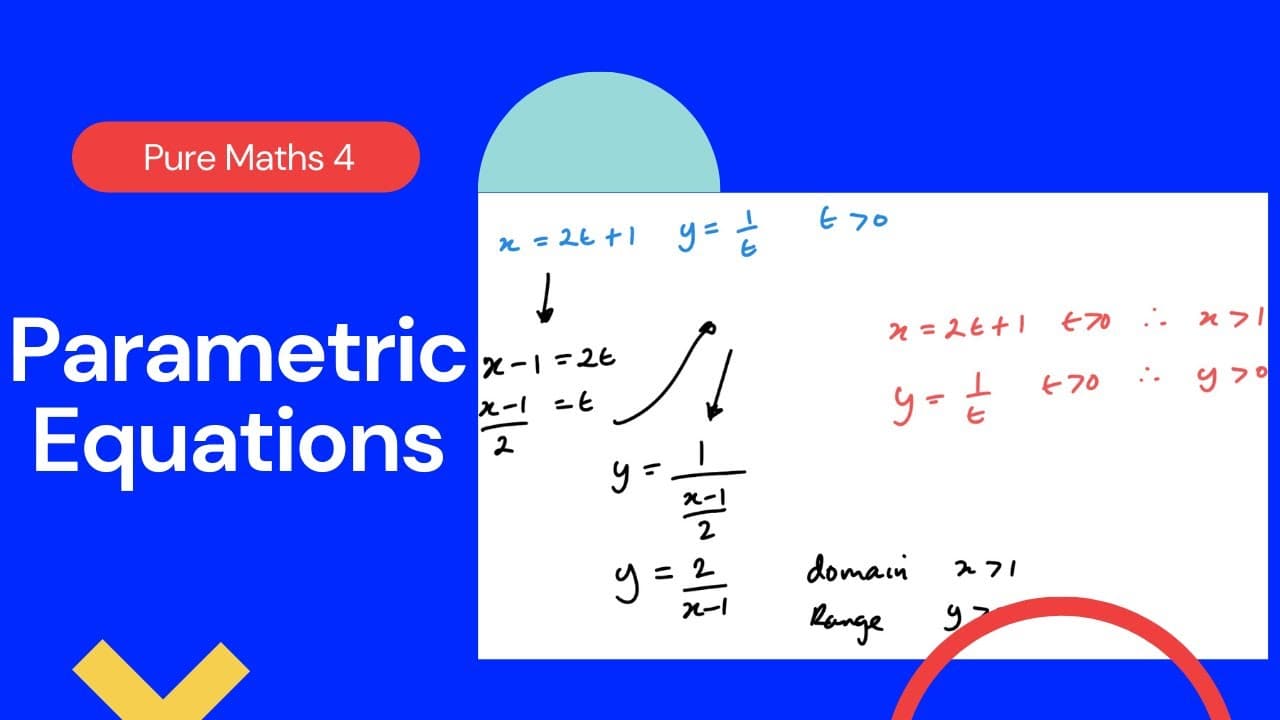
- Converting parametric to Cartesian involves substituting and rearranging equations to eliminate the parameter t.
- Understanding the range and domain of parametric equations is crucial, particularly when determining the limits of x and y values.
- Parametric equations can be used to derive the Cartesian equation of a line, providing a straightforward method to understand linear relationships.
- Calculating the length of line segments in parametric equations involves using Pythagorean theorem, highlighting the geometric interpretation.
- Parametric equations can represent the same Cartesian line differently, showcasing their flexibility in mathematical modeling.
Install to Summarize YouTube Videos and Get Transcripts
Explore YouTube Video Summarizer or Get YouTube Transcript Extractor
Questions & Answers
Q: What are parametric equations?
Parametric equations involve expressing the coordinates of points on a curve as functions of a third variable, known as the parameter. This approach is beneficial for simplifying the representation of complex curves and allows for easier manipulation, such as differentiation and integration, compared to Cartesian equations.
Q: How do you convert parametric equations to Cartesian form?
To convert parametric equations to Cartesian form, you need to eliminate the parameter by expressing one of the variables in terms of the other. This involves rearranging the equations to solve for the parameter and substituting it back into one of the equations, resulting in a single equation in terms of x and y.
Q: Why are parametric equations useful?
Parametric equations are useful because they simplify the representation of complex curves and shapes, making it easier to perform mathematical operations such as differentiation and integration. They provide flexibility in modeling relationships between variables and can represent the same Cartesian line in different forms.
Q: What is the relationship between domain and range in parametric equations?
In parametric equations, the domain of one function can relate to the range of another. This relationship helps visualize how the parameter affects the x and y coordinates, allowing for a better understanding of the graph's behavior and the limits of the variables involved.
Q: How is the length of a line segment calculated in parametric equations?
The length of a line segment in parametric equations is calculated using the Pythagorean theorem. By determining the horizontal and vertical distances between the endpoints of the segment, you can use these values to find the segment's length, providing a geometric interpretation of the parametric representation.
Q: Can parametric equations represent the same Cartesian line differently?
Yes, parametric equations can represent the same Cartesian line in different forms. This flexibility allows for various approaches to modeling and problem-solving, showcasing the versatility of parametric equations in mathematical analysis and applications.
Q: What is the significance of the parameter in parametric equations?
The parameter in parametric equations is significant because it links the x and y coordinates, providing a way to express complex curves and shapes. It allows for a more straightforward representation and manipulation of equations, particularly when dealing with differentiation, integration, and graphing.
Q: How does understanding parametric equations benefit mathematical analysis?
Understanding parametric equations benefits mathematical analysis by offering a simplified method to represent and manipulate complex relationships between variables. It enhances the ability to perform operations like differentiation and integration, and provides flexibility in modeling, making it an invaluable tool in various mathematical contexts.
Summary & Key Takeaways
-
Parametric equations break down complex relationships between variables by introducing a third parameter, simplifying the graphing process. They allow for easier differentiation and integration, making them a powerful tool for mathematical analysis.
-
Converting parametric equations to Cartesian form involves eliminating the parameter t, which simplifies the equations and often makes them easier to work with. This process requires understanding the relationship between the domain and range of the equations.
-
Understanding the domain and range in parametric equations is essential for accurately determining the limits of x and y values. This knowledge is crucial when calculating distances or converting between different forms of equations.
Read in Other Languages (beta)
Share This Summary 📚
Summarize YouTube Videos and Get Video Transcripts with 1-Click
Try YouTube Summary with ChatGPT & Claude or YouTube Transcript Generator
Explore More Summaries from Maths Deity 📚
Summarize YouTube Videos and Get Video Transcripts with 1-Click
Try YouTube Summary with ChatGPT & Claude or YouTube Transcript Generator