Differentiating polynomials | Derivative rules | AP Calculus AB | Khan Academy
TL;DR
This video explains the power rule and other derivative properties that allow for the calculation of derivatives of polynomials.
Transcript
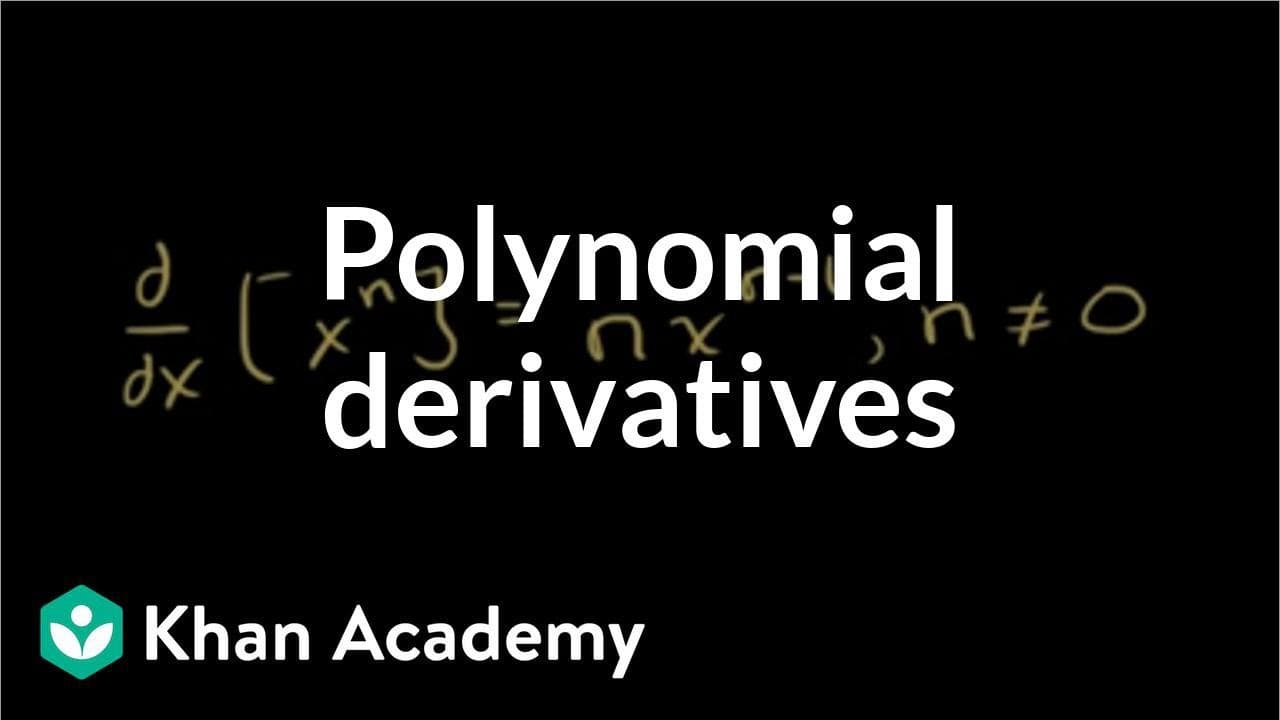
Now that we know the power rule, and we saw that in the last video, that the derivative with respect to x, of x to the n, is going to be equal to n times x to the n minus 1 for n not equal 0. I thought I would expose you to a few more rules or concepts or properties of derivatives that essentially will allow us to take the derivative of any polynom... Read More
Key Insights
- ☺️ The derivative of x to the n power is equal to n times x to the n minus 1, for n not equal to 0.
- ❓ The derivative of a constant is always 0.
- ✖️ The derivative of a constant multiplied by a function can be found by taking the derivative of the function and multiplying it by the constant.
- 🍹 The derivative of the sum of two functions is equal to the sum of the derivatives of the individual functions.
Install to Summarize YouTube Videos and Get Transcripts
Explore YouTube Video Summarizer or Get YouTube Transcript Extractor
Questions & Answers
Q: Why is the derivative of x to the 0 power equal to 1?
The derivative of x to the 0 power is equal to the derivative of 1, which is a constant. The derivative of any constant is 0. Therefore, the derivative of x to the 0 power is 0.
Q: What is the derivative of a constant?
The derivative of any constant is always 0. This is because the derivative measures the rate of change, and a constant does not change with respect to the independent variable.
Q: How do you find the derivative of a constant multiplied by a function?
To find the derivative of a constant multiplied by a function, you can take the derivative of the function and then multiply it by the constant. This can be expressed as A times f'(x) or A times the derivative of f(x) with respect to x.
Q: What is the derivative of the sum of two functions?
The derivative of the sum of two functions is equal to the sum of the derivatives of the individual functions. This property allows us to simplify the process of finding the derivative of a polynomial by taking the derivatives of each term separately and adding them together.
Summary & Key Takeaways
-
The video introduces the derivative of x to the n power, which is equal to n times x to the n minus 1, for n not equal to 0.
-
It discusses the derivative of a constant, which is always equal to 0.
-
The video explains the derivative of a constant times a function, where the constant can be factored out of the derivative.
-
It covers the derivative of the sum of two functions, which is equal to the sum of the derivatives of the individual functions.
Read in Other Languages (beta)
Share This Summary 📚
Summarize YouTube Videos and Get Video Transcripts with 1-Click
Try YouTube Summary with ChatGPT & Claude or YouTube Transcript Generator
Explore More Summaries from Khan Academy 📚



Summarize YouTube Videos and Get Video Transcripts with 1-Click
Try YouTube Summary with ChatGPT & Claude or YouTube Transcript Generator