Limit of a Definite Integral Involving the Inverse Hyperbolic Sine Function
TL;DR
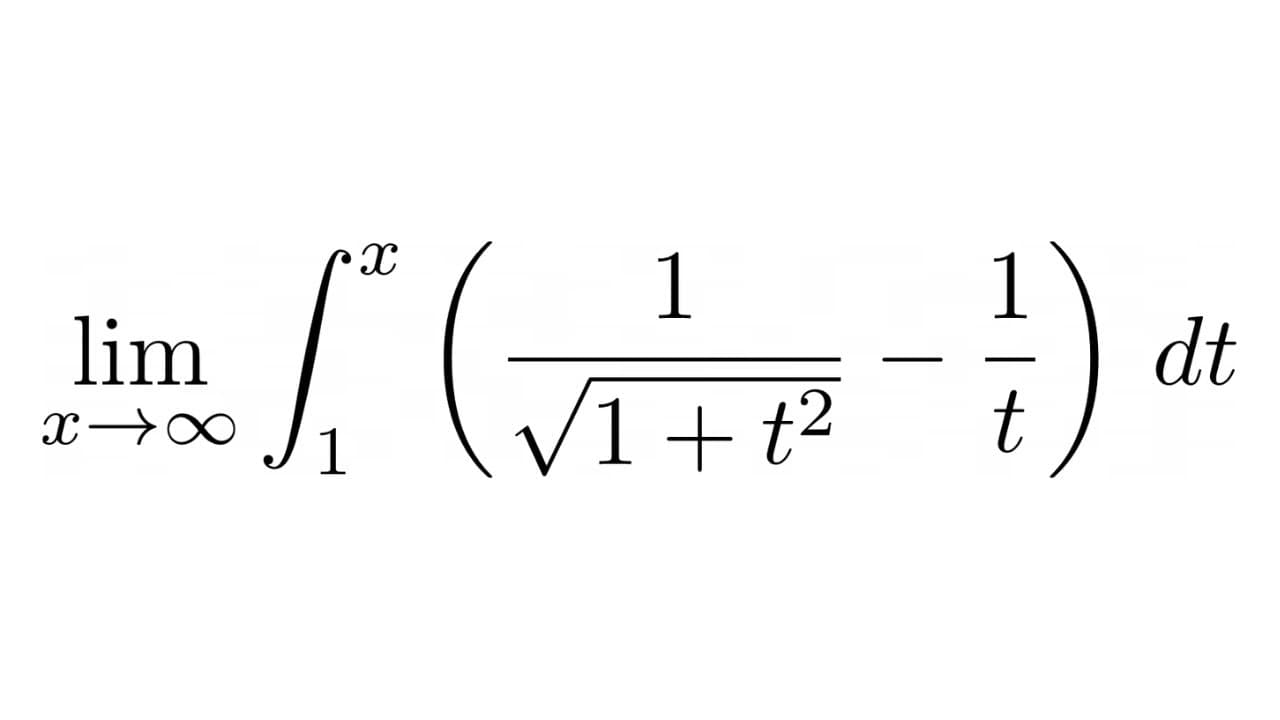
Calculate the limit as x approaches infinity of a definite integral, resulting in the natural log of 2 over 1 plus the square root of 2.
Transcript
in this problem we have to find the limit as x approaches infinity of the definite integral from 1 to x of this expression here let's go ahead and work through it so this is the limit as x approaches infinity and let's go ahead and integrate this so this first integral here is a formula it's going to become the inverse hyperbolic sine of t it's jus... Read More
Key Insights
- 👨💼 Utilize the inverse hyperbolic sine function to simplify the definite integral calculation.
- 😑 Apply the properties of logarithms to simplify the expression and find the final answer.
- 😑 Consider the behavior of the expression for large values of x to determine the limiting value accurately.
Install to Summarize YouTube Videos and Get Transcripts
Explore YouTube Video Summarizer or Get YouTube Transcript Extractor
Questions & Answers
Q: How do you calculate the limit as x approaches infinity of a definite integral?
To calculate this limit, first find the definite integral of the function, then use the properties of logarithms and evaluate for large values of x.
Q: What is the significance of the inverse hyperbolic sine function in this calculation?
The inverse hyperbolic sine function helps simplify the integral expression and leads to the final result involving natural logarithms and a square root term.
Q: How do properties of logarithms factor into finding the limit of the definite integral?
The properties of logarithms allow for simplification of the expression, ultimately leading to the final answer of the natural log of 2 over 1 plus the square root of 2.
Q: Why is it important to consider the behavior of the expression for large values of x in this calculation?
Understanding how the expression behaves for large x values helps in determining the limiting value and simplifying the final result effectively.
Summary & Key Takeaways
-
Calculate the limit as x approaches infinity of a definite integral using the inverse hyperbolic sine function and natural logarithms.
-
Apply the properties of logarithms to simplify the expression and evaluate for large values of x.
-
The final answer is the natural log of 2 over 1 plus the square root of 2.
Read in Other Languages (beta)
Share This Summary 📚
Summarize YouTube Videos and Get Video Transcripts with 1-Click
Try YouTube Summary with ChatGPT & Claude or YouTube Transcript Generator
Explore More Summaries from The Math Sorcerer 📚




Summarize YouTube Videos and Get Video Transcripts with 1-Click
Try YouTube Summary with ChatGPT & Claude or YouTube Transcript Generator