Why Are Pipelines Buried Underground and How Are They Stabilized?
TL;DR
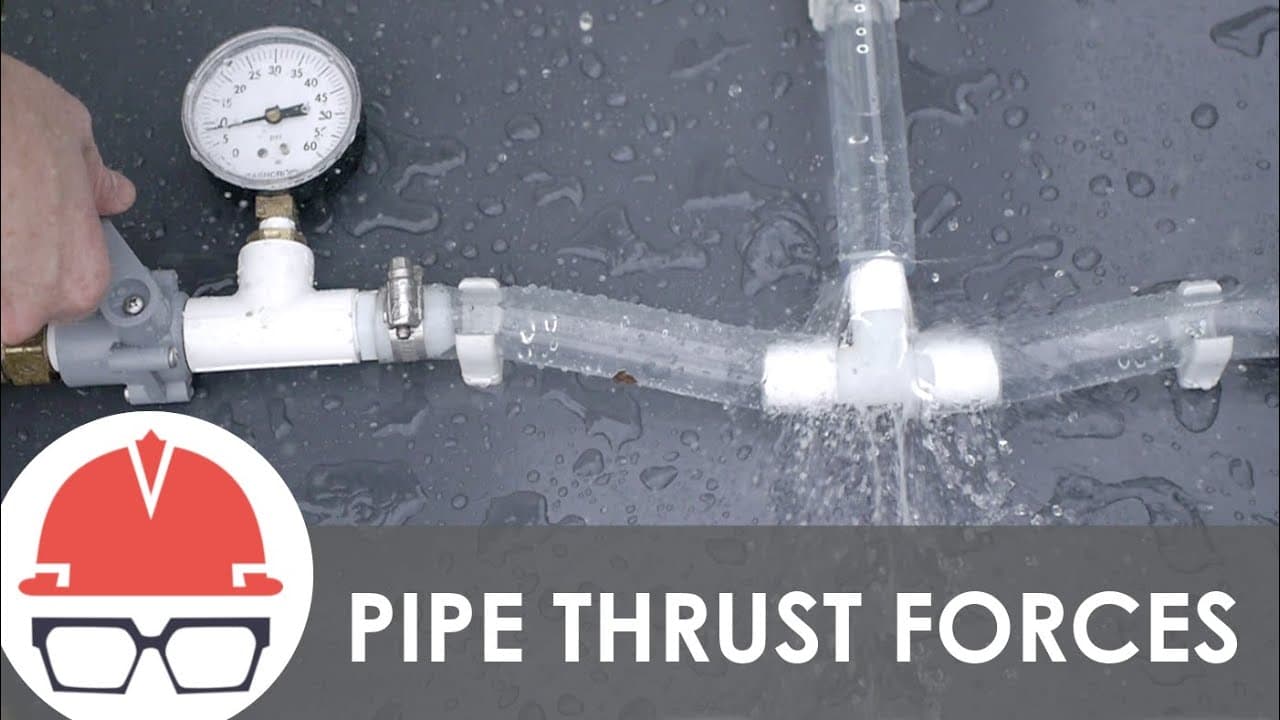
Pipelines are buried to protect them and minimize disruption, but they require careful design to mitigate thrust forces from internal pressure. Engineers use thrust blocks, which distribute these forces to the surrounding soil, and longitudinal restraint fittings to prevent movement. Proper stabilization is crucial to prevent leakages and costly repairs.
Transcript
We use pipes to carry all kinds of fluids. Pretty much anyone can tell you how they work. You put a liquid or a gas in one side and it comes out the other. But, designing pipe systems is not always as simple as it seems. Pipes don’t float in the air on their own; they have to be held in some way. We often bury pipes to protect them and keep them ou... Read More
Key Insights
- Pipelines are not just simple conduits for fluids; their design must account for significant forces, especially in large systems.
- Hydrostatic forces in pipelines are due to fluid pressure within the pipe, acting in all directions and requiring proper restraint.
- Hydrodynamic forces occur when fluid is in motion, adding complexity to pipeline design and requiring additional considerations.
- Push-on fittings are commonly used in municipal pipelines due to their cost-effectiveness and ease of installation, despite not providing longitudinal restraint.
- Thrust blocks, made of concrete, are traditional solutions to manage thrust forces by distributing them over a larger area against the soil.
- Modern solutions include longitudinal restraint fittings, which, although more expensive, offer significant benefits over traditional thrust blocks.
- Engineers must decide on appropriate restraint systems based on the specific conditions and requirements of each pipeline project.
- The demonstration of water rockets provides an analogy for understanding thrust forces, illustrating how pressure and momentum contribute to propulsion.
Install to Summarize YouTube Videos and Get Transcripts
Explore YouTube Video Summarizer or Get YouTube Transcript Extractor
Questions & Answers
Q: What are the two main types of forces in pipelines?
The two main types of forces in pipelines are hydrostatic and hydrodynamic forces. Hydrostatic forces arise from the pressure within the pipe, acting in all directions, while hydrodynamic forces occur when the fluid is in motion. Both types of forces must be managed to ensure the stability and integrity of the pipeline system.
Q: Why are push-on fittings commonly used in municipal pipelines?
Push-on fittings are commonly used in municipal pipelines because they are cost-effective, reliable, and easy to install. These fittings use gaskets and tight tolerances to achieve a watertight seal, which speeds up construction time. However, they do not provide longitudinal restraint, requiring additional measures to prevent pipe movement under pressure.
Q: How do thrust blocks help manage forces in pipelines?
Thrust blocks help manage forces in pipelines by distributing thrust forces over a larger area against the soil. They are masses of concrete placed at strategic points like bends, tees, or reductions to counteract the forces that could cause the pipeline to move or separate. This traditional method ensures the pipeline remains stable under pressure.
Q: What are the advantages of using longitudinal restraint fittings?
Longitudinal restraint fittings, although more expensive than traditional thrust blocks, offer several advantages. They provide direct restraint at the joints, reducing the need for bulky concrete blocks. This makes them more suitable for areas with limited space or where other subsurface utilities are present. They facilitate easier excavation and repair of pipelines when necessary.
Q: How do water rockets illustrate thrust forces in pipelines?
Water rockets illustrate thrust forces in pipelines by demonstrating how pressure and momentum contribute to propulsion. The video uses water rockets to show how the thrust equation, derived from Newton's second law, applies to both rockets and pipelines. This analogy helps viewers understand the dynamics of thrust forces and the importance of proper pipeline design.
Q: What role do engineers play in pipeline design?
Engineers play a crucial role in pipeline design by ensuring that pipelines are stable and functional under various forces. They must consider factors like hydrostatic and hydrodynamic forces, soil conditions, and the type of fittings used. Engineers decide on appropriate restraint systems, whether thrust blocks or restraint fittings, to prevent pipeline movement and ensure long-term reliability.
Q: Why is it important to manage thrust forces in pipelines?
Managing thrust forces in pipelines is important to prevent movement, separation of joints, and potential leakage. Unmanaged thrust forces can lead to significant maintenance challenges, service disruptions, and increased costs. Proper design and restraint systems ensure that pipelines remain stable, reducing the risk of failure and the need for costly repairs.
Q: What are the challenges of using soil for pipeline restraint?
Using soil for pipeline restraint presents challenges because soil is not inherently strong. It may not provide adequate resistance against hydrostatic and hydrodynamic forces, leading to joint separation and leakage. Engineers must often rely on additional measures like thrust blocks or restraint fittings to ensure the pipeline remains securely in place, especially under high-pressure conditions.
Summary & Key Takeaways
-
Pipelines require careful design to manage hydrostatic and hydrodynamic forces, ensuring they remain stable and functional. Engineers use various methods, including thrust blocks and longitudinal restraint fittings, to counteract these forces.
-
Push-on fittings are popular in municipal settings due to their ease of installation, but they require additional measures like thrust blocks or restraint fittings to prevent pipe movement under pressure.
-
The video uses water rockets as an analogy to explain thrust forces in pipelines, illustrating how pressure and momentum contribute to force dynamics and the importance of proper design.
Read in Other Languages (beta)
Share This Summary 📚
Summarize YouTube Videos and Get Video Transcripts with 1-Click
Try YouTube Summary with ChatGPT & Claude or YouTube Transcript Generator
Explore More Summaries from Practical Engineering 📚


Summarize YouTube Videos and Get Video Transcripts with 1-Click
Try YouTube Summary with ChatGPT & Claude or YouTube Transcript Generator