Introduction to discrete probability distributions
TL;DR
This video introduces random variables and probability distributions, specifically focusing on a discrete random variable derived from a coin flip.
Transcript
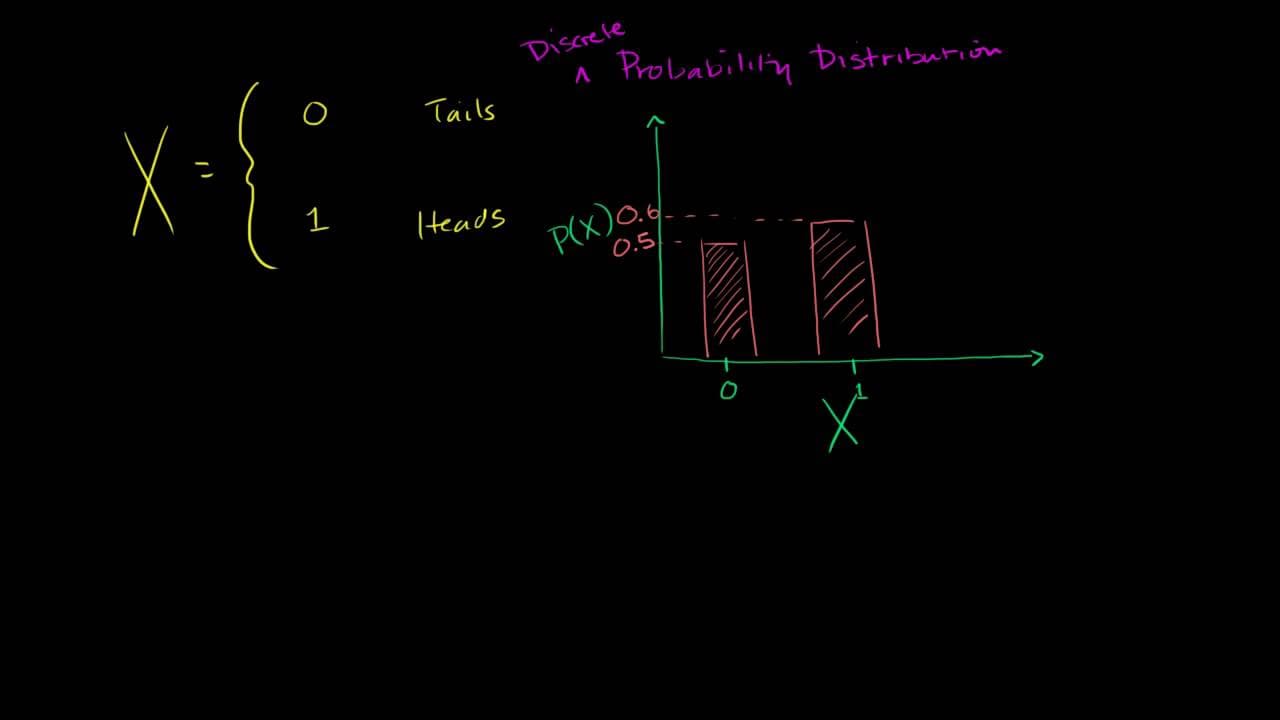
we've already spent some time looking at random variables and defining random variables in different ways and the one that I keep alluding to may be because it's one of the simplest definitions of a random variable is one that's derived from a coin flip maps the outcomes of a coin flip to some numbers to a random variable and so we could say that t... Read More
Key Insights
- 💨 Random variables are a way to assign numbers to the outcomes of a random experiment.
- 💁 Probability distributions provide information about the likelihood of different outcomes for a random variable.
- ❓ A discrete random variable has distinct and countable outcomes.
- 🍹 A probability distribution should assign probabilities to all possible outcomes that sum up to 1.
- 📊 Probability distributions can be visually represented using histograms or bar charts.
- ❓ The chances of obtaining different outcomes for a random variable can be determined by analyzing the probability distribution.
- 💁 The given coin flip example initially had an incorrect probability distribution but was corrected to form a legitimate distribution.
Install to Summarize YouTube Videos and Get Transcripts
Explore YouTube Video Summarizer or Get YouTube Transcript Extractor
Questions & Answers
Q: What is a random variable and how is it defined using a coin flip?
A random variable is a way to assign numbers to the outcomes of a random experiment. In this case, a coin flip is used to derive a random variable, where heads is assigned a value of 1 and tails is assigned a value of 0.
Q: What does a probability distribution tell us about a random variable?
A probability distribution provides information about the likelihood of each possible outcome of a random variable. It assigns probabilities to each outcome, helping us understand the chances of obtaining different values.
Q: Is the given probability distribution for the coin flip example legitimate?
Initially, the probability distribution in the video incorrectly added up to 1.1, indicating a mistake. However, after correction, the updated probability distribution (0.4 for 0 and 0.6 for 1) is legitimate since the probabilities now add up to 1.
Q: Based on the random variable, is the given coin more likely to result in heads or tails?
The random variable suggests that the coin used in the example is slightly weighted towards heads. This is because the variable is defined as 1 when the coin lands on heads, indicating a higher probability for obtaining heads.
Summary & Key Takeaways
-
The video explains the concept of random variables and how a coin flip can be used to define a simple random variable.
-
It emphasizes the importance of a probability distribution in determining the likelihood of different outcomes for the random variable.
-
The video presents a visual representation of a discrete probability distribution for the random variable based on a given coin flip scenario.
Read in Other Languages (beta)
Share This Summary 📚
Summarize YouTube Videos and Get Video Transcripts with 1-Click
Try YouTube Summary with ChatGPT & Claude or YouTube Transcript Generator
Explore More Summaries from Khan Academy 📚



Summarize YouTube Videos and Get Video Transcripts with 1-Click
Try YouTube Summary with ChatGPT & Claude or YouTube Transcript Generator