Brian Dettmer: Old books reborn as intricate art
TL;DR
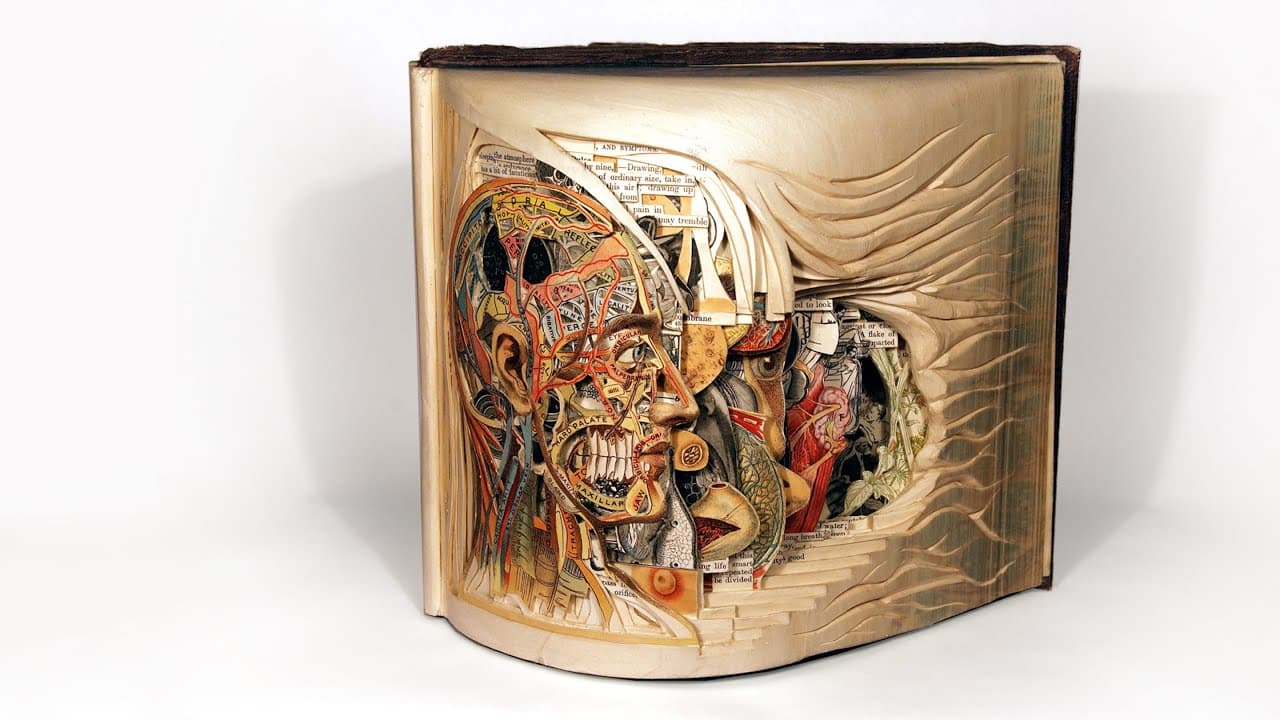
In this introduction, the artist discusses their unique book-cutting technique and explores the concept of books as living, evolving entities.
Transcript
I'm an artist and I cut books. This is one of my first book works. It's called "Alternate Route to Knowledge." I wanted to create a stack of books so that somebody could come into the gallery and think they're just looking at a regular stack of books, but then as they got closer they would see this rough hole carved into it, and wonder what was hap... Read More
Key Insights
- 📚 Books as art: The artist creates sculptures out of books by carving into them, revealing the potential for books to be more than just objects of knowledge.
- 💡 Remixing materials: The artist sees their work as a remix, like a DJ working with someone else's music, transforming traditional works into contemporary ones.
- 🗝️ Pushing the boundaries: The artist pushes the linear format of books, using clamps, ropes, and other materials to create sculptural forms, breaking the traditional structure of books.
- 🔪 Carving as excavation: The artist sees their work as an archaeology, excavating and maximizing the potential of the book's content, resulting in a piece that the viewer completes themselves.
- 💻 Digital vs. physical: The artist acknowledges the dominance of intangible information and the constant need for digital updates but emphasizes the enduring value and potential evolution of the physical book.
- 🎨 Evolution of books: Just as photography and printmaking allowed painting to evolve into different branches, digital technology allows books to become something new, suggesting an exciting future for the format.
- ⚖️ Books as body, technology, tool: The artist sees books as living things, a body that relates to our own bodies, as well as a technology, tool, and machine.
- 🌄 Books as landscapes: Through their choice of images and the tactile nature of the material, the artist transforms books into representations of landscapes, pushing the visual and sensory experience of reading.
Install to Summarize YouTube Videos and Get Transcripts
Explore YouTube Video Summarizer or Get YouTube Transcript Extractor
Questions & Answers
Q: What inspired the artist to create "Alternate Route to Knowledge"?
The artist wanted to create a stack of books that appeared ordinary at first glance but revealed a rough hole carved into them upon closer inspection. This was done to make viewers wonder about the purpose and significance of the carved hole, as well as ponder the materiality of books.
Q: How does the artist transform books into artworks?
The artist seals the edges of a book with a thick varnish, creating a solid exterior while leaving the pages inside loose. Then, without adding or moving anything, the artist carves into the surface of the book, creating a sculpture around the existing text and images.
Q: How does the artist describe their approach to working with books?
The artist compares their work to a remix, similar to how a DJ might work with someone else's music. By remixing, carving, and transforming existing books, the artist aims to make them more contemporary and breathe new life into them.
Q: What does the artist think about books as living things?
The artist believes that books are seen as living things because they are created to relate to our bodies in terms of scale. Additionally, books have the potential to grow and evolve into new forms. The artist considers books to be alive, both as a body and a technology, with the ability to become something new.
Q: How does the artist approach the concept of landscapes in their artwork?
The artist creates sculptures using connected and sanded encyclopedias, specifically choosing images of landscapes to carve into. The material itself, along with the imagery, suggests a landscape. By considering both text and images in a similar way, the artist invites viewers to complete the pieces themselves, creating a yin-yang relationship between language and imagery.
Q: What does the artist reflect on regarding the future of books in the digital age?
The artist acknowledges that the format of books might not be ideal for nonlinear information, leading to shifts and changes. However, the artist believes that books will not die but rather evolve, just like painting did when photography and printmaking emerged. This evolution allows the book to take on new forms and tell its own story, making it an exciting time for artists and the future of books.
Summary & Key Takeaways
-
The artist creates book sculptures by carving into them, leaving the pages loose and adding a varnish to the edges.
-
The artist sees their work as a remix, using someone else's material (books) to create something new and contemporary.
-
The artist believes that books are alive and have the potential to become new things, and that the shift towards digital technology is allowing the book to evolve into something new.
Read in Other Languages (beta)
Share This Summary 📚
Summarize YouTube Videos and Get Video Transcripts with 1-Click
Try YouTube Summary with ChatGPT & Claude or YouTube Transcript Generator
Explore More Summaries from TED 📚

Summarize YouTube Videos and Get Video Transcripts with 1-Click
Try YouTube Summary with ChatGPT & Claude or YouTube Transcript Generator