Faraday's Law for generating electricity | Physics | Khan Academy
TL;DR
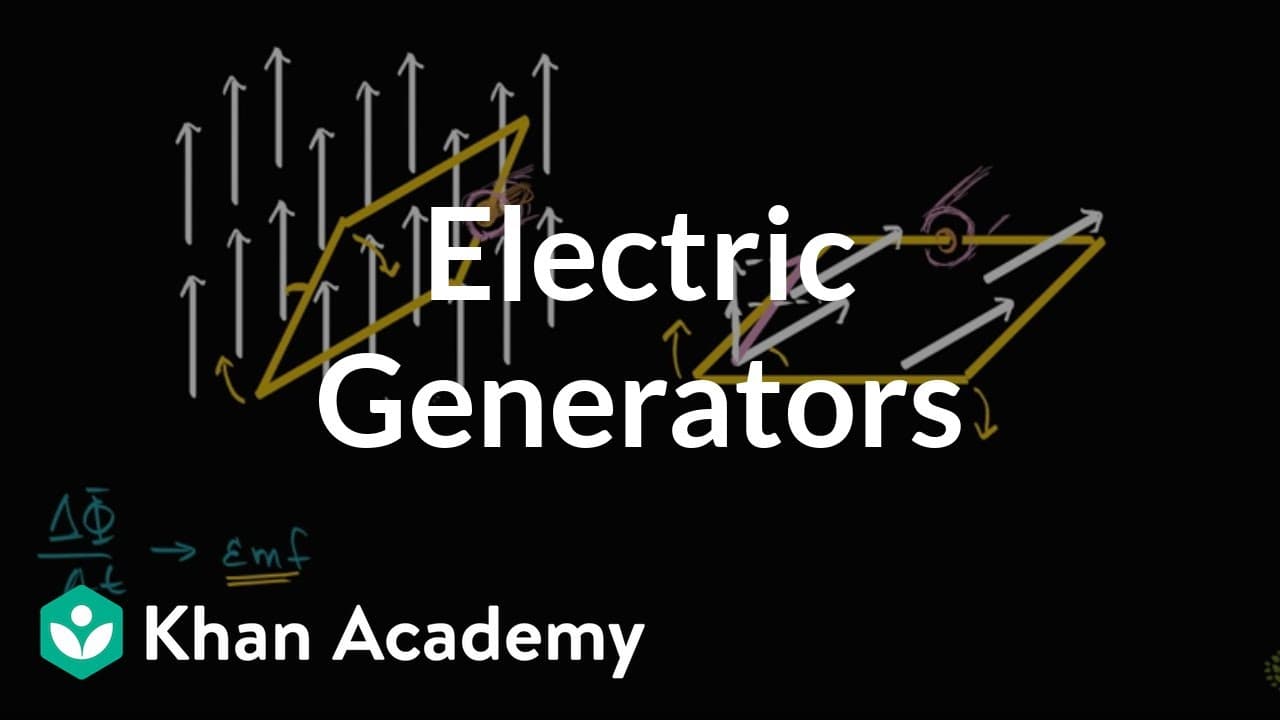
The video explains how rotating a loop of wire in a magnetic field can induce a current, highlighting the principle behind electric generators.
Transcript
- [Voiceover] We're already looked at Faraday's law in some detail. It showed us that if we have some loop of conductor and we have a change in magnetic flux over time through the surface defined by that loop, it's going to induce an EMF through that loop which will cause a current to start to circulate through that loop and that current, of course... Read More
Key Insights
- 💱 Faraday's Law states that a change in magnetic flux induces an EMF and a current.
- 💱 Inducing a change in magnetic flux can be achieved through changing the magnetic field, changing the shape of the conductor loop, or changing the orientation of the loop.
- 🏑 Rotating a loop of wire in a uniform magnetic field results in a changing orientation, inducing an increase in flux and generating a current.
- 💦 Electric generators utilize the principle of induction by converting mechanical rotation, such as wind or flowing water, into electrical energy.
Install to Summarize YouTube Videos and Get Transcripts
Explore YouTube Video Summarizer or Get YouTube Transcript Extractor
Questions & Answers
Q: How does Faraday's Law relate to the generation of electricity?
Faraday's Law states that a change in magnetic flux through a loop of conductor induces an EMF and a current, which is the fundamental principle behind the generation of electricity in devices like electric generators.
Q: What are the different ways to induce a change in magnetic flux?
The main ways to induce a change in magnetic flux are changing the magnetic field, changing the shape of the conductor loop, and changing the orientation of the loop.
Q: How does rotating a loop of wire in a magnetic field induce a current?
When a loop of wire is rotated in a uniform magnetic field, the changing orientation of the loop leads to an increase in the component of the magnetic field perpendicular to the surface, causing an increase in flux and inducing an EMF, which in turn generates a current.
Q: How do electric generators work?
Electric generators work based on Faraday's Law, where mechanical rotation is used to induce a current. In an electric generator, a mechanical force, such as wind or flowing water, rotates an axle, which induces a current through the same principle demonstrated in the video.
Summary & Key Takeaways
-
Faraday's law states that a change in magnetic flux through a loop of conductor induces an electromotive force (EMF) and a current in the loop.
-
Various ways to induce a change in magnetic flux include changing the magnetic field, changing the shape of the conductor loop, and changing the orientation of the loop.
-
When a loop of wire is rotated in a uniform magnetic field, the changing orientation of the loop induces a current, demonstrating how mechanical rotation can generate electricity.
Read in Other Languages (beta)
Share This Summary 📚
Summarize YouTube Videos and Get Video Transcripts with 1-Click
Try YouTube Summary with ChatGPT & Claude or YouTube Transcript Generator
Explore More Summaries from Khan Academy 📚



Summarize YouTube Videos and Get Video Transcripts with 1-Click
Try YouTube Summary with ChatGPT & Claude or YouTube Transcript Generator