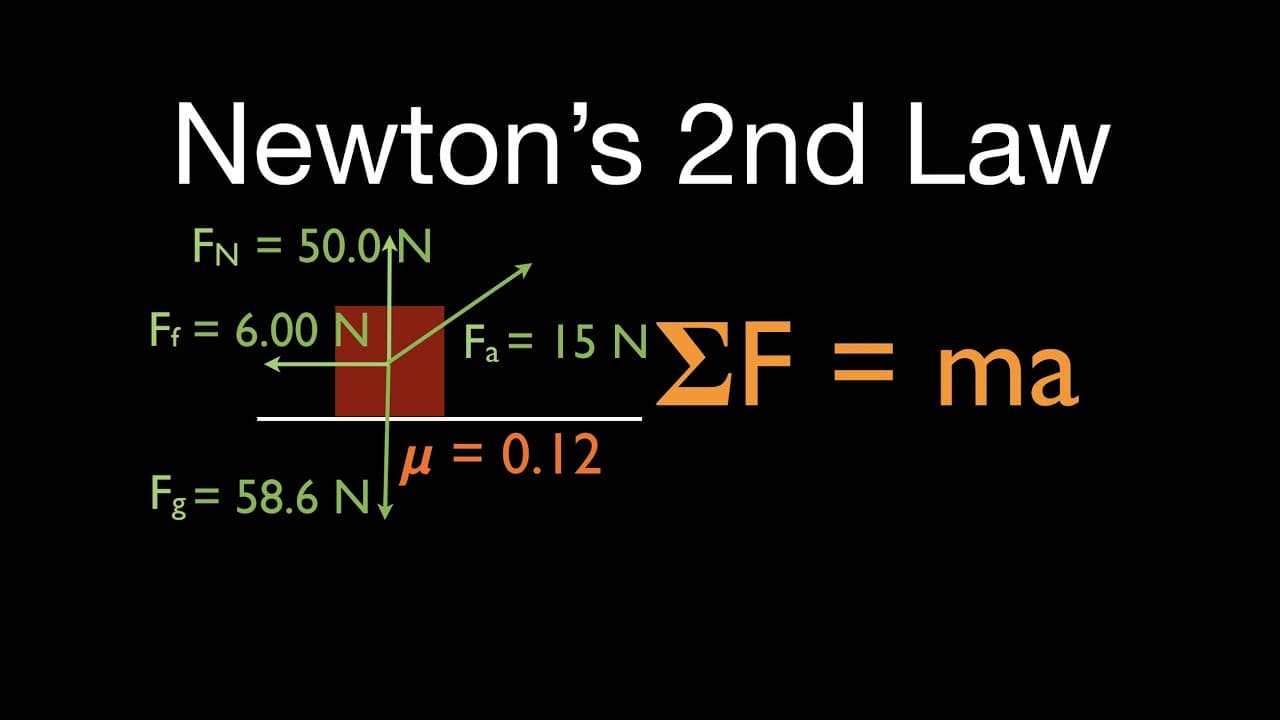
Newton's 2nd Law (4 of 21) Calculate Acceleration with Friction, Net Force Above the Horizontal
TL;DR
Calculate object acceleration with Newton's 2nd law considering friction and applied force at an angle.
Transcript
okay in today's video I'm going to go over how to use Newton's second law to calculate the acceleration of an object and there is friction between the object and the surface and there is a force that is applied to the object and that force is applied at an angle above the horizon okay so here's the description that probably or right would force a P... Read More
Key Insights
- 👮 Newton's second law is crucial for calculating acceleration in systems with various forces.
- 🦻 Breaking down forces into components aids in accurate force calculations.
- ❓ Understanding the interplay of forces like normal force and friction is vital for physics problem-solving.
- ❓ Trigonometry is utilized to determine force components in different directions.
- ❓ Coefficient of friction affects the magnitude of the frictional force in a system.
- 🥺 Systematic approach to calculating forces leads to finding acceleration of an object.
- ❓ Labeling and understanding all forces in a system is essential for resolving physics problems.
Install to Summarize YouTube Videos and Get Transcripts
Explore YouTube Video Summarizer or Get YouTube Transcript Extractor
Questions & Answers
Q: How do you calculate the normal force in a system with an applied force at an angle?
The normal force can be calculated by summing forces in the Y direction, knowing that it equals the weight minus the Y component of the applied force.
Q: Why is it important to break down the applied force into X and Y components?
Breaking down the applied force into components helps in accurately calculating the normal force, friction force, and ultimately the acceleration in the X direction.
Q: What role does the coefficient of friction play in the calculation of the friction force?
The coefficient of friction is multiplied by the normal force to calculate the friction force, showcasing the resistance opposing the object's motion.
Q: How does understanding the forces acting on an object help in determining its acceleration?
By analyzing all forces, including gravitational, applied force components, and friction, one can accurately find the acceleration of the object in the X direction.
Summary & Key Takeaways
-
Demonstrates using Newton's second law to calculate acceleration with friction and applied force.
-
Breaks down applied force into X and Y components for accurate calculations.
-
Calculates normal force, friction force, and ultimately finds object acceleration in the X direction.
Read in Other Languages (beta)
Share This Summary 📚
Summarize YouTube Videos and Get Video Transcripts with 1-Click
Try YouTube Summary with ChatGPT & Claude or YouTube Transcript Generator
Explore More Summaries from Step by Step Science 📚


Summarize YouTube Videos and Get Video Transcripts with 1-Click
Try YouTube Summary with ChatGPT & Claude or YouTube Transcript Generator