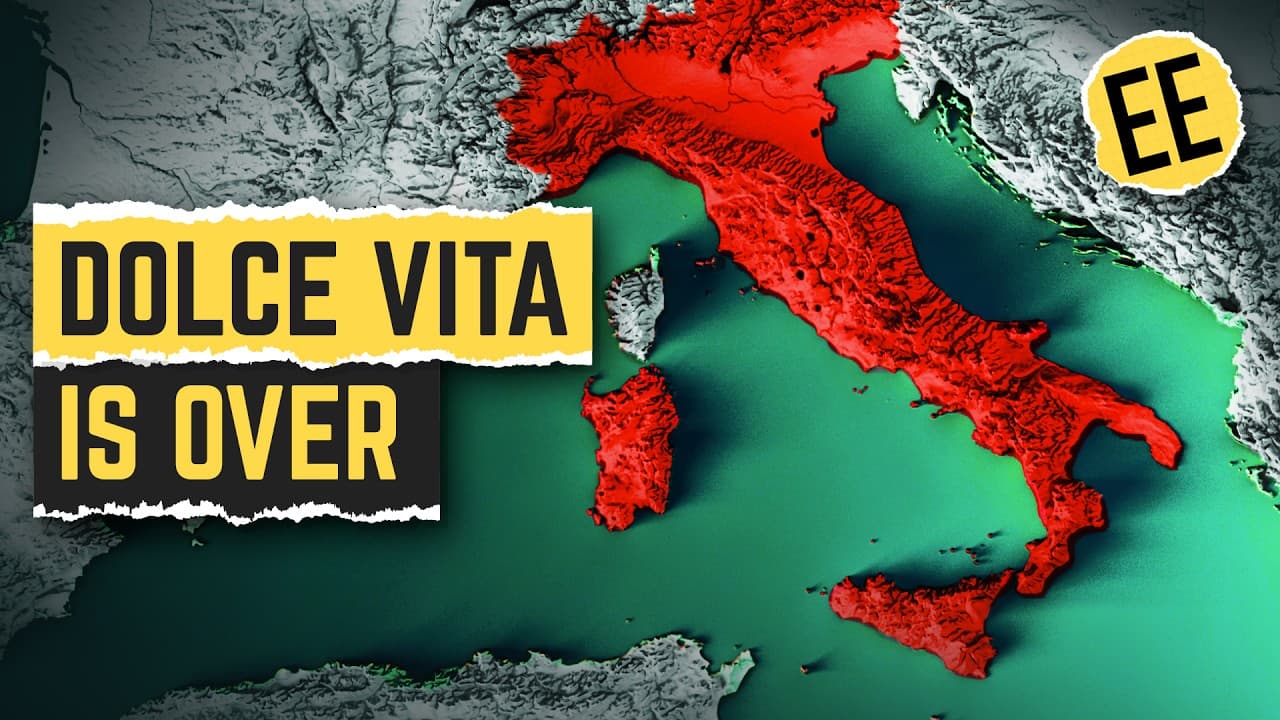
Something Terrible Is Happening in Italy
TL;DR
Italy faces economic stagnation due to multiple systemic issues.
Transcript
Italy is one of the most fascinating economies in the world because it is facing most if not all the major economic challenges that other countries around the world are experiencing, but it is somehow dealing with them all at the same time. Italy has some of the highest levels of national debt in the world, it has an aging population, an exodus of ... Read More
Key Insights
- Italy is grappling with high national debt, an aging population, and a brain drain of young skilled workers, contributing to economic stagnation.
- The country's economic history is marked by cycles of rapid growth followed by stagnation, influenced by both internal policies and external economic conditions.
- Despite its challenges, Italy remains a major player in the European Union, contributing significantly to the region's economic output.
- The black market plays a substantial role in Italy's economy, accounting for a significant portion of its GDP, which complicates taxation and regulation efforts.
- Italy's small businesses struggle with productivity and technological adoption, making them less competitive on a global scale.
- The country's membership in the EU facilitates the movement of skilled workers to other countries, exacerbating the issue of brain drain.
- Economic policies in Italy have historically swung between expansionary and restrictive, impacting growth and stability.
- Italy's geographic advantages have historically supported its economic development, but current systemic issues pose significant challenges to future growth.
Install to Summarize YouTube Videos and Get Transcripts
Explore YouTube Video Summarizer or Get YouTube Transcript Extractor
Questions & Answers
Q: What are the main economic challenges Italy is facing?
Italy is facing several economic challenges, including high national debt, an aging population, and a significant brain drain of young skilled workers. Additionally, the country struggles with regional inequality, sluggish growth, and unreliable tax revenues. These issues have contributed to a prolonged period of economic stagnation.
Q: How has Italy's economic history influenced its current situation?
Italy's economic history is characterized by cycles of rapid growth followed by stagnation. These cycles have been influenced by both internal policies and external economic conditions. The country's past reliance on debt-fueled growth and subsequent need for austerity measures have contributed to its current economic challenges.
Q: What role does the black market play in Italy's economy?
The black market plays a significant role in Italy's economy, accounting for a substantial portion of its GDP. This complicates taxation and regulation efforts, as many businesses operate in grey markets to avoid taxes and regulations. The black market's size reflects broader issues of economic informality and inefficiency.
Q: How does Italy's membership in the EU affect its economy?
Italy's membership in the EU facilitates the free movement of goods, services, and people, which has both positive and negative effects. While it attracts foreign investment and workers, it also exacerbates the brain drain issue, as skilled Italian workers move to other EU countries for better opportunities.
Q: What are the challenges faced by Italy's small businesses?
Italy's small businesses face challenges in productivity and technological adoption, making them less competitive on a global scale. The average size of Italian businesses is smaller compared to other European countries, limiting their ability to achieve economies of scale and invest in specialized tools and technologies.
Q: What historical factors have contributed to Italy's current economic stagnation?
Historical factors contributing to Italy's current economic stagnation include past cycles of debt-fueled growth followed by austerity measures, political tensions, and reliance on traditional industries. These factors have led to structural issues such as high debt, low productivity, and an aging workforce, which continue to impact the economy.
Q: How has Italy's geographic position influenced its economy?
Italy's geographic position, with mountainous protection in the north and access to the Mediterranean Sea, has historically supported its economic development through trade and industry. However, current systemic issues, such as high debt and low productivity, pose significant challenges to leveraging these geographic advantages for future growth.
Q: What potential solutions exist for Italy's economic challenges?
Potential solutions for Italy's economic challenges include implementing policies to attract and retain skilled workers, investing in technology and innovation, and addressing regional inequalities. Additionally, improving tax compliance and reducing reliance on the black market could help stabilize the economy and promote sustainable growth.
Summary & Key Takeaways
-
Italy's economy is in a state of stagnation, facing challenges such as high national debt, an aging population, and brain drain. Despite these issues, Italy remains a significant economic force in the European Union.
-
Historically, Italy has experienced cycles of rapid economic growth followed by stagnation, influenced by both domestic policies and global economic conditions. The country's economic output is also impacted by a substantial black market.
-
Italy's small businesses face challenges in productivity and technological adoption, making them less competitive internationally. The country's membership in the EU further exacerbates the brain drain issue, as skilled workers move to other countries.
Read in Other Languages (beta)
Share This Summary 📚
Summarize YouTube Videos and Get Video Transcripts with 1-Click
Try YouTube Summary with ChatGPT & Claude or YouTube Transcript Generator
Explore More Summaries from Economics Explained 📚





Summarize YouTube Videos and Get Video Transcripts with 1-Click
Try YouTube Summary with ChatGPT & Claude or YouTube Transcript Generator