How ELECTRICITY works - working principle

TL;DR
This video explains the fundamental concepts of electricity, such as atoms, electrons, conductors, insulators, voltage, current, resistance, transformers, capacitors, and the difference between alternating current (AC) and direct current (DC).
Transcript
Hey there, guys, Paul here from theengineeringmindset.com. In this video, we are going to be looking at how electricity works. Now, this is pretty essential knowledge for any engineering, so we'll run through the basic parts of what you need to know. So let's start at the very basics and for that, we need to take a look at the atom. Everything, inc... Read More
Key Insights
- 🫀 Atoms are the building blocks of everything, and they consist of a nucleus and orbital shells.
- 👻 Conductors allow the flow of electrons, while insulators prevent it.
- ⚡ Voltage, current, and resistance are fundamental concepts in electricity.
- ⚡ Transformers can increase or decrease voltage in a circuit.
- 🙂 Resistors restrict the flow of electrons to protect components or create light and heat.
- 🏪 Capacitors store electrons temporarily in an electric field.
Install to Summarize YouTube Videos and Get Transcripts
Explore YouTube Video Summarizer or Get YouTube Transcript Extractor
Questions & Answers
Q: What are the three main particles found in an atom, and where are they located?
An atom consists of protons and neutrons (located inside the nucleus) and electrons (located outside the nucleus).
Q: What determines if a material is a conductor or an insulator?
Conductors have loosely bound electrons that can flow between atoms, while insulators do not have free electrons and cannot pass electrons between atoms.
Q: How does voltage affect the flow of electrons in a circuit?
Voltage is the pushing force that allows electrons to move in a circuit. The higher the voltage, the more electrons can flow.
Q: How is resistance determined in a circuit?
The resistance in a circuit depends on the material, length, and thickness of the wire. It also changes with temperature.
Q: What is the purpose of a resistor in an electrical circuit?
Resistors are used to purposefully restrict the flow of electrons in a circuit, protecting other components or creating light and heat.
Q: How does a transformer work?
A transformer consists of primary and secondary coils that induce a voltage in the secondary coil, which forces the flow of electrons if the circuit is closed.
Q: What is the function of a capacitor in an electric circuit?
A capacitor stores a build-up of electrons within an electric field, providing a power source for a short period of time when the power supply is cut.
Q: What is the difference between alternating current (AC) and direct current (DC)?
AC continuously reverses the direction of current flow, while DC flows in only one direction. AC is commonly used in power sockets, while DC is provided by batteries.
Key Insights:
- Atoms are the building blocks of everything, and they consist of a nucleus and orbital shells.
- Conductors allow the flow of electrons, while insulators prevent it.
- Voltage, current, and resistance are fundamental concepts in electricity.
- Transformers can increase or decrease voltage in a circuit.
- Resistors restrict the flow of electrons to protect components or create light and heat.
- Capacitors store electrons temporarily in an electric field.
- AC and DC are two types of current electricity, with different applications.
Summary & Key Takeaways
-
Everything is made of atoms, which consist of a nucleus (with protons and neutrons) and orbital shells (with electrons).
-
Conductors allow electrons to flow, while insulators do not. Combining them safely allows the use of electricity.
-
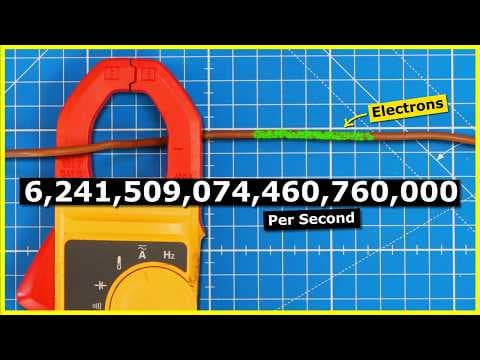
Voltage is the pushing force of electrons, current is the flow of electrons, and resistance restricts the flow of electrons in a circuit.
Read in Other Languages (beta)
Share This Summary 📚
Summarize YouTube Videos and Get Video Transcripts with 1-Click
Try YouTube Summary with ChatGPT & Claude or YouTube Transcript Generator
Explore More Summaries from The Engineering Mindset 📚
Summarize YouTube Videos and Get Video Transcripts with 1-Click
Try YouTube Summary with ChatGPT & Claude or YouTube Transcript Generator