Modeling annual temperature variation with trigonometry | Trigonometry | Khan Academy
TL;DR
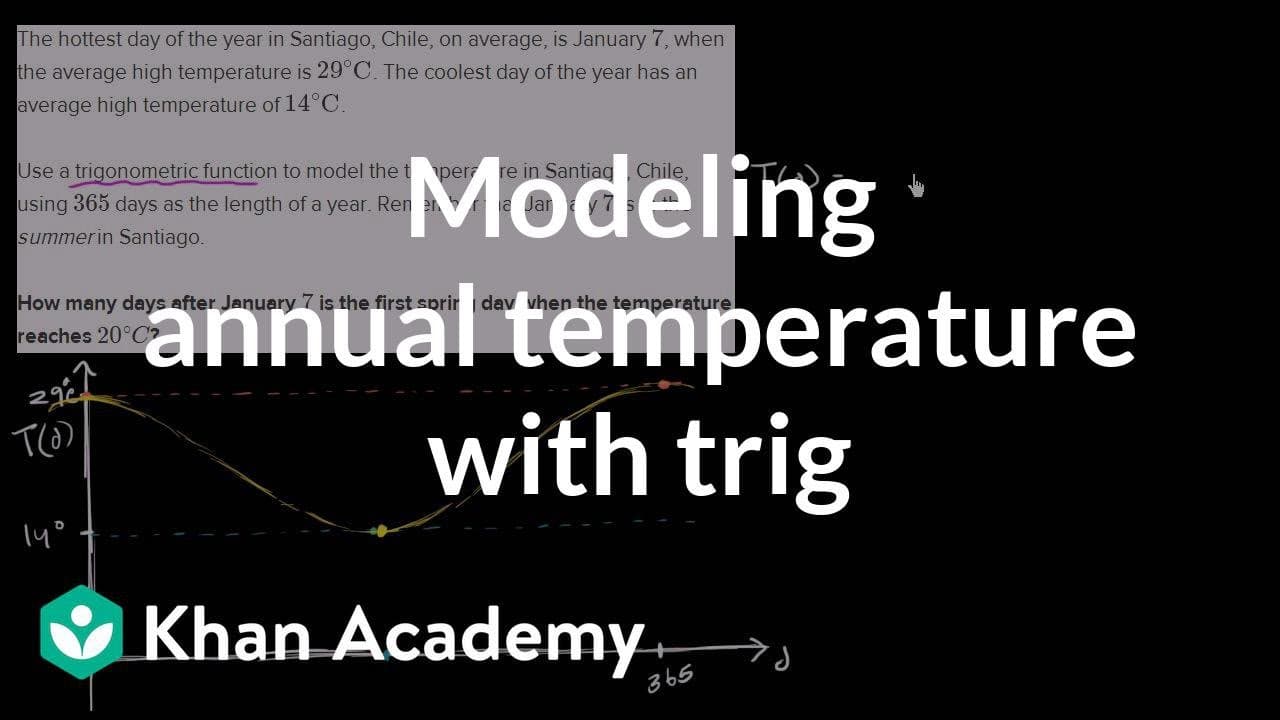
Use a trigonometric function to model the temperature in Santiago, Chile and determine how many days after January seventh is the first spring day when the temperature reaches 20 degrees Celsius.
Transcript
Voiceover:The hottest day of the year in Santiago, Chile on average, is January seventh, when the average high temperature is 29 degrees Celsius. The coolest day of the year has an average high temperature of 14 degrees Celsius. Use a trigonometric function to model the temperature in Santiago, Chile, using 365 days as the length of a year. Remembe... Read More
Key Insights
- 💄 The temperature in Santiago, Chile exhibits cyclical variations throughout the year, making a trigonometric function an appropriate model.
- ❓ The amplitude of the trigonometric function represents the maximum deviation from the average temperature.
- ❓ The midline of the trigonometric function represents the average temperature.
- 🥳 The argument of the trigonometric function is dependent on the number of days after January seventh.
- 😒 The use of a cosine function rather than a sine function is based on the starting point aligning with the maximum temperature on January seventh.
- 🌸 Determining the first spring day with a temperature of 20 degrees Celsius helps identify the transition from winter to spring.
- 🧑🏭 The model can be refined by considering other factors such as daily temperature fluctuations and trends over multiple years.
Install to Summarize YouTube Videos and Get Transcripts
Explore YouTube Video Summarizer or Get YouTube Transcript Extractor
Questions & Answers
Q: Why is a trigonometric function a good model for temperature variations in Santiago, Chile?
Trigonometric functions are cyclical, just like the seasonal variations in temperature throughout the year. This makes them a suitable choice for modeling the temperature in Santiago, Chile.
Q: How can the temperature in Santiago, Chile be modeled using a trigonometric function?
The temperature can be modeled using a cosine function with an amplitude that represents the maximum deviation from the midline, a midline that represents the average temperature, and an argument that depends on the number of days after January seventh.
Q: What is the purpose of determining the first spring day when the temperature reaches 20 degrees Celsius?
Determining the first spring day with a temperature of 20 degrees Celsius helps identify the onset of spring in Santiago, Chile. It provides insight into the timing of seasonal changes in temperature.
Q: Why is the cosine function chosen instead of the sine function?
The cosine function is chosen because it starts at the maximum point, which aligns with the highest average temperature on January seventh. The sine function starts at zero, which would require an additional shift.
Summary & Key Takeaways
-
The video explains how to model the temperature in Santiago, Chile using a trigonometric function with days after January seventh as the input.
-
Temperature variations throughout the year can be represented by a cyclical trigonometric function.
-
Using a cosine function, the temperature can be modeled with an amplitude, a midline, and an argument dependent on the number of days.
Read in Other Languages (beta)
Share This Summary 📚
Summarize YouTube Videos and Get Video Transcripts with 1-Click
Try YouTube Summary with ChatGPT & Claude or YouTube Transcript Generator
Explore More Summaries from Khan Academy 📚



Summarize YouTube Videos and Get Video Transcripts with 1-Click
Try YouTube Summary with ChatGPT & Claude or YouTube Transcript Generator