Series estimation with integrals | Series | AP Calculus BC | Khan Academy
TL;DR
Learn how to estimate the range of convergence for an infinite series by splitting it into a finite sum and an infinite sum.
Transcript
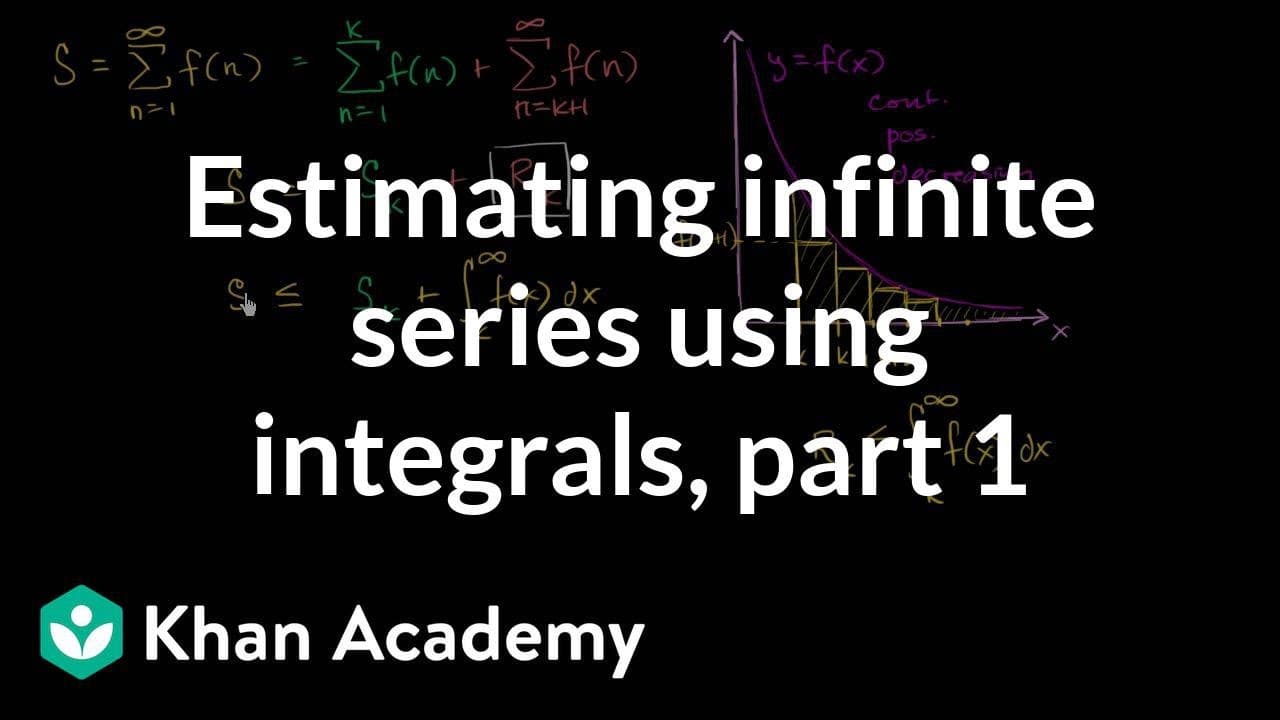
- [Voiceover] So let's say S is the value that this infinite series converges to. We're going to assume that this series actually converges. And the definition of the series, each term is going to be a function of N. We're going to assume that this is the same type of series that we looked at when we looked at the integral test, or namely that this... Read More
Key Insights
- 🍹 The range of convergence for an infinite series can be estimated by splitting it into a finite sum and an infinite sum.
- 🍹 The upper bound for the sum can be computed by adding the partial sum of the first k terms and the improper integral from k to infinity.
- 🍹 The lower bound for the sum can be computed by adding the partial sum of the first k terms and the improper integral from k+1 to infinity.
- 👻 Estimating the range of convergence allows for a good approximation of the actual sum with minimal computation.
- 😉 The accuracy of the estimate improves as the value of k increases.
- 🍉 The estimation process can be understood by visualizing the area under the curve and the rectangles representing the terms of the sum.
Install to Summarize YouTube Videos and Get Transcripts
Explore YouTube Video Summarizer or Get YouTube Transcript Extractor
Questions & Answers
Q: How can we estimate the range of convergence for an infinite series?
The range of convergence can be estimated by splitting the infinite series into a finite sum and an infinite sum. The finite sum can be computed manually or using a computer, while the infinite sum can be computed using calculus techniques.
Q: What is the purpose of estimating the range of convergence?
Estimating the range of convergence allows us to approximate the value that the infinite series converges to. It is useful when we cannot find the exact value and want to have a good estimate with minimal computation.
Q: How can we find an upper bound for the sum of an infinite series?
An upper bound can be found by adding the partial sum of the first k terms and the improper integral from k to infinity. This will give us a value that is greater than or equal to the actual sum.
Q: How can we find a lower bound for the sum of an infinite series?
A lower bound can be found by adding the partial sum of the first k terms and the improper integral from k+1 to infinity. This will give us a value that is less than or equal to the actual sum.
Summary & Key Takeaways
-
The video discusses estimating the range of convergence for an infinite series by splitting it into a finite sum and an infinite sum.
-
By using a continuous positive decreasing function, the video explains how to compute an upper bound and a lower bound for the sum.
-
The upper bound can be computed by adding the partial sum and the improper integral from k to infinity, while the lower bound is computed by adding the partial sum and the improper integral from k+1 to infinity.
Read in Other Languages (beta)
Share This Summary 📚
Summarize YouTube Videos and Get Video Transcripts with 1-Click
Try YouTube Summary with ChatGPT & Claude or YouTube Transcript Generator
Explore More Summaries from Khan Academy 📚



Summarize YouTube Videos and Get Video Transcripts with 1-Click
Try YouTube Summary with ChatGPT & Claude or YouTube Transcript Generator