Great Schism part 1
TL;DR
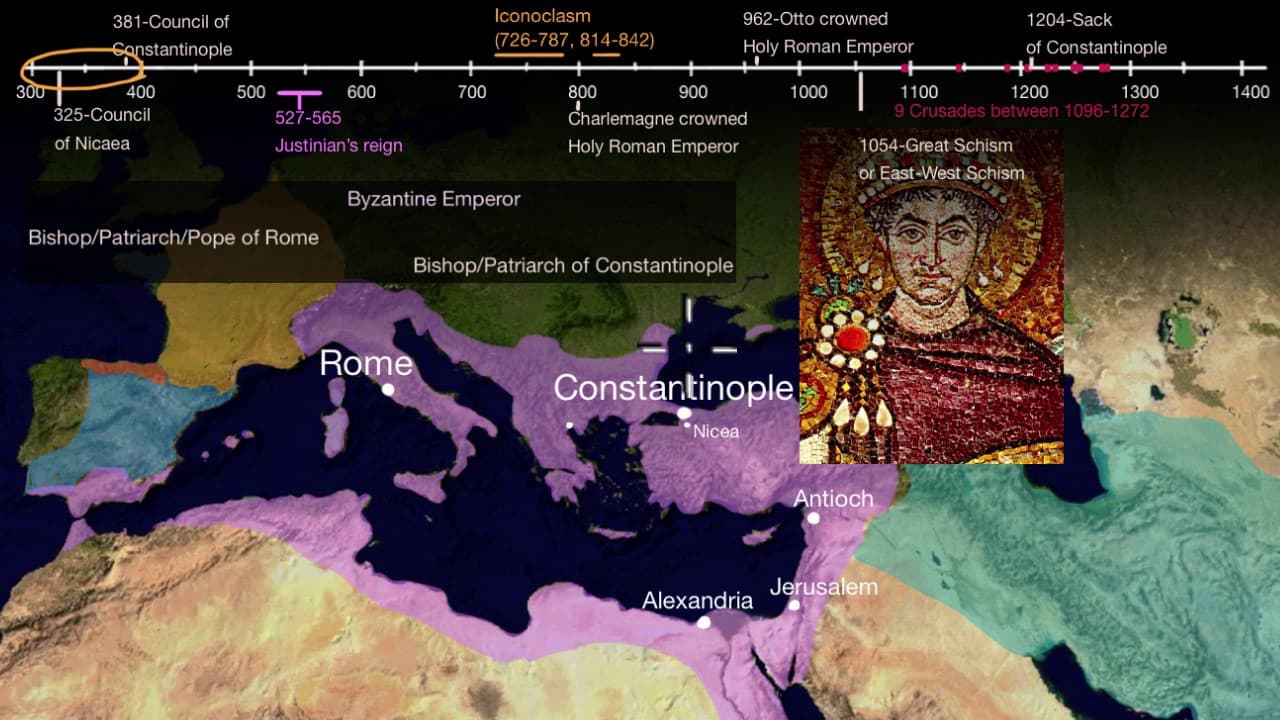
The division between the church in the east (Byzantine Empire) and the church in the west (Germanic kingdoms) was driven by language, power struggles, and theological differences.
Transcript
- [Narrator] In previous videos we talked about the dramatic turn around in the fourth century in terms of how Christianity was treated in the Roman Empire. As you enter into the fourth century it's persecuted by Diocletian but then Constantine takes power. He's sympathetic to the Christians. He even convinced them in order to unify the Christians ... Read More
Key Insights
- 😮 Christianity experienced a significant shift in the fourth century, with Constantine's support leading to the religion's rise in the Roman Empire.
- ⛪ The division between the church in the west and the church in the east became more pronounced with the fall of the western empire and the emergence of Germanic kingdoms.
- ✊ Language, power struggles, and theological disputes served as catalysts for the division between east and west.
- ✊ Charlemagne's crowning as Holy Roman Emperor introduced a new actor in the power dynamics between east and west.
- 🗂️ The filioque controversy and Iconoclasm further deepened theological and cultural divides.
- 🤱 The nature of the west became more Germanic, while the east continued in Greek traditions.
- ✊ The Byzantine Empire's weakening and the spread of Islam impacted the power dynamics between east and west.
Install to Summarize YouTube Videos and Get Transcripts
Explore YouTube Video Summarizer or Get YouTube Transcript Extractor
Questions & Answers
Q: What led to the division between the church in the west and the church in the east?
The division was influenced by factors such as language differences (Latin in the west, Greek in the east), power struggles between the Byzantine emperor and the Pope, and theological disputes.
Q: Why did the Pope crown Charlemagne as Holy Roman Emperor?
The Pope sought protection from Charlemagne, who considered himself a defender of Christianity. In exchange, the Pope crowned Charlemagne to establish him as the new Roman emperor, creating tensions with the Byzantine Empire.
Q: What was the filioque controversy?
The filioque controversy arose from the addition of the Latin term filioque ("and the Son") to the Nicene Creed by the west. This led to disagreements between the east and west regarding the procession of the Holy Spirit.
Q: How did the issue of Iconoclasm contribute to the division?
The Byzantine emperor initiated Iconoclasm, the destruction of religious images, causing conflict with the west. The Pope asserted his universal jurisdiction and opposed the actions of the Byzantine emperor.
Summary & Key Takeaways
-
The fourth century saw a dramatic shift in the treatment of Christianity in the Roman Empire, with Constantine promoting and eventually converting to Christianity.
-
The division between the church in the west and the church in the east became more pronounced in the 5th century, with the western empire falling to Germanic conquerors.
-
Language, power struggles between the Byzantine emperor and the Pope, and theological debates, such as the issue of Iconoclasm and the filioque controversy, further contributed to the divide between east and west.
Read in Other Languages (beta)
Share This Summary 📚
Summarize YouTube Videos and Get Video Transcripts with 1-Click
Try YouTube Summary with ChatGPT & Claude or YouTube Transcript Generator
Explore More Summaries from Khan Academy 📚





Summarize YouTube Videos and Get Video Transcripts with 1-Click
Try YouTube Summary with ChatGPT & Claude or YouTube Transcript Generator