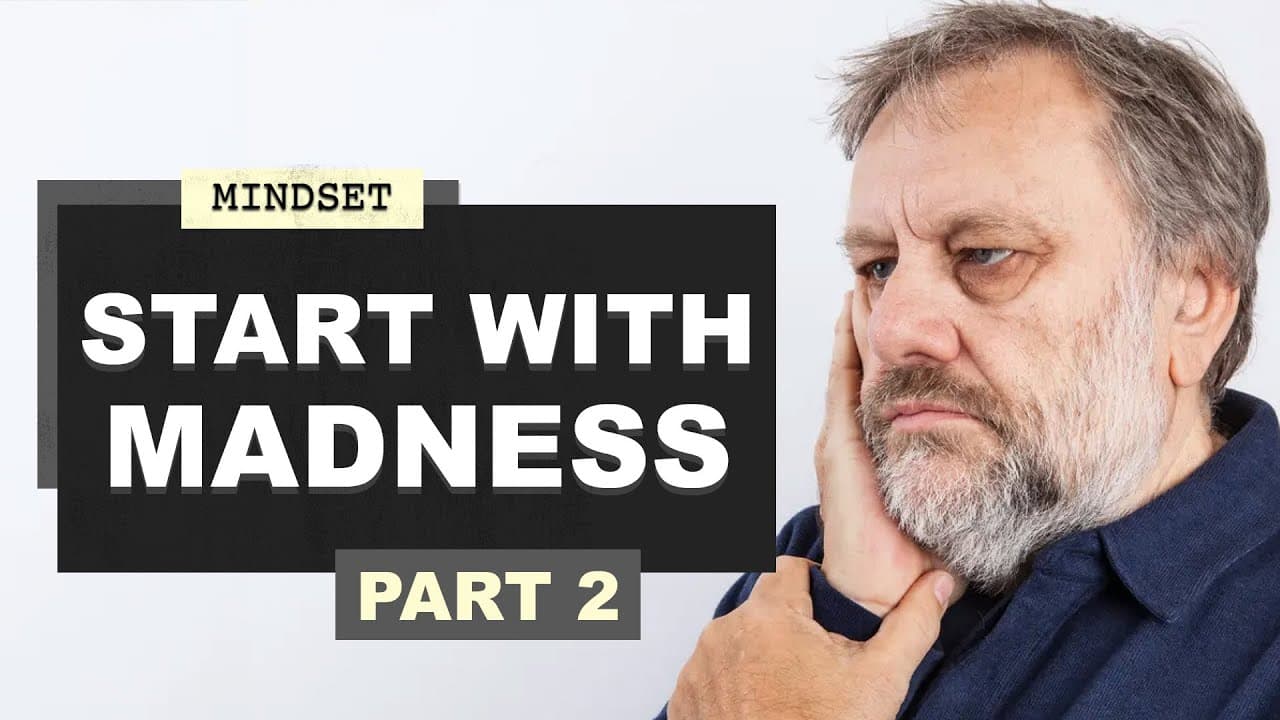
Slavoj Zizek: How To Find Sanity (Part 2)
TL;DR
Exploring the connection between philosophy, Heidegger, and reclaiming subjective freedom through thinking.
Transcript
it's it's interesting you say there's perhaps something naive in in what you say there um there's a fascinating uh passage in your book i think it's uh when you're talking about heidegger or one of the places when you were talking about heidegger and um you're talking about the end of philosophy there's a quote here you say are we philosophers not ... Read More
Key Insights
- 😷 The perception of freedom in surveillance capitalism may mask a deeper form of non-freedom.
- 🤔 Heidegger's concept of thinking offers a path to rekindling subjective agency and freedom.
- 👾 Capitalist madness can create new social spaces for freedom, but also poses significant risks.
- 🫵 The speaker navigates between pessimism and naive optimism, cautioning against simplistic views of the world.
- 🫵 Sanity is viewed as a retroactive attempt to control our inherent madness, as discussed by Hegel and Derrida.
- 🙂 The debate on madness between Foucault and Derrida sheds light on the foundational nature of madness in human discourse.
- 👾 Control and transparency are essential in maintaining freedom within emerging social spaces, even within capitalism.
Install to Summarize YouTube Videos and Get Transcripts
Explore YouTube Video Summarizer or Get YouTube Transcript Extractor
Questions & Answers
Q: How does the speaker view the danger of surveillance capitalism and its impact on individual freedom?
The speaker highlights that surveillance capitalism poses a unique danger as individuals often perceive non-freedom as freedom within the system, leading to a loss of agency.
Q: What role does Heidegger play in the discussion on agency and freedom?
Heidegger's distinction between philosophy and thinking suggests that engaging in authentic thinking can help individuals rediscover subjective freedom and counter the loss of agency in contemporary society.
Q: How does the speaker address the shift of traditional philosophical questions to scientific realms?
The speaker notes that traditional philosophical inquiries, such as free will or the origins of the world, have been overshadowed by scientific disciplines like brain sciences and quantum cosmology, signaling a shift away from philosophy.
Q: Can capitalist madness have emancipatory potential, as suggested by the speaker?
The speaker acknowledges that within the chaos and excesses of capitalism, there may exist a space for new forms of freedom, but also recognizes the dangers and complexities inherent in such transformations.
Summary & Key Takeaways
-
Discusses the interplay between philosophy, Heidegger, and the loss of subjective freedom in modern times.
-
Examines how thinking, as opposed to philosophizing, can lead to rediscovering subjective agency.
-
Explores the idea that our perception of freedom in surveillance capitalism may actually be a dangerous form of non-freedom.
Read in Other Languages (beta)
Share This Summary 📚
Summarize YouTube Videos and Get Video Transcripts with 1-Click
Try YouTube Summary with ChatGPT & Claude or YouTube Transcript Generator
Explore More Summaries from How To Academy Mindset 📚



Summarize YouTube Videos and Get Video Transcripts with 1-Click
Try YouTube Summary with ChatGPT & Claude or YouTube Transcript Generator