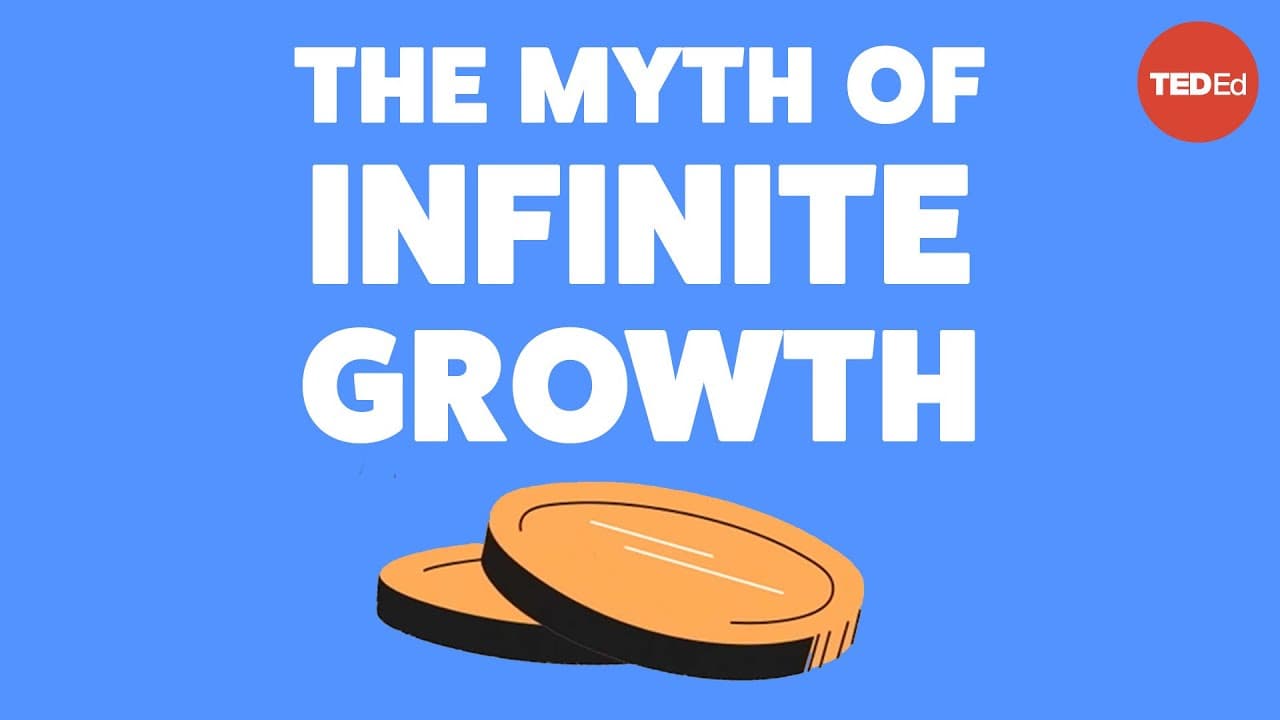
Can the economy grow forever?
TL;DR
Economists debate infinite growth vs. post-growth economy amidst resource scarcity and climate change concerns.
Transcript
Let’s say you discover a magical gold coin that doubles every 25 years. 75 years later, you’d only have eight coins. But 1,000 years later, you’d have over a trillion. And in just 4,600 years, your gold coins would outweigh the observable universe. This periodic doubling is an example of exponential growth, and while we’re not in any danger of d... Read More
Key Insights
- 🤨 Exponential economic growth raises concerns about resource depletion and environmental degradation.
- 🥺 Technological advancements can both enhance efficiency and lead to increased resource consumption.
- 🏣 Transitioning to a post-growth economy may require significant social and economic restructuring.
- 🌐 Balancing economic growth with environmental sustainability remains a crucial global challenge.
- 💱 Innovation and human ingenuity may offer solutions to address climate change and resource scarcity.
- 👋 Debate among economists continues on the best approach to achieving a sustainable and equitable economy.
- 🏣 Implementing a post-growth economy may involve redefining societal needs and industries.
Install to Summarize YouTube Videos and Get Transcripts
Explore YouTube Video Summarizer or Get YouTube Transcript Extractor
Questions & Answers
Q: How does the concept of exponential growth apply to the global economy?
The global economy has seen exponential growth over the past 200 years, increasing value but also consuming resources at an unsustainable rate.
Q: What are the challenges associated with increasing economic efficiency through new technologies?
While technology improves efficiency, it can also lead to increased resource consumption and environmental impact due to boosted demands.
Q: Why do some economists advocate for a post-growth economy?
Advocates suggest transitioning to a post-growth economy that focuses on sustainable practices, reducing inequality, and prioritizing essential needs over continuous growth.
Q: What are the key differences between pursuing infinite growth and transitioning to a post-growth economy?
While infinite growth prioritizes economic expansion, post-growth economy emphasizes sustainability, social equality, and prioritizing essential resources and services.
Summary & Key Takeaways
-
The global economy has been growing exponentially, driven by innovations and resource consumption.
-
Increasing efficiency through technology poses challenges of new demand and environmental impact.
-
Debate arises between pursuing infinite growth or transitioning to a post-growth economy prioritizing sustainability.
Read in Other Languages (beta)
Share This Summary 📚
Summarize YouTube Videos and Get Video Transcripts with 1-Click
Try YouTube Summary with ChatGPT & Claude or YouTube Transcript Generator
Explore More Summaries from TED-Ed 📚




Summarize YouTube Videos and Get Video Transcripts with 1-Click
Try YouTube Summary with ChatGPT & Claude or YouTube Transcript Generator