Addition elimination method 3 | Systems of equations | 8th grade | Khan Academy
TL;DR
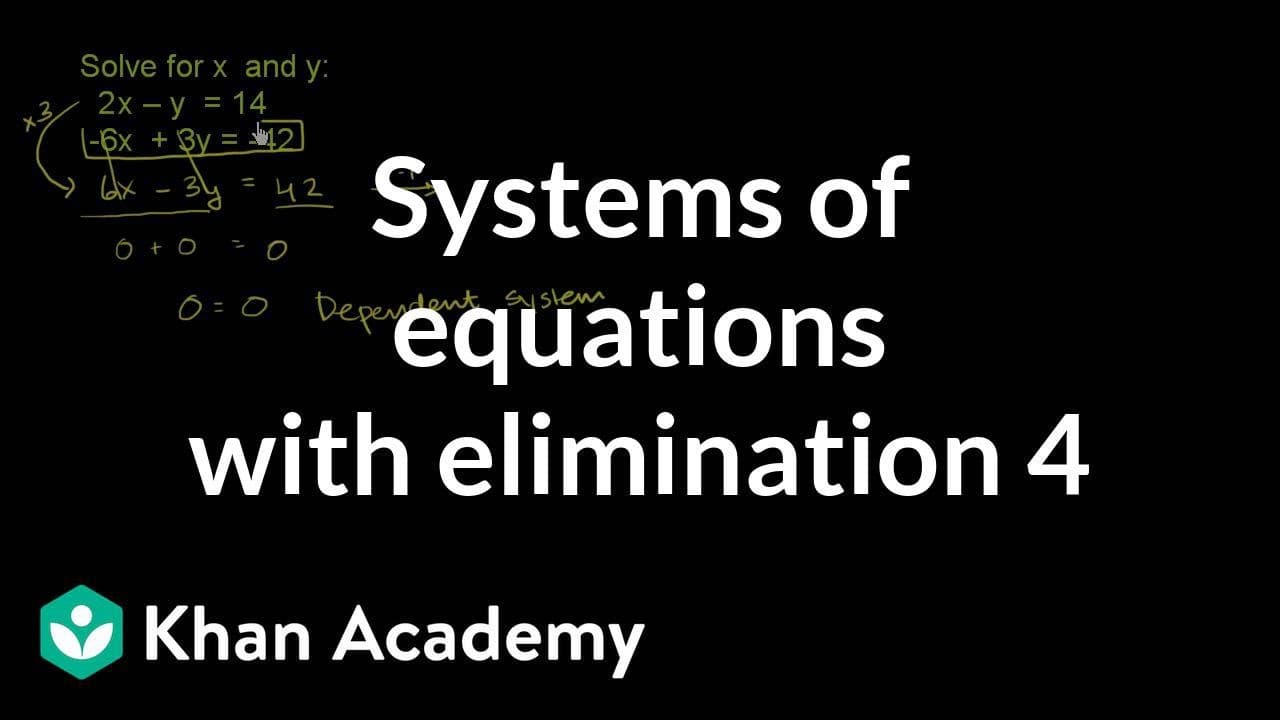
When the equations in a system are multiples of each other, it forms a dependent system with infinitely many solutions.
Transcript
Solve for x and y. And we have the system of equations right here. We have 2x minus y is equal to 14, and negative 6x plus 3y is equal to negative 42. So we could try to solve this by elimination, and let's see if we can eliminate our y variables first. We have a 3y here, and we have a negative y up here. And they won't eliminate. If you just add n... Read More
Key Insights
- ❓ The method of elimination involves manipulating equations to eliminate one variable and solve for the other.
- ❓ Dependent systems have infinitely many solutions and occur when the equations are essentially the same.
- 🫥 Independent systems have a unique solution and occur when the equations represent intersecting lines.
- ❓ When the resulting equation after elimination is 0=0, it indicates a dependent system.
Install to Summarize YouTube Videos and Get Transcripts
Explore YouTube Video Summarizer or Get YouTube Transcript Extractor
Questions & Answers
Q: How can the method of elimination be used to solve systems of equations?
The method of elimination involves manipulating the equations to eliminate one variable by multiplying one or both equations to make the coefficients match. This allows us to solve for the remaining variable and find the solution.
Q: What does it mean to have a dependent system of equations?
A dependent system occurs when the two equations are essentially the same or multiples of each other. This leads to infinitely many solutions because any solution that satisfies one equation will also satisfy the other.
Q: What happens when the resulting equation after elimination is 0=0?
When the resulting equation is 0=0, it means that both equations are identical and represent the same line. This indicates a dependent system with an infinite number of solutions.
Q: How can you distinguish between dependent and independent systems?
Dependent systems have infinite solutions and occur when the equations are multiples or have the same slope-intercept form. Independent systems have a unique solution and occur when the equations represent intersecting lines.
Summary & Key Takeaways
-
The video explains how to solve a system of equations with two variables using the method of elimination.
-
It demonstrates the process of turning one equation into a multiple of the other equation to eliminate one variable.
-
In the case where the resulting equation is 0=0, it indicates a dependent system with infinite solutions.
Read in Other Languages (beta)
Share This Summary 📚
Summarize YouTube Videos and Get Video Transcripts with 1-Click
Try YouTube Summary with ChatGPT & Claude or YouTube Transcript Generator
Explore More Summaries from Khan Academy 📚



Summarize YouTube Videos and Get Video Transcripts with 1-Click
Try YouTube Summary with ChatGPT & Claude or YouTube Transcript Generator