Division as equal groupings
TL;DR
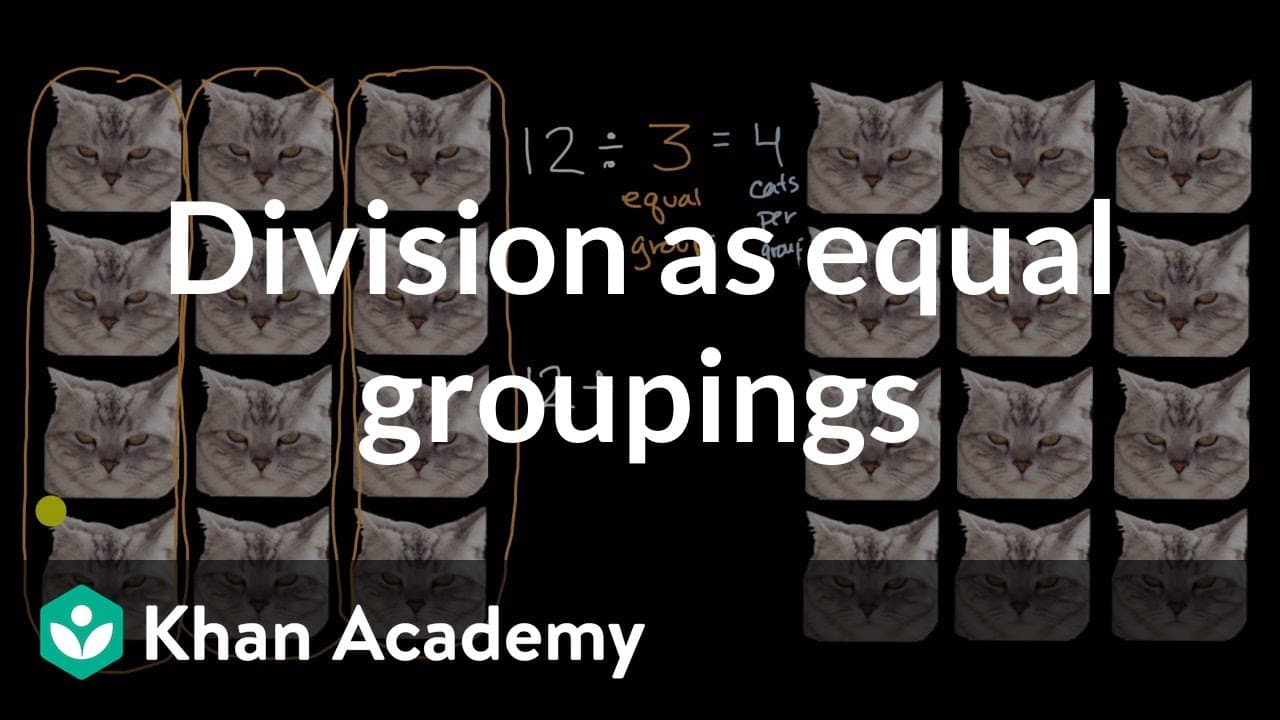
Learn how to divide 12 angry cats into three equal groups by understanding two different interpretations of division.
Transcript
- [Instructor] So it looks like we have some angry cats on our hands, meow, yeah they seem angry. And what we want to do is think about how can we separate these angry cats 'cause the only thing worse than an angry cat is 12 of them coordinating potentially to take over the world. And so what we're going to think about is can we divide these 12 ang... Read More
Key Insights
- 👥 Dividing a given number into equal groups can be approached differently based on the desired outcome.
- 😺 The division of 12 angry cats into three equal groups results in four cats per group.
- 👥 Dividing 12 angry cats into groups of three results in four equal groups.
- 👥 The first approach focuses on how many cats are in each group, while the second approach focuses on the number of equal groups formed.
- 👻 Understanding different interpretations of division allows for greater flexibility in problem-solving.
- 👥 Dividing equally can help manage and organize a large group.
- 👥 The number being divided can be adjusted based on the desired group size or the number of equal groups.
Install to Summarize YouTube Videos and Get Transcripts
Explore YouTube Video Summarizer or Get YouTube Transcript Extractor
Questions & Answers
Q: How does the video suggest dividing 12 angry cats into three equal groups?
The video demonstrates two approaches. The first approach is to divide 12 into three equal groups, resulting in four cats per group. The second approach is dividing 12 into groups of three, resulting in four equal groups.
Q: What is the difference between the two interpretations of division?
The difference lies in how the groups are formed. The first interpretation divides 12 into three equal groups, while the second interpretation divides 12 into groups of three. The first interpretation focuses on the number of cats per group, while the second interpretation focuses on the number of equal groups formed.
Q: How many angry cats are there in each equal group when divided into three groups of four cats each?
When divided into three groups, each consisting of four cats, there are four angry cats in each equal group.
Q: How many equal groups are formed when dividing 12 angry cats into groups of three each?
When dividing 12 angry cats into groups of three, four equal groups are formed.
Summary & Key Takeaways
-
The video demonstrates dividing 12 angry cats into three equal groups using two different approaches.
-
The first approach involves dividing 12 into three equal groups, resulting in four cats per group.
-
The second approach involves dividing 12 into groups of three, resulting in four equal groups.
Read in Other Languages (beta)
Share This Summary 📚
Summarize YouTube Videos and Get Video Transcripts with 1-Click
Try YouTube Summary with ChatGPT & Claude or YouTube Transcript Generator
Explore More Summaries from Khan Academy 📚



Summarize YouTube Videos and Get Video Transcripts with 1-Click
Try YouTube Summary with ChatGPT & Claude or YouTube Transcript Generator