Isothermal process Thermodynamics - Work, Heat & Internal Energy, PV Diagrams
TL;DR
This content explains the calculations for a variety of ideal gas processes, including isothermal expansion and compression, and provides derivations for the formulas used in these calculations.
Transcript
five moles of an ideal gas expands from three liters to eight liters at a constant temperature of 300 kelvin what is the change in the internal energy of the gas now because the temperature is constant what type of process do we have would you say it's an isochoric process isobaric isothermal or adiabatic because the temperature is constant we have... Read More
Key Insights
- 🫢 In an isothermal process, the change in internal energy of an ideal gas is always zero.
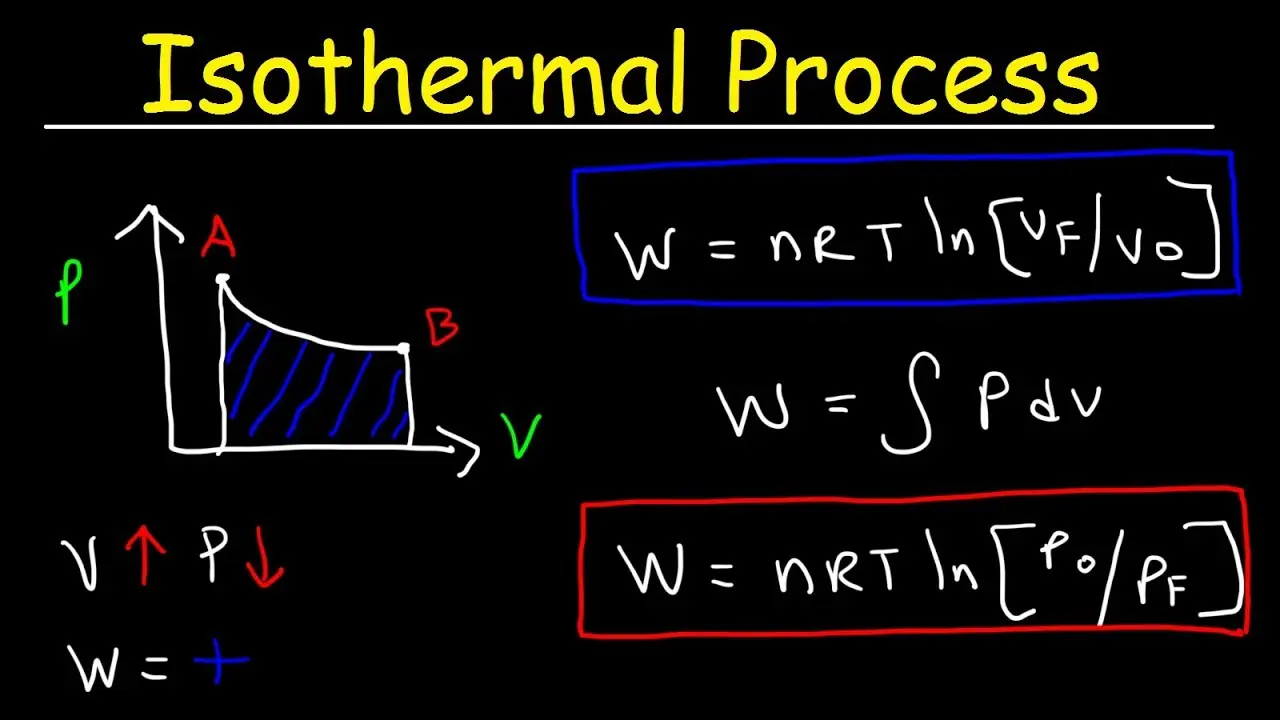
- 🫢 The work performed by an ideal gas during an isothermal expansion can be calculated using the formula W = nRT * ln(V₂/V₁).
- 🫢 The work performed by an ideal gas during an isothermal compression can be calculated using the formula W = nRT * ln(P₁/P₂).
- 🎭 The heat energy transferred in an isothermal process is equal to the work performed by the gas.
- 🫢 During an isothermal expansion, the work performed by the gas is positive, indicating that heat energy flowed into the gas.
- 🫢 During an isothermal compression, the work performed by the gas is negative, indicating that heat energy flowed out of the gas.
- 🫢 The work performed by a gas during an isothermal process can also be calculated using the equation W = P ΔV, where P is the pressure and ΔV is the change in volume.
Install to Summarize YouTube Videos and Get Transcripts
Explore YouTube Video Summarizer or Get YouTube Transcript Extractor
Questions & Answers
Q: What is the change in the internal energy of an ideal gas during an isothermal process?
During an isothermal process, the change in internal energy of an ideal gas is always zero because the temperature remains constant.
Q: How can we calculate the work performed by an ideal gas during an isothermal expansion?
The work performed by an ideal gas during an isothermal expansion can be calculated using the formula W = nRT * ln(V₂/V₁), where n represents the number of moles, R is the gas constant, T is the temperature, V₂ is the final volume, and V₁ is the initial volume.
Q: What is the relationship between heat energy and work in an isothermal process?
In an isothermal process, the heat energy transferred into or out of the gas is equal to the work performed by the gas. This means that if work is positive, indicating expansion, heat energy flowed into the gas, and if work is negative, indicating compression, heat energy flowed out of the gas.
Q: How is the work performed by an ideal gas calculated during an isothermal compression?
The work performed by an ideal gas during an isothermal compression can be calculated using the formula W = nRT * ln(P₁/P₂), where n represents the number of moles, R is the gas constant, T is the temperature, P₁ is the initial pressure, and P₂ is the final pressure.
Summary & Key Takeaways
-
The content discusses the calculation of the change in internal energy of an ideal gas during an isothermal process, which is always zero.
-
It explains how to calculate the work performed by an ideal gas during an isothermal expansion, using the formula W = nRT * ln(V₂/V₁).
-
The content also covers the calculation of heat energy transferred in an isothermal process, which is equal to the work performed by the gas.
Read in Other Languages (beta)
Share This Summary 📚
Summarize YouTube Videos and Get Video Transcripts with 1-Click
Try YouTube Summary with ChatGPT & Claude or YouTube Transcript Generator
Explore More Summaries from The Organic Chemistry Tutor 📚




Summarize YouTube Videos and Get Video Transcripts with 1-Click
Try YouTube Summary with ChatGPT & Claude or YouTube Transcript Generator