2011 Calculus BC free response #6d | AP Calculus BC | Khan Academy
TL;DR
This video discusses how to use Taylor polynomials and the absolute value of the fifth derivative of a function to bound the error when approximating a function using a polynomial.
Transcript
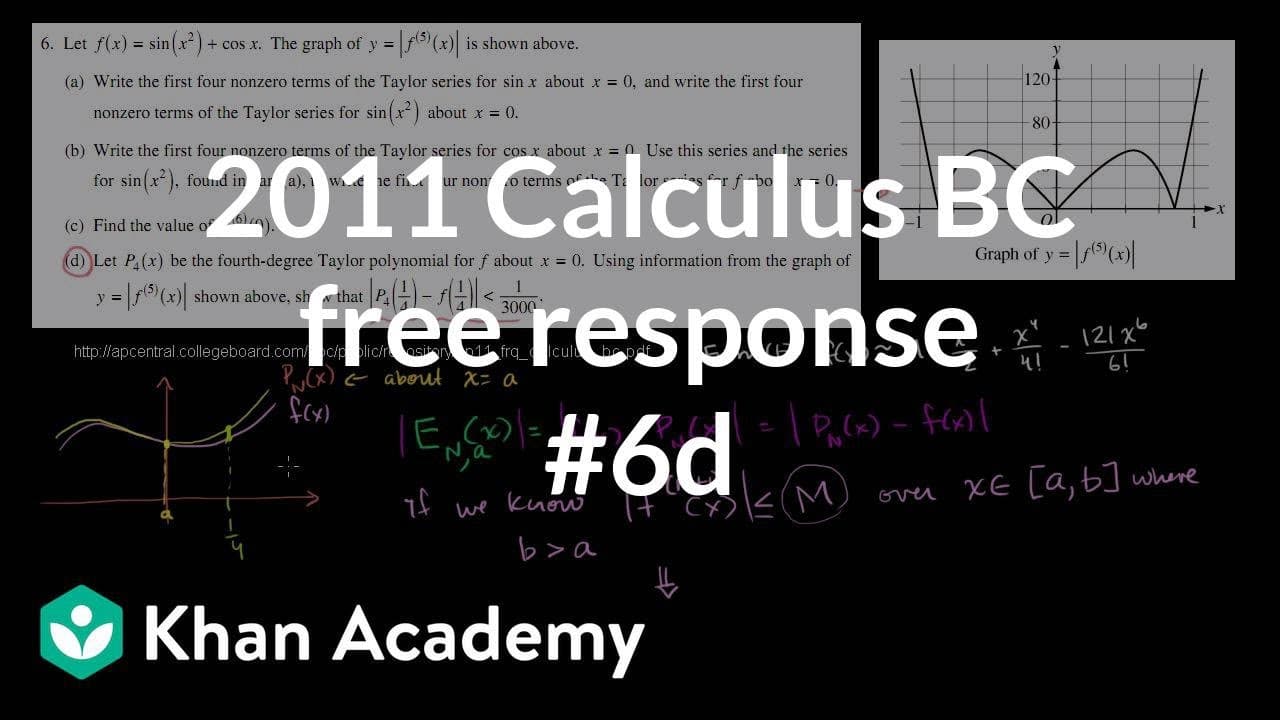
Part D. Let p sub 4 of x be the fourth degree Taylor polynomial for f about x equals 0. Using information from the graph of y is equal to the absolute value of the fifth derivative of f of x, shown above-- and that's the graph right over here, I put it on the side to save space-- show that the absolute value of the difference between the polynomial... Read More
Key Insights
- 😥 Taylor polynomials are used to approximate functions by creating a polynomial that matches the function at a given point.
- ☠️ The absolute value of the fifth derivative of a function provides information about the function's maximum rate of change.
- ❓ The error in a polynomial approximation can be bounded by knowing the maximum value of the (n+1)th derivative of the function over a given interval.
Install to Summarize YouTube Videos and Get Transcripts
Explore YouTube Video Summarizer or Get YouTube Transcript Extractor
Questions & Answers
Q: What is the purpose of Taylor polynomials?
Taylor polynomials are used to approximate functions by creating a polynomial that closely matches the function at a given point. They are useful for estimation and simplification of complex functions.
Q: How can the absolute value of the fifth derivative of a function help bound the error in a polynomial approximation?
The absolute value of the fifth derivative represents the maximum rate of change of the function. By knowing the maximum value of the fifth derivative over a given interval, we can bound the error in the polynomial approximation for any point within that interval.
Q: How is the error of a polynomial approximation bounded using Taylor polynomials?
The error of the n-th degree polynomial approximation at x=a is bounded by the expression M*(x-a)^(n+1)/(n+1), where M is the maximum value of the (n+1)th derivative of the function over the interval [a,b].
Q: Why is it important to know the properties of the nth+1 derivative of the function when using Taylor polynomials?
The properties of the (n+1)th derivative determine the maximum rate of change of the function. By knowing this maximum value, we can determine an upper bound for the error in the polynomial approximation.
Summary & Key Takeaways
-
The video explains the concept of Taylor polynomials and their use in approximating functions.
-
It demonstrates how to use the absolute value of the fifth derivative of a function to bound the error in the polynomial approximation.
-
The video provides a step-by-step example of applying these concepts to find a bound for the error when approximating the function at x = 1/4.
Read in Other Languages (beta)
Share This Summary 📚
Summarize YouTube Videos and Get Video Transcripts with 1-Click
Try YouTube Summary with ChatGPT & Claude or YouTube Transcript Generator
Explore More Summaries from Khan Academy 📚



Summarize YouTube Videos and Get Video Transcripts with 1-Click
Try YouTube Summary with ChatGPT & Claude or YouTube Transcript Generator