What Are Trigonometric Identities and Their Uses?
TL;DR
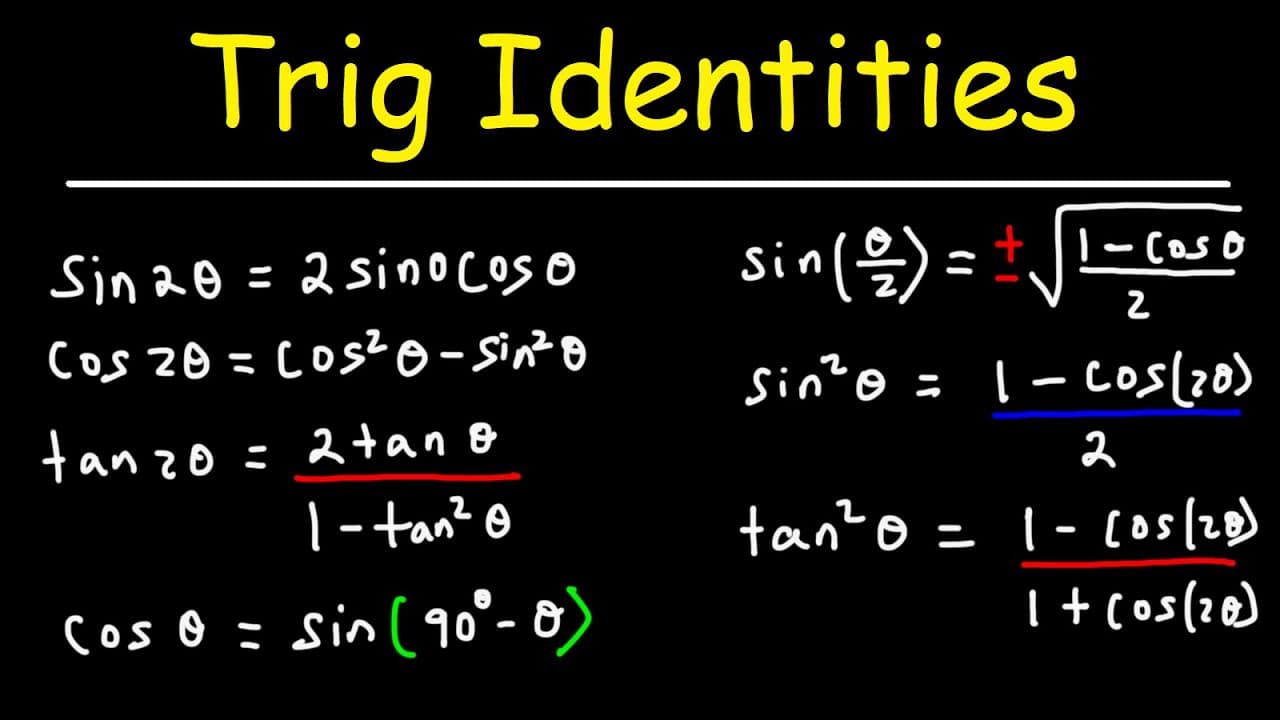
Trigonometric identities are formulas that relate the angles and sides of triangles, essential for solving trigonometry problems. Key identities include sine, cosine, tangent, reciprocal identities, and Pythagorean identities. The video also covers double angle identities, half angle identities, as well as the law of sines, law of cosines, and area formulas for triangles.
Transcript
in this video we're going to go over some common trig identities that you're going to counter in a typical trigonometry course so this video is going to be helpful regardless if you're starting trigonometry or if you're studying for your final exam we're going to go over the formulas that you need to know so here we have a right triangle across the... Read More
Key Insights
- ❓ Trigonometric identities are essential for solving problems in trigonometry.
- 🥳 Understanding trig ratios, reciprocal identities, and Pythagorean identities is crucial for further trigonometric calculations.
- 🔺 Knowing the sum and difference identities, double angle identities, and half angle identities allows for simplification of trigonometric expressions.
- 👮 The law of sines and the law of cosines help solve triangles when different information is given.
- 🍹 Power reducing formulas, product to sum formulas, and sum to product formulas provide further tools for simplifying trigonometric expressions.
- 🔺 The area of a triangle can be calculated using trigonometry, either through the area formula or Heron's formula.
Install to Summarize YouTube Videos and Get Transcripts
Explore YouTube Video Summarizer or Get YouTube Transcript Extractor
Questions & Answers
Q: What are the three fundamental trigonometric ratios and their definitions?
The three fundamental trigonometric ratios are sine, cosine, and tangent. Sine is the ratio of the opposite side to the hypotenuse, cosine is the ratio of the adjacent side to the hypotenuse, and tangent is the ratio of the opposite side to the adjacent side.
Q: What are the reciprocal identities of the trigonometric ratios?
The reciprocal identities are cosecant (csc), secant (sec), and cotangent (cot), which are the reciprocals of sine, cosine, and tangent, respectively. For example, cosecant(theta) = 1/sine(theta).
Q: How do you derive the Pythagorean identities?
The first Pythagorean identity, sine^2(theta) + cosine^2(theta) = 1, can be derived by dividing both sides of the Pythagorean theorem (a^2 + b^2 = c^2) by the hypotenuse squared. The other two Pythagorean identities, 1 + cotangent^2(theta) = cosecant^2(theta) and cotangent^2(theta) + 1 = secant^2(theta), can be derived by dividing the first Pythagorean identity by either sine^2(theta) or cosine^2(theta), respectively.
Q: What are the even and odd functions in trigonometry?
In trigonometry, cosine and secant are even functions because their values remain the same when the angle is replaced by its negative. Sine, cosecant, tangent, and cotangent are odd functions because their values change sign when the angle is replaced by its negative.
Q: How can the law of sines be used to solve a triangle?
The law of sines states that the ratio of the sine of an angle to the length of the side opposite that angle is the same for all three angles in a triangle. By knowing the length of two sides and the measure of one angle, you can use the law of sines to find the missing angles and side lengths in a triangle.
Q: How does the law of cosines help in finding the measure of an angle in a triangle?
The law of cosines allows you to find the measure of an angle in a triangle if you know the lengths of all three sides. Using the formula c^2 = a^2 + b^2 - 2abcos(C), you can solve for angle C by rearranging the equation and taking the inverse cosine of both sides.
Q: What are the power reducing formulas in trigonometry?
The power reducing formulas are used to reduce the power of a trigonometric function. For sine^2(theta) and cosine^2(theta), you can use the formulas sine^2(theta) = (1 - cosine(2theta))/2 and cosine^2(theta) = (1 + cosine(2theta))/2. For tangent^2(theta), the formula is tangent^2(theta) = (1 - cosine(2theta))/(1 + cosine(2theta)).
Q: Can you explain the product to sum formulas in trigonometry?
The product to sum formulas allow you to express the product of two trigonometric functions as a sum or difference of trigonometric functions. For example, sine(A)sin(B) can be written as (1/2)[cos(A - B) - cos(A + B)]. Similarly, cosine(A)cos(B) can be written as (1/2)[cos(A - B) + cos(A + B)].
Summary & Key Takeaways
-
The video explains the three fundamental trigonometric ratios, sine, cosine, and tangent, and their reciprocal identities.
-
It introduces the Pythagorean identities and demonstrates how they can be derived from the fundamental trigonometric ratios.
-
The video covers even and odd functions, cofunction identities, double angle identities, half angle identities, sum and difference identities, power reducing formulas, and product to sum formulas.
-
It also explains the law of sines, the law of cosines, and provides formulas for calculating the area of a triangle, including Heron's formula. The lesser-known law of tangents is briefly mentioned.
Read in Other Languages (beta)
Share This Summary 📚
Summarize YouTube Videos and Get Video Transcripts with 1-Click
Try YouTube Summary with ChatGPT & Claude or YouTube Transcript Generator
Explore More Summaries from The Organic Chemistry Tutor 📚




Summarize YouTube Videos and Get Video Transcripts with 1-Click
Try YouTube Summary with ChatGPT & Claude or YouTube Transcript Generator