Some developers are too emotionally attached to tech
TL;DR
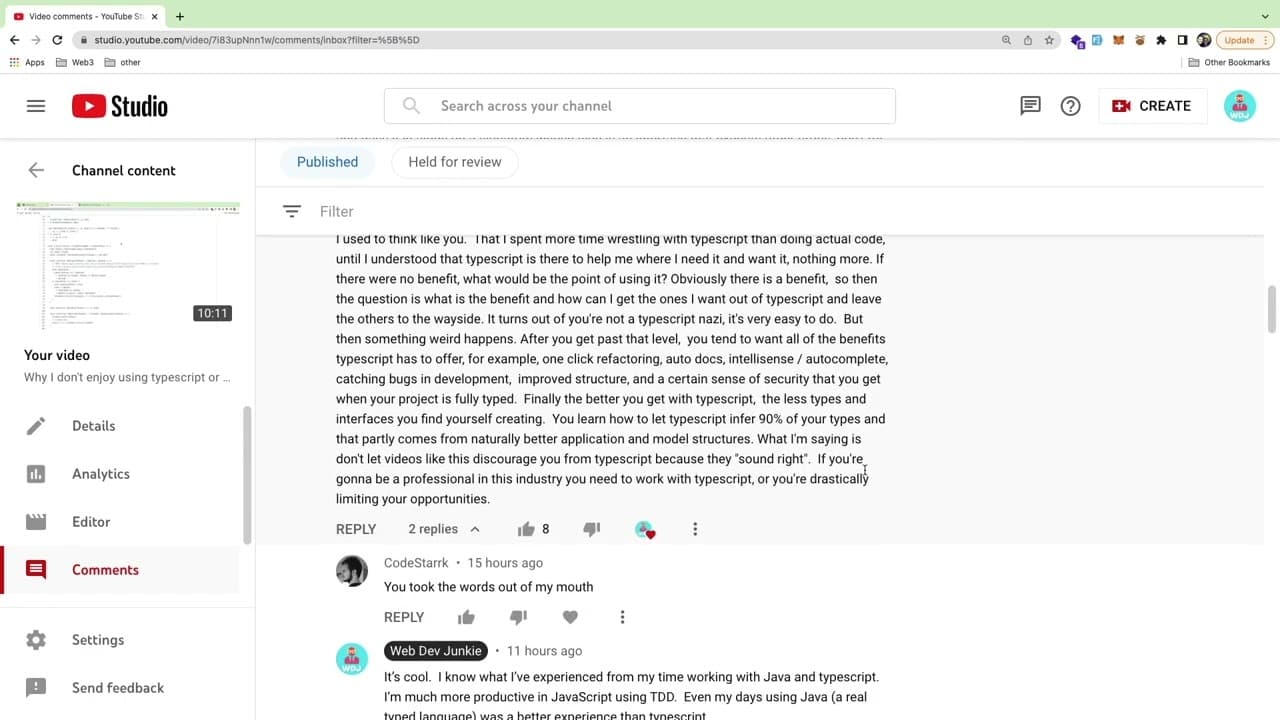
Typescript has merits, but its importance is often overstated.
Transcript
how's it going y'all so i'm going to do a little follow-up video on this and i'm just going to probably stop talking about this but i made a video called why i don't enjoy using typescript or static language as much and i knew a lot of people probably comment on this and just kind of defend typescript although i'm not really bashing typescript in t... Read More
Key Insights
- 🐛 The speaker believes that the hype surrounding Typescript doesn't align with their experience, as most bugs arise from issues other than type safety.
- 🥺 They suggest that beginners may misunderstand the necessity of type systems, potentially leading to unwarranted emotional defenses of languages like Typescript.
- 🫵 Effective testing practices are viewed by the speaker as more critical than type-checking in ensuring software reliability and efficiency.
- 🥺 The development community often exhibits tribalism around programming languages, which can lead to defensive behaviors among developers.
- 🚚 The speaker encourages developers to adopt a pragmatic approach to choosing tools, stressing that the ultimate goal is the effective delivery of software solutions.
- 💪 They argue that strong IDE support can effectively handle refactoring tasks similarly to what static type systems would offer.
- 😚 The speaker advocates for a mindset of continual learning, recognizing that over time, tools and languages may lose relevance or popularity.
Install to Summarize YouTube Videos and Get Transcripts
Explore YouTube Video Summarizer or Get YouTube Transcript Extractor
Questions & Answers
Q: Why does the speaker believe Typescript is overvalued?
The speaker believes that while Typescript has its benefits, particularly in statically typed languages, the majority of bugs in their extensive JavaScript codebase are not type-related. They argue that good coding practices, combined with effective testing methodologies, provide sufficient reliability without the need for Typescript's additional type safety.
Q: What role does testing play in the speaker's coding philosophy?
The speaker emphasizes that thorough testing, including unit and integration testing, is essential for verifying that software behaves as intended. They advocate for test-driven development, arguing that it is more pivotal than type safety, particularly in fast turnaround environments like web development where changes are quickly reflected.
Q: How does the speaker view the emotional attachment to programming languages?
The speaker mentions that many developers, especially those newer to the field, tend to become emotionally attached to their preferred languages. They believe this attachment is unnecessary, arguing that languages and frameworks are simply tools to meet project requirements, and that being overly loyal can hinder adaptability in an ever-changing industry.
Q: What is the speaker's stance on the necessity of sticking to one programming language?
The speaker suggests that developers should be flexible and not feel constrained to use a single language for a project. They advocate for a mix-and-match approach, using various tools as necessary to effectively implement features and meet client demands.
Q: How does the speaker address concerns about managing large codebases without static types?
They assert that managing large codebases can be achieved successfully through good coding practices and intelligent IDE support, allowing for seamless modifications and refactoring without the strictures of type systems. They believe that rigorous testing is sufficient to maintain code integrity.
Q: What does the speaker think about the future of programming languages and frameworks?
The speaker observes that programming languages and frameworks come and go, suggesting that developers should not hold rigidly to any one technology. They reference the decline of tools like CoffeeScript and Backbone.js, advocating for maintaining a flexible mindset towards evolving technologies.
Summary & Key Takeaways
-
The speaker discusses their experience working with JavaScript and shares that most bugs in their codebase are not type-related, questioning the necessity of Typescript.
-
They argue that testing methodologies, rather than type-checking, play a crucial role in ensuring code quality and reliability, especially in fast-refreshing web development.
-
The speaker reflects on the emotional attachment some developers have to programming languages, suggesting that it is unnecessary since languages are merely tools for delivering client solutions.
Read in Other Languages (beta)
Share This Summary 📚
Summarize YouTube Videos and Get Video Transcripts with 1-Click
Try YouTube Summary with ChatGPT & Claude or YouTube Transcript Generator
Explore More Summaries from Web Dev Cody 📚

Summarize YouTube Videos and Get Video Transcripts with 1-Click
Try YouTube Summary with ChatGPT & Claude or YouTube Transcript Generator