What Are Hydrogen Bonds and Why Are They Important?
TL;DR
Hydrogen bonds are strong intermolecular forces occurring between hydrogen and electronegative atoms in polar molecules, creating charged regions. They are crucial for biological processes, as they stabilize structures like DNA and proteins, and influence boiling points by adding to other attractive forces. Without hydrogen bonds, life as we know it would not exist.
Transcript
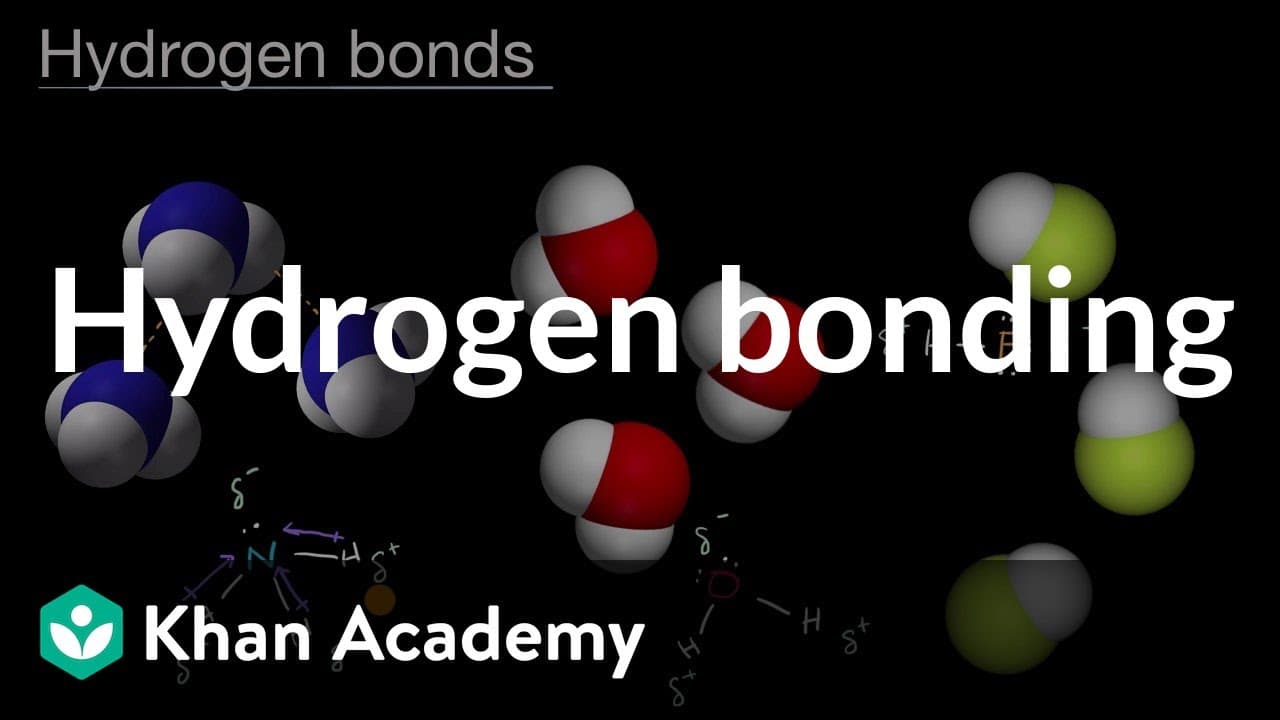
- [Instructor] Let's talk about hydrogen bonds. Depicted here, I have three different types of molecules. On the left, I have ammonia. Each ammonia molecule has one nitrogen bonded to three hydrogens. In the middle, I have something you're probably very familiar with, in fact, you're made up of it, which is water. Each oxygen is bonded to two hydro... Read More
Key Insights
- 🫀 Hydrogen bonds result from the electronegativity difference between hydrogen and more electronegative atoms in polar molecules.
- 😥 These intermolecular forces contribute to the polarity and higher boiling points of molecules.
- ❤️🩹 Hydrogen bonds are the strongest form of dipole-dipole interactions, creating a bond dipole with a partially positive hydrogen attracted to a partially negative end of another molecule.
- 😥 Hydrogen bonds are additive to other attractive forces, such as London dispersion forces, resulting in higher boiling points.
- ⏫ In biological systems, hydrogen bonds stabilize DNA double helix structure and influence protein shape and function.
- 🖐️ Hydrogen bonds are crucial for the existence of life, as they play a vital role in DNA stability and protein functionality.
- 😥 The separation in boiling points between molecules with similar molar masses but different electronegative atoms indicates the presence of other intermolecular forces, such as dipole-dipole forces.
Install to Summarize YouTube Videos and Get Transcripts
Explore YouTube Video Summarizer or Get YouTube Transcript Extractor
Questions & Answers
Q: What is the cause of polarity in molecules?
Polarity in molecules is caused by the unequal distribution of electrons due to the electronegativity difference between hydrogen and more electronegative atoms, resulting in a partial positive and partial negative charge.
Q: How do hydrogen bonds affect boiling points?
Hydrogen bonds, being stronger than London dispersion forces, contribute to the total attractive force between molecules, leading to higher boiling points compared to molecules with only dispersion forces.
Q: What are some examples of hydrogen bonds in biological systems?
Hydrogen bonds play a crucial role in DNA stability, where they form between base pairs, and in proteins, where they influence the shape and function by interacting between amino acids.
Q: Why are hydrogen bonds important for life?
Life heavily relies on hydrogen bonds as they are responsible for maintaining the structure of DNA and proteins, enabling crucial biological processes to occur.
Summary & Key Takeaways
-
Hydrogen bonds form between hydrogen and electronegative atoms in polar molecules, creating a partial positive and partial negative charge distribution.
-
These intermolecular forces are additive to other attractive forces, such as London dispersion forces, leading to higher boiling points.
-
Hydrogen bonds are crucial in biology, as they stabilize DNA double helix structure and influence the shape and function of proteins.
Read in Other Languages (beta)
Share This Summary 📚
Summarize YouTube Videos and Get Video Transcripts with 1-Click
Try YouTube Summary with ChatGPT & Claude or YouTube Transcript Generator
Explore More Summaries from Khan Academy 📚



Summarize YouTube Videos and Get Video Transcripts with 1-Click
Try YouTube Summary with ChatGPT & Claude or YouTube Transcript Generator