Chilling water problem | States of matter and intermolecular forces | Chemistry | Khan Academy
TL;DR
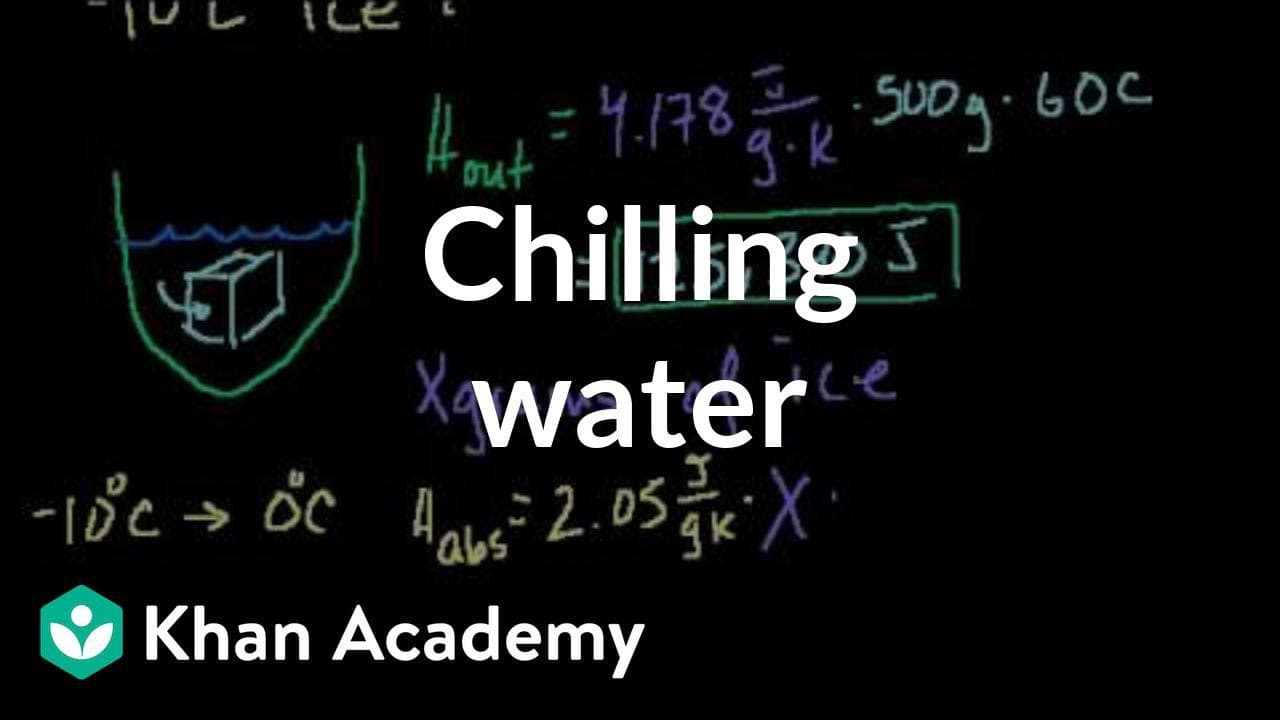
The video explains how to calculate the amount of ice needed to cool 500 grams of water from 60 degrees Celsius to 0 degrees Celsius.
Transcript
Let's do another states of matter phase change problem. And we'll deal with water again. But this one hopefully will stretch our neurons a little bit further. So let's say I have 500 grams of water. Of liquid water. At 60 degrees Celsius. Now my goal is to get it to zero degrees Celsius. And the way I'm going to do it is, I'm going to put ice into ... Read More
Key Insights
- 🥵 Cooling water requires transferring heat energy out of it.
- 🥵 The energy absorbed by ice is calculated based on its specific heat and the change in temperature.
- 🫠 Phase changes, such as melting, can absorb or release large amounts of energy without affecting the temperature.
- 🥶 The amount of ice needed to cool water can be determined by equating the energy absorbed by the ice to the energy required to cool the water.
- 🥶 The ice must not exceed zero degrees Celsius to effectively cool the water.
- 🥵 The heat absorbed during the phase change plays a significant role in the cooling process.
- 🥵 The calculations involve specific heat values and the heat of fusion of ice.
Install to Summarize YouTube Videos and Get Transcripts
Explore YouTube Video Summarizer or Get YouTube Transcript Extractor
Questions & Answers
Q: How can the amount of ice needed to cool the water be calculated?
The amount of ice needed can be determined by equating the energy absorbed by the ice to the energy required to cool the water. By solving the equation, we find that approximately 354 grams of ice are needed.
Q: Why is the ice able to cool the water even though its temperature change is smaller?
The majority of the cooling effect comes from the heat absorption during the phase change from ice to water. Even though the ice only goes from -10 degrees Celsius to 0 degrees Celsius, it can absorb a significant amount of energy by melting.
Q: Can the ice absorb more energy and raise its temperature above zero degrees Celsius?
No, the ice cannot exceed zero degrees Celsius because it would then start warming the water instead of cooling it. The ice must absorb the specified amount of energy without going above zero degrees Celsius.
Q: What units are used in the calculations?
The specific heat of water is in joules per gram Kelvin, the specific heat of ice is in joules per gram Kelvin, and the heat of fusion of ice is in joules per gram.
Summary & Key Takeaways
-
The goal is to cool 500 grams of water from 60 degrees Celsius to 0 degrees Celsius using ice at -10 degrees Celsius.
-
The heat absorbed by ice is calculated by considering the specific heat of ice and the change in temperature (-10 to 0 degrees Celsius).
-
The ice can also absorb heat during the phase change from ice to water (0 degrees Celsius) using the heat of fusion of ice.
Read in Other Languages (beta)
Share This Summary 📚
Summarize YouTube Videos and Get Video Transcripts with 1-Click
Try YouTube Summary with ChatGPT & Claude or YouTube Transcript Generator
Explore More Summaries from Khan Academy 📚



Summarize YouTube Videos and Get Video Transcripts with 1-Click
Try YouTube Summary with ChatGPT & Claude or YouTube Transcript Generator