System Level AWS Interview Design Challenge: Reacting to TomDoesTech 🔥🏆
TL;DR
Analyzing a tech interview problem involving AWS solutions for report generation.
Transcript
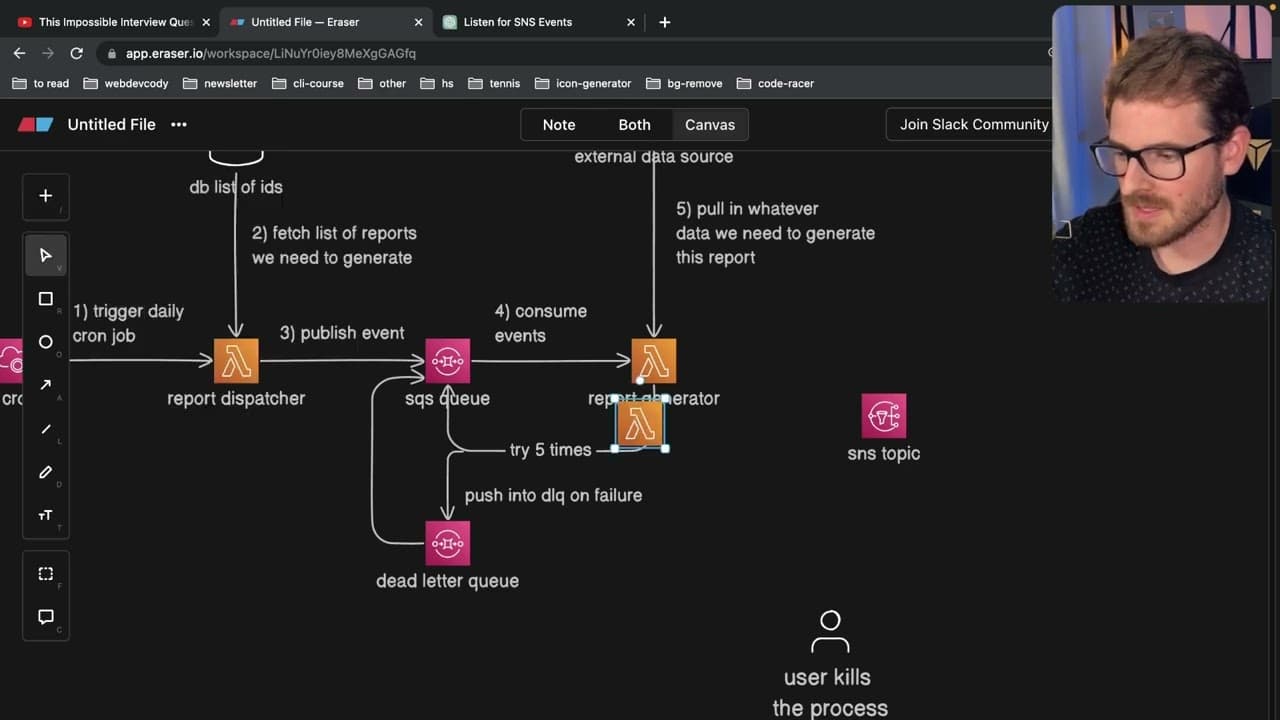
all right so this video is gonna be more of like a reaction video I don't know if reaction video is the correct like category but go check out Tom does Tech he's another YouTuber who does Tech content related to next.js and various other things but he recently published a video with kind of like an interview question using like system diagrams so I... Read More
Key Insights
- 🌸 Generating a large volume of reports requires a scalable, efficient architecture to prevent data loss and manage failures.
- 👻 AWS Lambda’s serverless model allows for seamless scalability, making it ideal for concurrent processing needs.
- 💀 SQS enhances the system’s reliability by managing message queues, ensuring retry capabilities, and providing insights into failures via dead-letter queues.
- 📡 Addressing shutdown signals dynamically is crucial for maintaining data integrity during disruptive events.
- 🤔 A well-structured approach to processing reports can help developers think critically about edge cases and potential pitfalls in design.
- ❓ The architecture should include mechanisms for monitoring and analyzing report generation processes to facilitate continuous improvement.
- 👣 Leveraging AWS CloudWatch for monitoring can help track performance and scale resource allocation appropriately in real-time.
Install to Summarize YouTube Videos and Get Transcripts
Explore YouTube Video Summarizer or Get YouTube Transcript Extractor
Questions & Answers
Q: What is the crux of the report generation problem presented in the video?
The video discusses a complex problem where a system must generate between 1,000 to 100,000 reports daily, each taking 10 to 90 seconds to process. The challenge lies in ensuring that all reports are generated on schedule without losing any data, even under failure conditions, necessitating a scalable and resilient architecture.
Q: Why is AWS Lambda considered a suitable solution for the problem?
AWS Lambda is suited for this task because it facilitates concurrent processing, allowing the system to handle multiple report generation tasks simultaneously. Its serverless architecture means developers do not need to manage server provision or scaling, as Lambda can automatically adjust to the workload, making it efficient for high-traffic scenarios.
Q: What role does SQS play in the proposed solution?
SQS, or Simple Queue Service, plays a critical role by managing the load of incoming report requests. Each report's generation can be encapsulated as a message in the queue, allowing for efficient processing without overwhelming backend resources. SQS also provides error handling, retry functionality, and a dead-letter queue mechanism for messages that cannot be processed after several attempts.
Q: How does the video address the issue of potential data loss during report generation?
The presenter emphasizes that the system cannot afford to lose reports while generating them. They propose using SQS in tandem with Lambda to ensure that if a report generation fails, the job is automatically re-queued for another attempt. Furthermore, implementing a dead-letter queue can help track persistent failures, enabling further investigation into data issues.
Q: What considerations are made regarding service shutdown or 'kill signals' in the system design?
The video highlights the need to respond to kill signals that could interrupt ongoing report generation. It suggests implementing a response system through AWS SNS (Simple Notification Service) that would allow currently active instances to gracefully exit. Ensuring no data is partially processed or lost when receiving such a signal is of paramount importance.
Q: What are some edge cases or design challenges mentioned during the solution brainstorming?
The presenter acknowledges that there are many edge cases to consider, such as managing what happens with partially completed reports when a kill signal is issued. They mention needing a mechanism to track which reports have been successfully generated and how to clean up failed or canceled reports accordingly, indicating the complexities involved in real-world implementations.
Q: How does scalability factor into the proposed architecture?
Scalability is a significant consideration as the system must support spikes of up to 100,000 report generations in a single day. By using AWS Lambda and SQS, the architecture is designed to handle sudden increases in load by automatically allocating resources as needed. The serverless model allows for quick, elastic responses to changing demands without pre-allocating resources.
Q: What is the importance of error handling and monitoring in the context of the discussed system?
Error handling and monitoring are essential to ensure that all reports are processed correctly and that any failures are appropriately managed. Implementing an error tracking solution using SQS with dead-letter queues provides insight into why certain reports fail, enabling developers to enhance the system’s robustness over time. Proper monitoring through AWS CloudWatch can also trigger alerts for unusual patterns or breakdowns in the report generation process.
Summary & Key Takeaways
-
The video involves a reaction to a fellow YouTuber's tech-driven approach to solving a system design question about generating reports.
-
The problem centers around the need to generate a large number of reports daily, which must be processed without losing any data, prompting considerations of scalability.
-
The presenter outlines potential AWS solutions, such as Lambda, SQS and CloudWatch, while attempting to create a robust architecture addressing challenges like error handling and shutdown signals.
Read in Other Languages (beta)
Share This Summary 📚
Summarize YouTube Videos and Get Video Transcripts with 1-Click
Try YouTube Summary with ChatGPT & Claude or YouTube Transcript Generator
Explore More Summaries from Web Dev Cody 📚

Summarize YouTube Videos and Get Video Transcripts with 1-Click
Try YouTube Summary with ChatGPT & Claude or YouTube Transcript Generator