Area density
TL;DR
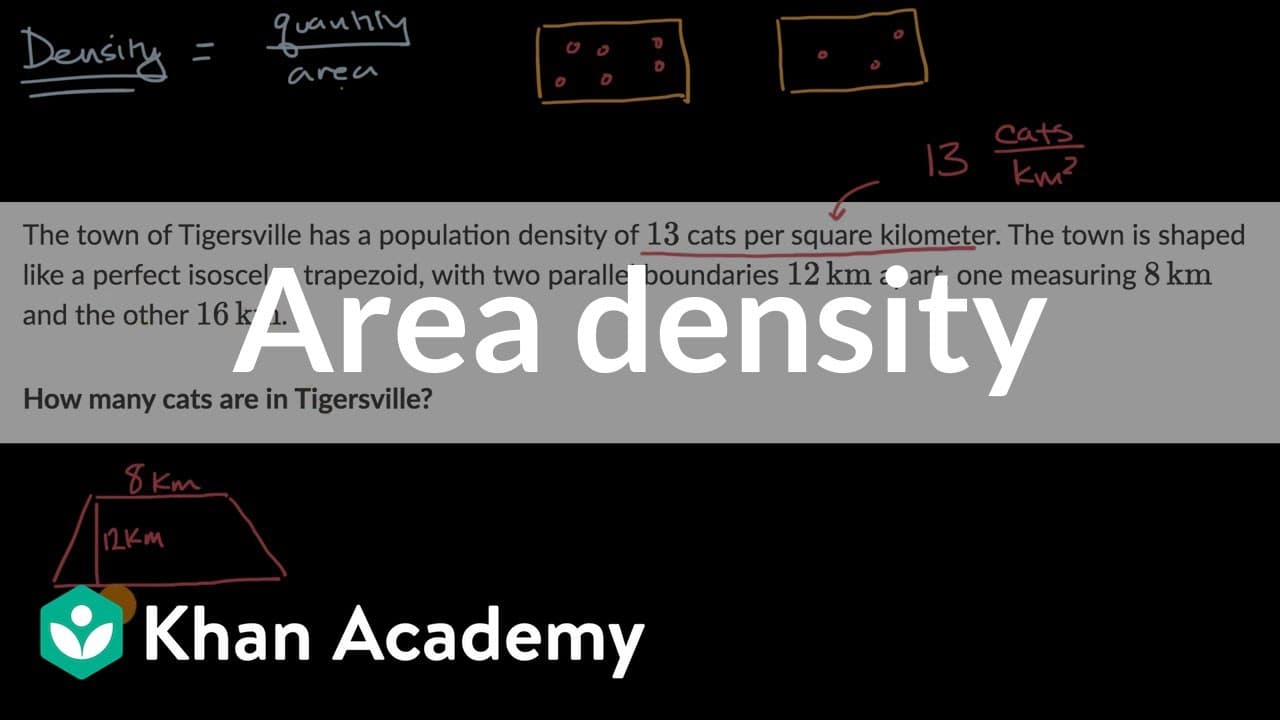
Density is the quantity per unit area, and in this video, we learn how to calculate the number of cats in Tigersville based on population density.
Transcript
- [Narrator] In this video, we're going to talk about density in the context of area. And the simplest way of thinking about it is density is going to be some quantity per unit area. So for example, let's say that I have a football field right over here and I have another identical football field right over here. Now they have the same area, but if... Read More
Key Insights
- ❓ Density is a measure that relates the quantity of something to the area it occupies.
- 🇦🇪 The formula for calculating density is quantity per unit area.
- ❓ Population density can be used to determine the total quantity of individuals in a given area.
- 🙃 Calculating the area of a trapezoid involves multiplying the height by the average of the length of the parallel sides.
Install to Summarize YouTube Videos and Get Transcripts
Explore YouTube Video Summarizer or Get YouTube Transcript Extractor
Questions & Answers
Q: What does density represent in the context of area?
Density refers to the quantity of something per unit area, indicating how densely that thing is distributed within the given space.
Q: How can we calculate the number of cats in Tigersville?
We can calculate the number of cats in Tigersville by multiplying the population density of 13 cats per square kilometer by the area of 144 square kilometers, resulting in 1872 cats.
Q: What is the formula for calculating the area of a trapezoid?
The formula for calculating the area of a trapezoid is (height of trapezoid) * [(sum of the length of the parallel sides) / 2].
Q: How do units cancel out when calculating the number of cats in Tigersville?
Units cancel out when multiplying 13 cats per square kilometer by 144 square kilometers, leaving us only with the unit "cats" in the final answer of 1872 cats.
Summary & Key Takeaways
-
Density is the quantity per unit area, which means it represents how much of something is present within a given space.
-
The example of Tigersville helps us understand how to calculate the number of cats based on the population density and the area of the town.
-
By multiplying the density of 13 cats per square kilometer by the area of 144 square kilometers, we find that there are a total of 1872 cats in Tigersville.
Read in Other Languages (beta)
Share This Summary 📚
Summarize YouTube Videos and Get Video Transcripts with 1-Click
Try YouTube Summary with ChatGPT & Claude or YouTube Transcript Generator
Explore More Summaries from Khan Academy 📚



Summarize YouTube Videos and Get Video Transcripts with 1-Click
Try YouTube Summary with ChatGPT & Claude or YouTube Transcript Generator